






















































































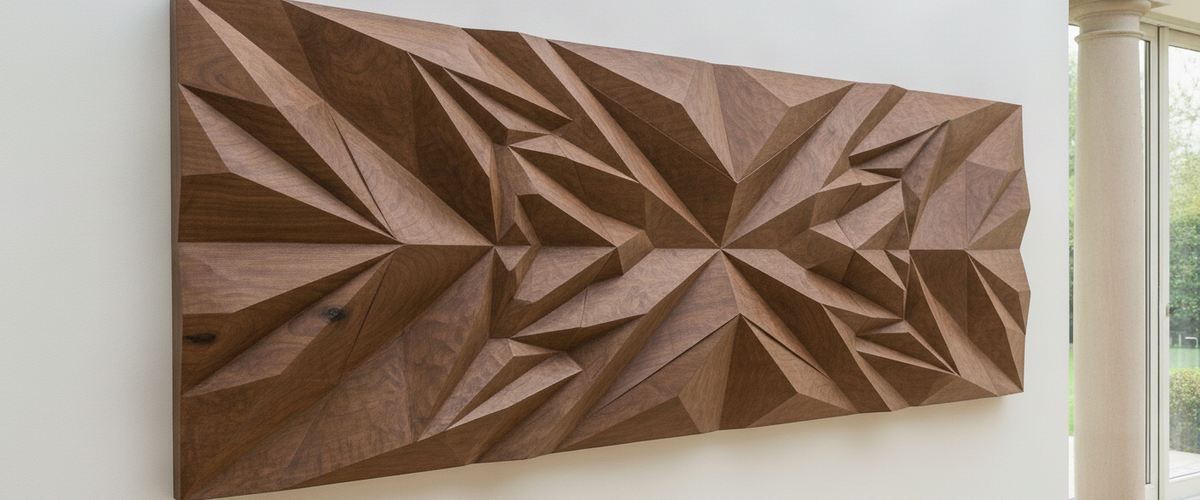

Most carved wood wall art looks great in a photograph and disappoints in a room. The plank is too thin, the relief too shallow, the species too soft for a kitchen wall that swings 20 degrees in temperature every day. Before a piece of carved wood wall art even reaches sketch stage, a sculptor is running through a checklist most clients never see. After many years of fielding briefs at Giant Sculptures, I want to walk you through that checklist so the next wood wall art decor you commission is the one you keep for thirty years, not three.
Looking for the full range in this category? Browse our Wood Wall Art collection for every available finish, size, and configuration of carved wood wall art.
A walnut relief panel mid-finish in the studio, lit to show shadow depth.

Key Takeaways at a Glance
Species, grain orientation and moisture content drive durability more than finish does.
Carved wood wall art needs to be designed for its viewing distance. A piece read at 10 ft fails at 30 ft.
Reclaimed wood wall art carries character and risk; both need to be priced into the commission.
A maquette and a finished sample panel are non-negotiable on any serious carved wood wall art project.
Heavy carved wood wall art panels need French cleats, blocking and the right anchors, not picture wire.

What Sculptors Actually Think About Before Accepting a Commission
When a brief for carved wood wall art lands, the first questions are rarely artistic. They are structural. How wide is the wall, how is it built, what is the relative humidity in the room, and is there sun coming through a south-facing window for six hours a day. A solid slab of black walnut that arrives at 8% moisture content will not stay at 8% on a kitchen wall above a range. It will move. The carving has to be designed to let it move.
Next comes species. White oak and walnut are workhorses for interior relief work because they hold a crisp edge under hand tools and behave reasonably as humidity shifts. Mahogany carves like butter and shows fine detail beautifully, though sourcing it ethically takes more paperwork than clients expect. Basswood and lime are traditional carving woods for a reason, but they bruise easily and need a more protected position. For a Napa dining room with radiant heat and skylights, none of those would be my first pick without an engineered substrate behind them.
Then the brief itself. A geometric wood wall art panel for a Manhattan loft reads as a graphic object; the carving is really about shadow geometry. A figurative relief for an Aspen lodge is closer to a sculpture flattened against the wall, and it needs depth, undercuts, and a viewing angle that works from a seated position by the fire. These are different jobs that use the same words.

Craft Decisions That Change the Final Result (and the Price)
Buyers often ask why one carved wood wall art piece costs a fraction of another that looks superficially similar. The honest answer lives in five places.
Stock preparation. A single slab of figured walnut wide enough for a 6 ft (1.8 m) panel is rare and expensive. Most large carved wood wall art panels are built from staved boards, glued and book-matched so the grain reads as one. Done well, you cannot see the joints at arm's length. Done badly, the seams telegraph through the finish within a season.
Relief depth. Shallow relief (under 1/2 inch / 12 mm) is faster to cut and easier to ship, but it lives or dies on raking light. Deep relief (1 to 3 inches / 25 to 75 mm) holds its own under flat ambient lighting and reads from across a room. Deep relief also means thicker stock, which means more weight, more movement, and more engineering behind the wall.
Tooling. CNC roughing followed by hand finishing is now standard on larger carved wood wall art commissions. Purely hand-carved work has a different signature; the gouge marks are part of the surface and you can feel a maker's rhythm in them. Purely machined work tends to look uniform in a way that flattens the piece. The mix matters and should be specified.
Finish system. An oil and wax finish on walnut looks wonderful for the first year and needs feeding. A conversion varnish is more bulletproof but reads plastic if the sheen is wrong. UV exposure changes everything, and it is worth understanding how light degrades wood and finishes before placing a sun-drenched piece on a west wall. The American Institute for Conservation publishes useful guidance on this.
Mounting. A proper French cleat system, recessed into the back and engineered for the panel's weight, adds real cost and real safety. Picture wire on a 60 lb (27 kg) wood panel is how floors get damaged.
Recessed French cleat on the back of a hardwood relief panel, ready for install.
Why Some Pieces Read Right at 10 ft and Wrong at 30
This is the single most common failure I see in handmade wood wall art commissions that buyers source from photographs alone. The carving was designed for a studio wall and a camera at 10 ft. In a 40 ft great room with the sofa at 25 ft, every subtle move dies.
Scale of incident is the trick. A wall art wall piece designed to be seen from across a lobby needs fewer, bolder moves: deeper relief, longer lines, simpler silhouettes. A carved wood wall art piece designed for an intimate study can carry filigree, fine texture, and quiet gesture, because the viewer is 6 ft away with a glass of wine. The carving language is genuinely different. A good sculptor will ask for the viewing distance, the seated eye-line, and the dominant light source before drawing a single line.
This is also where material vocabularies start to blur. If you love the depth and shadow of carved timber but the room genuinely needs the punch of metal at long range, a layered metal panel may serve you better. Where a 7 ft solid walnut slab would fight its own movement, a sculpted aluminum piece such as the Waverno Blue & Green Flow Metal 3D Wall Art throws shadow the way deep relief does without the dimensional risk. It is worth raising the question early rather than forcing timber to do a job it was not built for.
Reclaimed Wood Wall Art: Character with a Caveat
Reclaimed wood wall art is having a long moment, and rightly so. Old growth oak from a dismantled barn carries a density and grain you cannot buy new, and there is a real story attached. Two things to watch when you commission carved wood wall art from salvaged stock.
First, stability. Reclaimed stock that has lived in an unheated barn for 80 years can hide checks, nail holes, and embedded grit that destroys carbide tooling. A serious studio will mill, dry, and stabilize the wood before carving, and that process can take weeks. If a vendor offers a reclaimed panel on a two-week turnaround, ask hard questions.
Second, provenance. If you want a story you can tell guests, ask for documentation: where the wood came from, what building, what year. A photo of the original structure goes a long way. Without it, "reclaimed" is just a finish.
Studio Process: Maquette, Sample, Fabrication, Install
A bespoke carved wood wall art commission at Giant Sculptures usually moves through four stages, and skipping any of them is the fastest route to disappointment.
Maquette. A scaled study, often at 1:4 or 1:5, carved in the same species as the final. This is where composition gets resolved. Photos are not enough; you need to see shadow behavior in three dimensions.
Sample panel. A square foot of the actual surface treatment, finished to spec. This is the only honest way to approve a finish. Color cards lie under gallery lighting.
Fabrication. Stock selection, glue-up, roughing, carving, sanding, finishing. On a large panel this is typically 8 to 16 weeks. Rushed schedules show up in the joints.
Install. Site survey, wall preparation, cleat installation, hanging, final adjustment. For pieces over 50 lb (23 kg), this should be done by the studio or a partner installer, not a handyman.
Red Flags to Ask About Before You Commit
If you are commissioning carved wooden wall art, you should be hearing detailed answers to these before any deposit moves.
What is the moisture content of the stock at glue-up, and how is it acclimated to my space?
Is the panel solid wood, staved-and-jointed, or veneered over a stable substrate? Each has its place; you deserve to know which you are buying.
How is the back of the panel sealed? An unsealed back is the most common cause of cupping.
What is the hanging system, and what weight rating does it carry once installed?
What is the care schedule for the first year, and what does the studio guarantee if the panel moves?
Budget-wise, expect serious carved wood wall art to be quoted bespoke. Species, scale, relief depth, finish, and engineering all swing the number significantly, and any studio quoting a flat figure without seeing your wall is guessing. Ask for a tailored quote with the variables itemized so you can make trade-offs intelligently.
How to Hang Heavy Wood Panels Properly
The single most useful upgrade on any sizable carved wood wall art panel is a French cleat system. Two interlocking 45-degree bevels, one screwed into the back of the panel, one anchored into wall studs or solid blocking. The panel lifts on and off in seconds and the load distributes across the full width of the cleat. For panels above 40 lb (18 kg), screw the wall cleat into at least two studs with structural screws; on plaster or drywall without studs in the right place, add a plywood backer board first. Toggle anchors alone are not enough for serious work. Light pieces under 15 lb (7 kg) can sit on a single heavy-duty Z-bar, but I would still prefer a cleat.
One small studio habit worth borrowing when installing carved wood wall art: live with the piece on the floor, leaning against the wall, for 48 hours before drilling. Light changes through the day will tell you whether the height and orientation are right. We have moved more than one commission 4 inches (10 cm) after that exercise, and the client always thanks us later.
Scale and placement also change which material reads best. For a smaller study or hallway where carved detail can be appreciated up close, an intricately patterned panel like the Minara Indigo Twilight Pagoda 3D Button Wall Art offers the same close-range richness as fine relief carving without the moisture sensitivity of solid hardwood. If timber ultimately is not the answer for your wall, our wall art and wall decor collection is a good place to compare carved wood wall art against metal, acrylic and mixed-media options at scale. For pieces destined for a covered terrace or loggia, the outdoor wall art collection filters for finishes built to handle weather, which solid carved hardwood rarely is.
For wider placement ideas, Bring the Outdoors In: Transform Your Walls with Nature-Inspired 3D Art is useful companion reading before you finalize the setting and sightlines for your carved wood wall art.