





































































































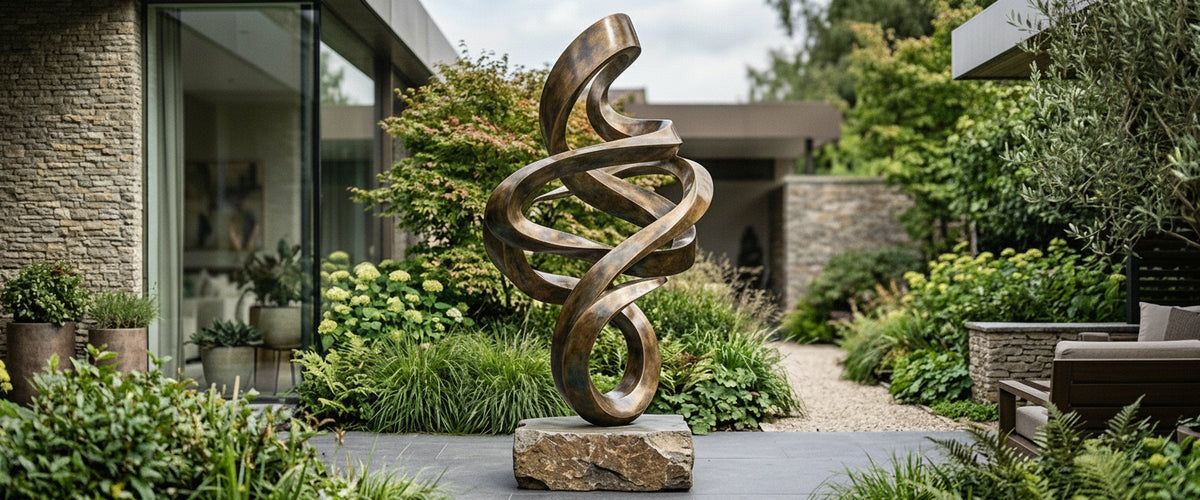

Most disappointing sculptures are not badly made. They are badly matched. The bronze is lovely; it is just two feet too small for the courtyard, or the finish fights the architecture, or nobody asked how the piece would read from the road at dusk. That mismatch is exactly what bespoke sculpture commissions are meant to solve. Instead of buying what exists, you build the piece around the site, the sightlines, and the way you actually live with it.
This is the part of the business we know best, so let us walk through how a sculpture commission really works, what moves the budget, and how to brief one without wasting months.
A commissioned bronze figure scaled to its courtyard and approach.

Key Takeaways
A commission is site-led. Scale, material, and pose are decided around your space, not pulled off a shelf.
Material drives longevity. Bronze, stainless steel, Corten, stone, and marble behave very differently outdoors over decades.
Budget depends on inputs. Material, scale, complexity, engineering, finishing, and installation all shape the quote; there is no flat rate.
Lead time is real. Modeling, fabrication, finishing, and shipping take months, not days, especially at large scale.
A good brief saves money. Clear references and accurate site measurements cut revisions and surprises on bespoke sculpture commissions.

What Bespoke Sculpture Commissions Mean, and Who They Suit
A bespoke sculpture is designed and built specifically for you. You might bring a rough concept, a mood, a memorial idea, a brand motif, or simply a difficult space that nothing standard suits. From there, the studio develops the form, agrees the material and scale, fabricates it, finishes it, and delivers it. That is the spine of every sculpture commission.
Commissioned pieces tend to suit a few groups. Collectors who want something that does not exist anywhere else. Architects and landscape designers who need a work sized to a specific axis or terrace. Developers and venue owners who want a signature piece at the entrance to a hotel, winery, or corporate campus. And private clients marking something personal, where an off-the-shelf figure would feel borrowed. Bespoke sculpture commissions earn their place when the meaning has to be exact.
If you already love an existing design and your space is forgiving, you may not need a custom build at all. The case for commissioning a sculpture gets stronger as the site gets harder: an exposed coastal garden in the Hamptons, a double-height lobby in NYC, a sloping Aspen plot where the viewing angle changes as you climb the drive.
Key Materials, Finishes, and Scale Decisions
Material is the first real decision on any sculpture commission, because it sets longevity, weight, finish options, and how the piece ages. Each behaves differently once it leaves the studio.
Bronze is the long game. Cast properly and patinated, it holds fine detail and weathers gracefully for generations; this is why so much public and memorial work is bronze. A patina is a controlled surface chemistry, and it can be tuned warm, dark, or verdigris green, then sealed and maintained. The Smithsonian's conservation guidance on outdoor bronze is a useful primer on how these surfaces are cared for over time (si.edu).
Stainless steel reads modern and reflective. Mirror-polished, it pulls in the sky and surrounding color, which makes it brilliant for contemporary architecture and water features. Brushed or satin finishes calm the reflection down. It resists corrosion well, though grade matters near salt air.
Corten (weathering steel) develops a stable rust-toned surface that suits naturalistic and sculptural-garden settings. It feels earthy against grasses and gravel, and it ages into the landscape rather than standing apart from it.
Stone and marble carry weight, history, and a hand-carved quality that metal cannot fake. They reward classical and figurative work. They also demand honest conversations about siting, freeze-thaw exposure, and structural support.
A polished stainless steel commission scaled to read from across an open lawn.
Scale is where bespoke sculpture commissions earn their keep. A figure that looks generous in a studio can vanish on a wide lawn. As a rough working rule, a sculpture meant to anchor an open garden often needs to read clearly from 50 to 80 feet (15 to 24 m) away, which usually pushes it well past life size. We will model the piece against your measurements before anyone commits, because correcting scale on paper is free and correcting it in bronze is not.
Where to Place a Commissioned Piece for the Strongest Impact
For wider placement ideas, Sculpture Of Chief Crazy Horse: From Tabletop Bronze to Monument is useful companion reading before finalising the setting and sightlines.
Placement is half the design. The same piece can feel monumental or lost depending on where it lands, so sculpture placement deserves as much thought as the form itself.
Think first about the approach. What do people see first, and from how far? A reflective stainless form at the end of a Napa driveway works because it catches movement and light as you arrive. A bronze figure in a courtyard works because you circle it slowly and the detail rewards a closer look.
Then think about the backdrop. Pale stone disappears against a white wall and sings against dark hedging or water. Corten wants planting, not pristine masonry. Mirror-polished steel needs something worth reflecting, whether that is sky, foliage, or the building itself.
For interiors, ceiling height and circulation matter more than floor area. A tall lobby in Texas or California can take a vertical piece that would overwhelm a domestic room. Plan the negative space around the work; a sculpture needs room to breathe, and crowding it with furniture kills the effect.
One hard-won lesson from the studio: always check the piece at night. We have shipped large garden works where the client only discovered the magic once we discussed lighting. A single grazing light across a textured bronze, or an uplight under a polished form, turns a daytime feature into the thing you notice from the kitchen window at 9pm. Build lighting into the plan early, not as an afterthought.
Budget, Commissioning, and Delivery Considerations
The honest answer on cost is that it depends, and anyone quoting a flat figure before seeing the brief is guessing. The real drivers behind bespoke sculpture commissions are material, finished size, design complexity, structural engineering, finishing work, and installation. A simple polished form and an intricate multi-figure bronze can sit worlds apart even at the same height. For a meaningful number, send the concept and the site details and ask for a tailored quote.
The commissioning process usually runs in stages:
Brief and references. You share the idea, the mood, the space, and any must-haves.
Concept and scale study. The studio proposes form, material, and dimensions, often with sketches or a maquette.
Approval and deposit. Once the design is agreed, fabrication is scheduled.
Fabrication and finishing. Modeling, casting or building, patination or polishing, sealing.
Delivery and installation. Crating, freight, craneage where needed, and fixing on site.
Build in time. Large sculpture commissions are measured in months, driven by the casting or fabrication process and the finishing, not by shipping alone. Weight and access also shape delivery: a piece running into hundreds or thousands of pounds may need a crane, a prepared base, and a clear route to the spot. We would rather flag a tight gateway or a soft lawn early than discover it on delivery day.
A Quick Commissioning Checklist
Site measurements, including viewing distances and access width.
Photos of the space from the main approach and key windows.
Reference images of forms, finishes, and scale you respond to.
The mood or meaning you want the piece to carry.
Indoor or outdoor, and the exposure (coastal, frost, full sun).
Any deadline tied to an event, opening, or season.
Whether lighting and base preparation are in scope.
How Giant Sculptures Can Help With Bespoke Projects
Giant Sculptures is a supplier built around large-scale and statement work, which means we are used to the practical end of bespoke sculpture commissions as well as the creative one. We work in bronze, stainless steel, Corten, stone, and marble, and we ship worldwide, so a piece designed in the UK studio can land in a Hamptons garden or a California lobby.
If you are still gathering ideas, browsing the catalog is a good way to calibrate scale and material before you commit. Our bronze sculptures show how patina and detail read at size, while the stainless steel sculptures show how a reflective finish behaves in different light. Seeing an existing piece often sharpens what you want changed, which is exactly where bespoke sculpture commissions begin.
The strongest sculpture commissions are not rushed. Bring the site, bring the idea, and let the design grow from there. Done well, a custom sculpture stops being decoration and becomes the reason a space works.