

































































































The horse has outlasted almost every other subject in Western sculpture, and the reason is simple: get the anatomy right and you have movement, power, and presence in one form. Get it wrong and even the most expensive bronze looks like a toy. This is why the sculpture of Chief Crazy Horse in the Black Hills, still under carve after more than seven decades, remains the reference point for what monumental equine work actually demands. It is also why a 60cm marble horse head on a hallway console can fail for exactly the same reasons a 30-foot bronze stallion fails: proportion, posture, and the honesty of the cast.
At Giant Sculptures we build horse pieces across the full range, from intimate gallery bronzes to driveway and estate-scale commissions. The questions that come up about any sculpture of Chief Crazy Horse, or about a tabletop bronze study, are remarkably consistent across both ends of the spectrum, so this guide pulls them together.

Key Takeaways
- Horse sculpture lives or dies on anatomy; the tells are in the head, hocks, and tail set.
- Bronze is the long-term default for outdoor work; marble suits sheltered or formal settings; stainless and Corten suit contemporary architecture.
- Indoor pedestal pieces and paddock-scale installations are engineered very differently, especially around armature and base.
- Monumental commissions, in the spirit of any sculpture of Chief Crazy Horse at memorial scale, need siting, transport, and foundation planning from day one.
- Budget for a sculpture of Chief Crazy Horse, or any equine work, depends on material, scale, complexity, engineering, and finishing, so a tailored quote is the only honest figure.

Why the Horse Keeps Returning as a Sculptural Subject
From the Parthenon frieze to Remington, from Tang dynasty tomb figures to the bronze horses of San Marco, the horse has been the sculptor's stress test for more than two thousand years. A good horse sculpture carries narrative without needing a rider. It reads at distance because the silhouette is unmistakable. And it scales: a sculpture of a horse works on a library shelf and it works on a hillside.
The sculpture of Chief Crazy Horse, begun by Korczak Ziolkowski in 1948 and continued by his family, is the most ambitious expression of this. When finished, the mounted figure will be roughly 563 feet long and 641 feet tall (about 172 by 195 meters), making it the largest sculpture in progress on earth. You do not need that scale to learn from a sculpture of Chief Crazy Horse. What the project shows every buyer is that the horse, more than almost any subject, rewards conviction at scale. Half-measures look like half-measures.
Anatomy That Has to Be Right
Most disappointing horse sculpture, regardless of price, fails in the same handful of places. If you are evaluating a piece, look here first:
- The head and muzzle. Amateur work tends to oversize the eye socket and undersize the jaw, giving a cartoon look. The plane from the cheekbone to the nostril should be clean and slightly hollow.
- The neck-to-shoulder junction. A real horse has a defined withers and a clear scapula. Cheap casts smooth this into a tube.
- Hocks and pasterns. The back legs are where mass-produced resin gives itself away, with stiff, doll-like joints that no real horse has.
- Tail set and mane flow. These are dynamic in a live animal. If they look glued on, the sculptor was working from photos rather than from observation.
- Hoof to ground contact. A standing horse distributes weight unevenly. A piece where all four hooves press equally into the base reads as wooden.
This is the test we apply to every horse sculpture leaving the studio, whether it is a marble head for a foyer, a full bronze for a vineyard entrance, or a study-scale sculpture of Chief Crazy Horse for a private collector. It is also worth applying when you are looking at named decorative pieces such as an A. Santini horse sculpture or a Giannetti horse, both of which exist in a wide quality range across the secondary market.
Bronze, Marble, Resin, and Steel Compared
Material choice is the single biggest decision after subject. For any crazy horse sculpture, the material sets the lifespan, the surface, and the freight cost. Here is how the main options behave in practice.
Bronze
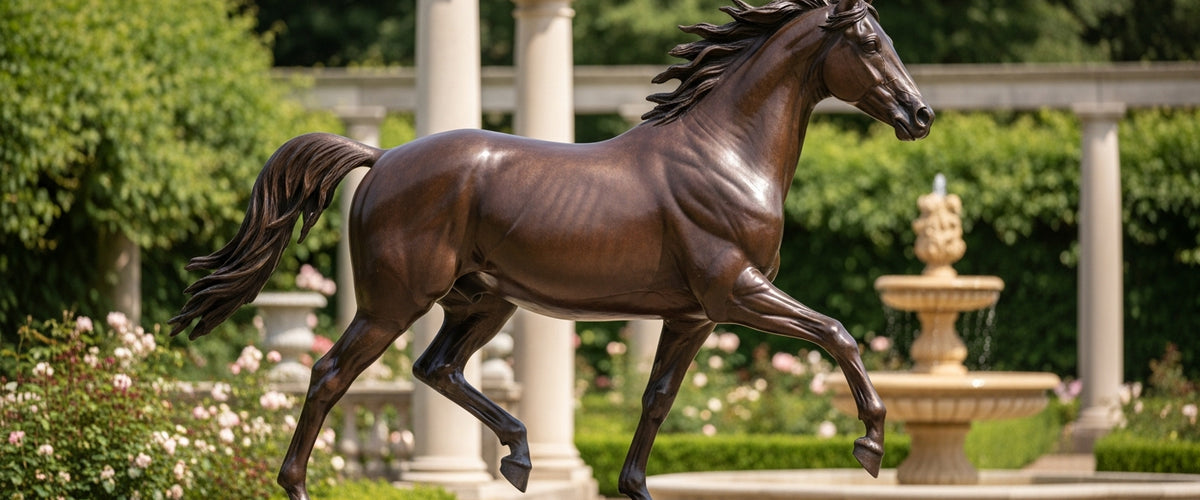
The historic default and still the right answer for most outdoor commissions, including a sculpture of Chief Crazy Horse intended as a private memorial piece. A well-patinated lost-wax bronze horse will outlive the building it sits in front of. Expect substantial weight: a life-size piece runs to roughly 1,500 to 2,500 pounds (around 680 to 1,135 kg) depending on wall thickness and pose. A bronze horse sculpture also takes patina beautifully, from traditional brown-black through to verdigris greens, and the surface can be refreshed decades later. For collectors browsing a bronze equine for a Hamptons garden or a Napa estate, this is the long-game material.
Marble and Stone
Marble suits formal settings, sheltered courtyards, and interiors. It does not love freeze-thaw cycles or acid rain, so a Colorado driveway is not its happiest home. Where it shines is the contained moment: a single head, a half-figure, a classical fragment. For a foyer console or a walled garden plinth, a carved marble head such as the Graceful Horse Head White Marble Outdoor Sculpture - 60cm often makes more sense than a full-bodied animal, because the carving rewards close reading and the material does the heavy lifting visually. Where the brief calls for statement scale in marble without crossing into bronze monumentality, something on the order of the Majestic Horse Black Marble Outdoor Sculpture - 220cm shifts the same subject into an architectural register, with the darker stone sitting comfortably against modern stonework and clipped planting.
Stainless Steel and Corten
Mirror-polished stainless gives you a contemporary horse that reflects sky and landscape, which is why you see it outside corporate campuses and modern ranches in Texas and Colorado. Corten weathers to a deep rust skin and pairs beautifully with prairie planting and modern timber architecture. Both materials handle weather indefinitely and tolerate scale better than marble, which is why a contemporary sculpture of Chief Crazy Horse rendered in steel can read powerfully against open sky.
Resin and Composite
For wider placement ideas, Timeless Monochrome: Black-and-White Iron Art Paintings for Sophisticated Spaces is useful companion reading before finalising the setting and sightlines.
Honest answer: useful for film, retail, and short-term exhibition. Not what we recommend for a piece you want your grandchildren to inherit. If you see a low price on a life-size sculpture horse, this is usually why.
Indoor Pedestal Pieces Versus Driveway and Paddock Installations
A horse sculpture for an interior is a different engineering problem from one sitting on grass. Indoors, the issues are floor loading, plinth proportion, and sight lines. A 60cm marble head needs a pedestal that lifts the eyeline to around 60 to 66 inches (152 to 168 cm) from the floor so the viewer reads the modeling correctly. Anchor with museum gel or a mechanical pin if the room sees foot traffic.
Outdoors, the question becomes foundation. A life-size bronze on lawn needs a reinforced concrete pad below frost line, usually 18 to 36 inches deep (45 to 90 cm) depending on climate, with stainless anchor bolts cast in. We have shipped equine pieces, including a study-scale sculpture of Chief Crazy Horse, into estates in upstate New York where the client wanted the work to read against a tree line at 200 feet; that distance forces decisions about pose (rearing reads better than standing at range) and about base height (a low plinth disappears into grass, a tall one fights the horizon).
Placement Checklist
- Walk the site at three times of day; equine silhouettes change dramatically with low sun.
- Check sightlines from the main approach, not just from the house.
- Allow at least one and a half times the sculpture's length as clear ground around it.
- Confirm the foundation specification with a structural engineer for anything over 500 pounds (227 kg).
- Plan delivery access. A 220cm marble or a life-size bronze does not fit through a standard garden gate.
Monumental Commissions
Once a piece passes roughly 10 feet (3 meters), it stops being an object and starts being architecture. The crazy horse mountain sculpture is the extreme case, carved directly from Thunderhead Mountain in South Dakota, but the principles cascade down to any monumental commission, including a private sculpture of Chief Crazy Horse.
Three things change at this scale. First, the armature: an internal stainless or marine-grade steel skeleton has to be engineered for wind load, seismic conditions where relevant, and the thermal expansion of the outer skin. Second, transport: a monumental bronze, whether a generic equine or a commissioned sculpture of Chief Crazy Horse, usually ships in segments, with welded joins finished and re-patinated on site. We have crated bronze sections for transatlantic freight where the largest piece was sized exactly to the container's internal diagonal. Third, siting: the foundation for a monumental equine work is a civil engineering project, not a landscaping one, and it needs to be in the design from week one rather than added at the end.
If you are considering something in this register, whether a private estate piece, a horse sculpture Denver collectors might recognise, or a civic commission like the well-known equestrian works in Denver's public collection, start the conversation early. Twelve to twenty-four months from brief to install is realistic for a serious bronze. Stone and direct carving take longer.
Commissioning a Bespoke Piece
Most of our equine work is bespoke, which means the brief sets the price rather than a catalog tag. Whether the client wants a quiet portrait head or a full sculpture of Chief Crazy Horse, a useful first conversation covers six points:
- Subject and pose. Standing, walking, trotting, rearing, or a portrait head. Each carries different engineering.
- Scale. Tabletop, half life-size, life-size, or monumental. State the intended viewing distance.
- Material. Bronze, marble, stainless, Corten, or a combination such as bronze on a stone plinth.
- Site. Indoor, sheltered exterior, exposed exterior, coastal, or alpine. Salt and freeze-thaw both matter.
- Reference. A specific breed, a specific horse, or a stylistic period. Photographs from multiple angles help.
- Timeline. Honest lead times sit between six and eighteen months for most bespoke bronze and stone work, longer for a full sculpture of Chief Crazy Horse at memorial scale.
Budget is the question everyone wants answered first and it is the one we cannot answer without the brief. A small bronze and a paddock-scale piece sit orders of magnitude apart, and a marble carving from a single block prices differently again. The honest route is a tailored quote once the brief is on paper.
For broader browsing while you shape a brief, our horse sculptures and statues collection shows the range of poses, materials, and scales we work in, and is a useful reference even if your final piece is a fully bespoke sculpture of Chief Crazy Horse.
A Note on Conservation
Bronze and stone horses both reward simple, regular care. A bronze sculpture of Chief Crazy Horse, like any outdoor bronze, wants an annual wax in mild weather, rinsing of bird droppings within days rather than months, and a check on anchor bolts every few years. Marble in temperate climates wants a soft brush, a gentle pH-neutral wash, and shelter from acidic runoff. For deeper guidance on outdoor metal conservation, the National Park Service's guidance on preserving outdoor sculpture is a good starting point, and museum-published material on equestrian bronzes from institutions like the Metropolitan Museum of Art is worth reading before you commission.
Done well, a sculpture of Chief Crazy Horse, or any serious equine piece, is a fifty-to-five-hundred year object. Done badly, it is a regret in expensive material. The difference is almost always in the brief, the anatomy, and the engineering, in that order.
For general conservation principles, Canadian Conservation Institute outdoor object care is a useful external reference, though the final care routine should always follow the material and finish specified for the individual commission.