





































































































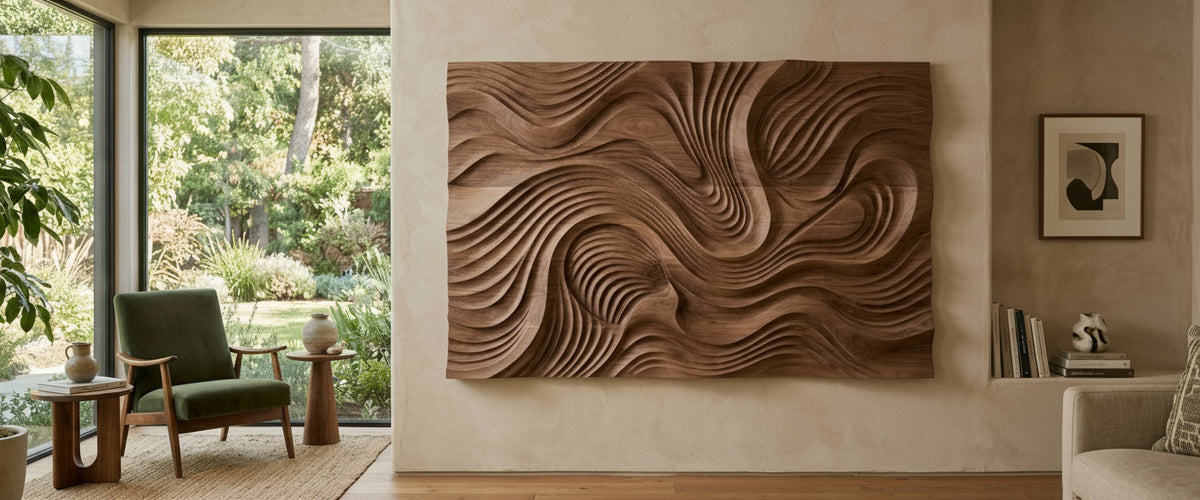

A motivational quote in a frame reads tired by the second week. The team stops seeing it, clients never noticed it, and the wall still feels flat. That is the gap most people miss when they shop for inspirational wall art office decor: the message matters far less than the object. A piece that holds attention does so through depth, material, and scale, not a slogan. When we take on an office commission at Giant Sculptures, the brief almost never starts with words. It starts with a wall, a viewing distance, and a question about what that space should make people feel when they walk in.
Looking for the full range in this category? Browse our Wall Art and Wall Decor collection for every available finish, size, and configuration.
Below is how the studio actually thinks through inspirational wall art for the office, from the first conversation to the day it goes up. The best inspirational wall art office projects are buyer-led, so this is written for the person signing off the commission.

Key Takeaways
Object over slogan. Dimensional, sculptural work holds a room longer than printed motivational text.
Viewing distance decides everything. A piece read at 10 feet (3 m) needs different relief and scale than one seen across a 30-foot (9 m) lobby.
Material sets the tone. Carved wood reads warm and human; brushed metal reads precise and corporate; acrylic and resin read light and modern.
Budget is built, not quoted blind. Material, size, depth of carving, finishing, and install all move the number. Ask for a tailored quote.
Process protects you. A maquette and a finish sample before fabrication remove most of the risk.

What Sculptors Think About Before Taking on an Office Commission
The first thing we ask is who stands in front of the work, and how often. A reception wall greets visitors for ten seconds at a time. A wall inside an open-plan studio is seen by the same people eight hours a day, which changes the brief for any inspirational wall art office piece completely. Art that shouts is fine for a lobby and exhausting in a workspace someone occupies daily.
Next comes the wall itself. Office walls are rarely as simple as they look. We need to know the construction (stud partition, masonry, or glass-backed), the lighting (overhead grid, daylight from one side, or spotlit), and what sits nearby. A textured relief next to a busy gallery of framed prints will fight for attention and lose. Office wall art works best with room to breathe.
Then we talk about tone. "Inspirational" means different things to a law firm and a tech studio. For some clients it means calm and considered; for others it means motion and energy. We translate that into form rather than text, which is what separates real inspirational wall art office work from a printed slogan. Where the brief calls for quiet momentum rather than a literal message, a flowing carved panel such as the Fluvien Teal Flow 3D Carving Wall Art suggests progress without spelling it out, which is why pieces like it tend to land well in daily workspaces.

Craft Decisions That Change the Final Result (and the Price)
A few choices made early have outsized effects on both how the piece reads and what it costs to make.
Material. Carved wood brings grain, warmth, and a handmade quality that suits human-centered brands and home office wall art alike. For a neutral, tactile surface that carries a wall without competing with the people in the room, a piece like the Deralin Taupe Trace Abstract 3D Carving Wall Art shows how restraint can still hold a space. Metal reads sharper and more architectural; where a reception desk needs a precise, light-catching anchor, a brushed or gilded finish such as the Astryn Gold Orbit Round Textured 3D Wall Art is closer to the right design language for inspirational wall art office settings. Acrylic and resin pieces sit lighter on the wall and suit modern, color-forward interiors.
Depth of relief. This is the detail buyers underestimate most. A shallow carving is cheaper and easier to ship, but it flattens under bright overhead lighting. Deeper relief casts its own shadows and stays alive across the day as the light shifts. If your office has a hard ceiling grid with even, shadowless light, you usually need more depth to compensate, not less. This single choice does more for inspirational wall art office impact than any caption ever could.
Finish. Matte surfaces hide fingerprints and reduce glare, which matters in a glass-walled meeting room. High-gloss and metallic finishes throw light and draw the eye but show every smudge near a high-traffic corridor. Each finish carries a different labor cost, so the look you choose also moves the quote.
Size and weight. Scale is the single biggest cost driver. A larger panel needs more material, more carving hours, heavier fixings, and sometimes a two-person install. We would rather talk through realistic dimensions early than design something the wall cannot safely carry. Good inspirational wall art office planning settles the scale before fabrication, not after.

Why Some Office Wall Art Reads Right at 10 Feet and Wrong at 30
This is the lesson buyers learn the hard way, so here it is up front. A piece designed for close viewing carries fine detail and subtle texture. Stand it at the end of a 30-foot (9 m) lobby and that detail dissolves; the eye reads only the silhouette. The reverse is just as true. A bold, large-gesture piece built to land across a wide reception looks coarse and heavy when you stand two feet from it at a desk. Matching the read to the room is the whole craft behind inspirational wall art office commissions.
So before anything is made, we set the primary viewing distance and design to it. For a corridor seen in passing, we push scale and contrast and keep the forms broad. For a wall someone sits beside all day, we pull detail in and soften the impact so it rewards a slow second look rather than hitting once and going quiet.
Grid-based and repeating patterns behave differently again. For a larger commercial wall read at distance, a modular layout such as the Deralin Taupe Grid Abstract 3D Carving Wall Art holds its rhythm because the eye reads the repeat rather than chasing fine detail. If you are weighing several directions for inspirational wall art office spaces, the Office Art collection is a useful place to see how different formats behave at scale.
Studio Process: Maquette, Sample, Fabrication, Install
A bespoke piece should never be a leap of faith. Our process for inspirational wall art office work is built so you approve the important decisions before anything expensive happens.
Brief and concept. We agree the wall, the viewing distance, the tone, and the material direction, then sketch concepts to scale.
Maquette. For larger commissions we produce a small-scale model so you can judge proportion and form in three dimensions, not just on a screen.
Finish sample. We make a physical sample of the chosen material and finish. Color and texture behave differently under your actual office lighting, so we want you to see it in the real space where possible.
Fabrication. Once form and finish are signed off, the piece is carved, cast, or fabricated. This is the longest stage, and the one you do not want to rush.
Install. We specify the fixings for your wall type and confirm whether the piece needs professional hanging. Heavier metal and deep-relief panels often do.
Building office wall art that lasts is mostly about getting these middle stages right. Durable inspirational wall art office pieces come from process, not luck, and skipping the sample to save a week is the most common false economy we see.
How to Arrange Art on an Office Wall
Placement makes or breaks a good piece. A few working rules from inspirational wall art office installs we have shipped:
Center on the sightline, not the wall. Hang to where people naturally look (the eye line as they enter or sit), which is often not the geometric center of the wall.
Give it negative space. A single strong piece with clear wall around it reads more confident than a crowded cluster. If you want a gallery feel, plan the spacing as one composition rather than hanging pieces one at a time.
Light it deliberately. A relief piece needs a light source slightly to one side to cast the shadows that give it depth. Flat front lighting kills dimensional work. The Illuminating Engineering Society publishes useful guidance on lighting for interior spaces if you want to brief a contractor properly (ies.org).
Mind the reflections. Glossy and metallic finishes opposite a window or screen will catch glare at certain times of day. Check the wall at the hours people actually use the room.
Vinyl office wall art stickers have their place for fast, low-cost messaging, but treat them as signage, not art. They peel, fade, and date quickly, and they do nothing for a wall under raking light. If the goal is inspirational wall art office decor that still looks considered in five years, dimensional work earns its keep.
Honest Red Flags to Ask About Before You Commit
Good questions protect your budget when you commission inspirational wall art office pieces. If a supplier dodges these, slow down.
"Can I see a finish sample before fabrication?" The answer should be yes. Approving color and texture from a render alone is a gamble.
"What viewing distance is this designed for?" If they cannot answer, the piece has not been designed for your space, just sold into it.
"How does it fix to my wall type?" A serious maker asks about your wall construction before quoting fixings. Weight matters, and a stud partition has limits.
"How is it packed and shipped?" Deep-relief and metal pieces need proper crating. We ship internationally, and the crate is part of the job, not an afterthought.
"What moves the price?" An honest answer covers material, scale, depth of carving, finish, and install. Anyone giving you a flat headline number without those details is guessing.
If you want to keep comparing formats for inspirational wall art office spaces, browse the Metal Wall Art and Wood Wall Art collections to see how each material carries weight and light differently before you commit to a direction. From there, a bespoke commission lets you tune the scale, depth, and finish to your exact wall.
For wider placement ideas, 3D Wall Sculptures: What Sculptors Weigh Before They Say Yes is useful companion reading before you finalize the setting and sightlines.