






















































































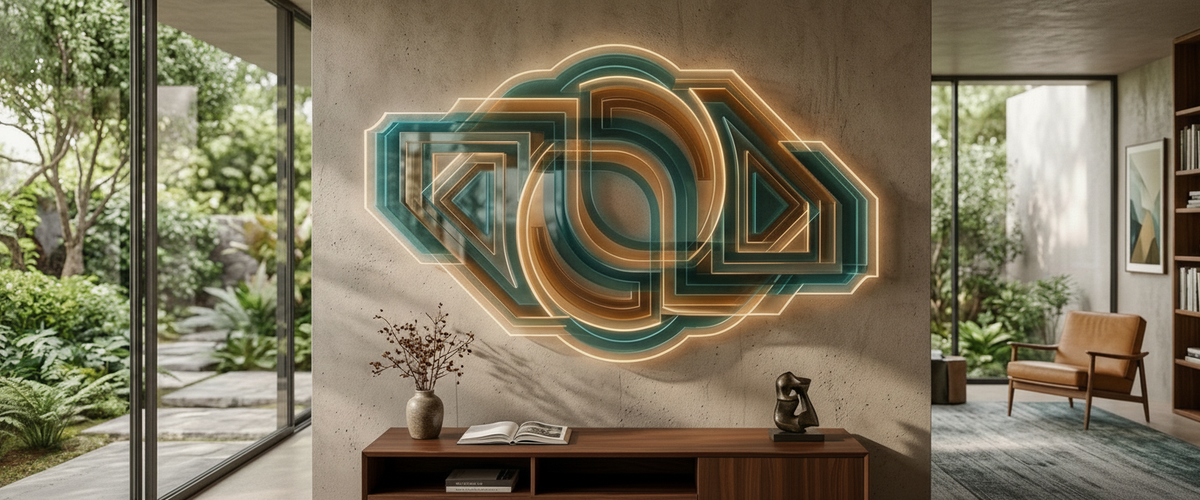

Most disappointing 3D acrylic wall art fails for a boring reason: nobody thought about the wall it would live on. A piece that dazzles on a studio screen can turn flat, cheap, or oddly small once it is bolted to a double-height entry in a Napa house or a lobby wall in NYC. The material is not the problem. The planning is. Before we shape a single layer of a 3D acrylic wall piece, there is a whole conversation most buyers never hear, and it changes both the result and the quote.
This is the part of the process worth understanding if you are commissioning a 3D acrylic wall design rather than buying off the shelf. It also explains why two pieces that look similar in photos can behave completely differently in a real room.

Key Takeaways for 3D Acrylic Wall Art Buyers
- Scale is a design decision, not a size upgrade. A 3D acrylic wall piece read from 10 ft needs different depth and edge work than one read from 30 ft.
- Craft choices drive both look and price: layer count, edge polish, backing, lighting integration, and mounting all move the number.
- Acrylic is one option among many. For long-life outdoor or heirloom work we usually steer clients toward bronze, stainless steel, or Corten instead.
- The studio path is maquette, sample, fabrication, install. Skipping the sample stage is where regret starts.
- Ask hard questions early: UV stability, seam visibility, mounting weight, and who owns the install.

What Sculptors Think About Before Taking a 3D Acrylic Wall Commission
The first thing we assess on any 3D acrylic wall commission is not the design. It is the environment. Direct sun on a west-facing wall, a swimming pool nearby, a gallery with raking spotlights, a Texas great room with 20 ft ceilings; each one asks a different thing of the material. Acrylic handles interior light beautifully and holds color with a depth that painted panels cannot match. Push it into harsh, unfiltered UV for years and you invite yellowing and stress, which is why serious conservation guidance treats plastics as a material class that needs monitoring, not a set-and-forget one (see the Getty Conservation Institute on modern materials in art).
So the honest early conversation often sounds like this: is this dimensional acrylic piece the right call, or is this really a job for a metal relief? If the piece will live outside, or the client wants something their grandchildren inherit, we say so. That is also where our core strength sits. Giant Sculptures is a bespoke maker of large-scale, durable work, and a good number of our 3D acrylic wall commissions start as an acrylic idea and end as a bronze or stainless steel relief because the setting demanded it.
The second thing we weigh is viewing distance and sightlines. A 3D acrylic wall piece seen up close in a hallway rewards fine layering and crisp polished edges. A piece across a wide lobby needs bolder relief and stronger shadow lines or it flattens into wallpaper.

Craft Decisions That Change the Result and the Price
People assume the cost of these layered pieces tracks with size. Size matters, but the craft calls underneath matter more.
Layer count and depth. True dimensional 3D acrylic wall work is built from stacked, shaped layers. More layers means more shadow, more internal glow, and far more hand finishing. A three-layer piece and a twelve-layer piece can share a footprint and sit worlds apart on effort.
Edge treatment. Flame-polished or diamond-polished edges catch light like water. Saw-cut edges look industrial. On a piece where the edges are visible, this single choice separates gallery quality from signage.
Color method. Tinted acrylic, back-painting, embedded pigment, and mirror layers each age and read differently. A back-painted surface can look flawless day one and reveal every imperfection under a low winter sun. Where warmer tones and a metal frame suit the room better than cool translucence, Aurenza Amber Acrylic & Metal Frame 3D Wall Art shows how framing and color method can shift the whole mood of a piece.
Lighting integration. LED edge-lighting turns a 3D acrylic wall piece into something that seems lit from within. Done well it is quietly theatrical, as in Onyx Flame Glow Acrylic 3D LED Wall Art, where the glow reads as part of the material rather than a bolted-on effect. Done cheaply you get hot spots, visible diodes, and a driver box nobody wants to look at.
Backing and mounting. Float mounts, standoffs, and concealed cleats all change how the piece sits off the wall and how the shadow reads behind it. This is structural, not cosmetic, especially as pieces get larger and heavier.
None of these are upsells for their own sake. Each one is a lever, and the right combination depends on your wall, your light, and how close people will stand. This is exactly why we do not publish a fixed price for a bespoke 3D acrylic wall commission; budget depends on material, scale, complexity, engineering, finishing, and install. The right move is a tailored quote once the design is real.

Why Some 3D Acrylic Wall Pieces Read Right at 10 ft and Wrong at 30
Here is a lesson we relearn on almost every large 3D acrylic wall commission. Detail that sings at arm's length can vanish across a room. A finely faceted, layered composition like Coreva Teal Acrylic & Gold Mirror Round 3D Wall Art works because its geometry stays legible as you step back; the mirror and color do the talking at distance while the layering rewards a closer look.
Contrast that with a busy, low-relief design. Up close it is intricate. At 30 ft (about 9 m) the shadows are too shallow to register and the whole thing reads as a gray smudge. The fix is not more detail. It is deeper relief, stronger tonal contrast, and simpler primary shapes, so the piece holds its structure at the true viewing distance.
We had a client scaling a 3D acrylic wall piece for a two-story stairwell who wanted an intimate, delicate design blown up to roughly 8 ft (2.4 m) wide. On paper it looked generous. In a sample at scale it looked thin. We rebuilt the composition with fewer, bolder elements and it finally owned the wall. That is why we test scale before we commit to fabrication, every time.
The Studio Process: Maquette, Sample, Fabrication, Install
A serious bespoke 3D acrylic wall commission moves through four stages, and each exists to catch problems while they are still cheap to fix.
- Maquette or digital study. We model the composition and, for larger work, produce a scaled study so you can judge proportion against your actual wall and ceiling height.
- Material sample. This is the stage buyers are tempted to skip and should not. A physical sample shows you the true edge polish, the exact color under your light, and how the layers throw shadow. Screens lie about depth.
- Fabrication. Cutting, shaping, layering, finishing, and, where relevant, wiring and lighting. Hand finishing is the slow part and the part that shows.
- Install. Mounting hardware, wall condition, weight distribution, and, for lit pieces, discreet power routing. On large or heavy work we plan this with the client's contractor rather than leaving it to chance.
If you are weighing acrylic against something more permanent, this is also the moment to look sideways at metal. Our 3D Wall Art collection spans both worlds, and browsing it next to the Acrylic Art collection makes the trade-offs obvious: acrylic for glow and lightness, cast or fabricated metal for weight, patina, and outdoor life.
Honest Red Flags to Raise Before You Commit
A good studio will welcome these questions before your 3D acrylic wall order goes ahead. If a supplier dodges them, that tells you something.
- UV and yellowing. Ask what grade of acrylic is used and how it performs under the light your wall actually gets. If the piece faces strong sun, ask whether a metal relief would serve you better.
- Seams and joins. On larger pieces, how are sections joined, and will the seams show at your viewing distance?
- Weight and wall type. Confirm the finished weight in pounds (and kilograms) and check it against your wall build. Plasterboard and structural masonry are not the same conversation.
- Lighting service. For LED pieces, ask how the driver is accessed and what happens if a strip fails in five years.
- Sample before sign-off. Insist on seeing a real sample of the finish and edge. Non-negotiable.
- Who owns the install. Clarify whether mounting is included, advised, or entirely on you.
The market has plenty of decorative panels sold as sculpture, including a lot of the mass-produced 3d acrylic wall art in Karachi and other volume hubs that ships flat and mounts thin. Some of it is perfectly good for the price. Just know what you are buying. A bespoke 3D acrylic wall piece is a different proposition: designed for one wall, built to hold up at the distance people will stand, and finished by hand.
If longevity is the priority, we will often point you toward metal. Where the setting wants permanence and patina rather than glow, a warm bronze relief such as the Classical Figural Torso Wall Sconce Bronze Sculpture - 90cm will outlast almost any interior fashion cycle, indoors or out. A 3D acrylic wall piece wins on light and modern sparkle. Bronze wins on permanence. The right answer is the one that fits your wall, your light, and how long you want to live with it.
Tell us the wall, the light, the viewing distance, and the feeling you want in the room. That is enough for us to start a maquette and a genuine quote for your 3D acrylic wall commission.
For wider placement ideas, 3d Wall Art Decor That Actually Reads From Across the Room is useful companion reading before finalising the setting and sightlines.