





































































































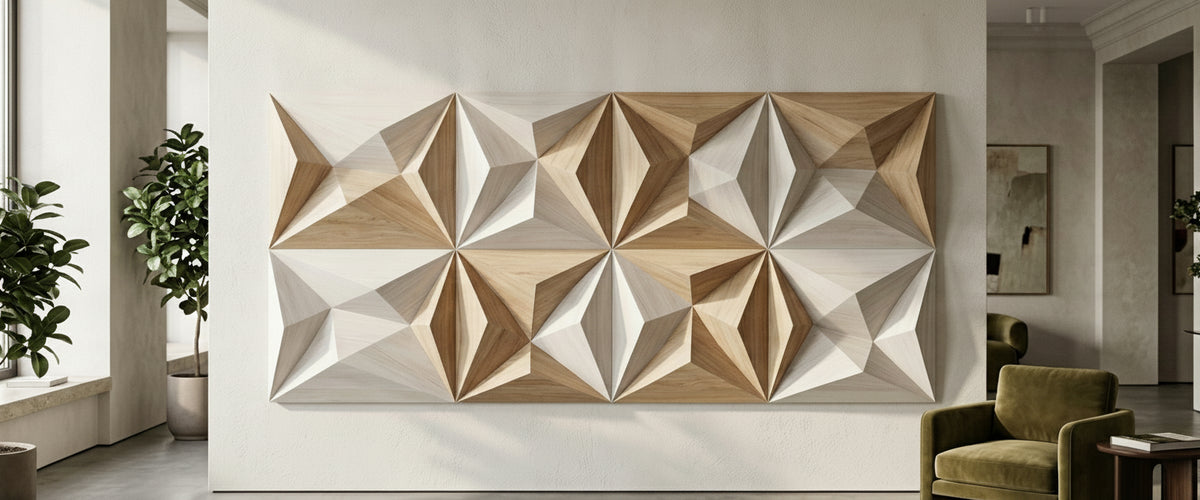

Most disappointing geometric wall art fails for a reason you cannot see in the showroom photo: it was designed for a camera, not a wall. The repeat reads tight and crisp in a 4 ft (1.2 m) studio shot, then goes flat and busy across a 22 ft (6.7 m) lobby wall. A geometric art wall is a sculptural problem before it is a decorative one, and the decisions that matter most happen long before anyone cuts material. Here is how we approach it at Giant Sculptures, and the questions worth asking before you sign off on a commission.

Key Takeaways Before You Commission a Geometric Art Wall
Viewing distance sets the module size. A piece read at 30 ft needs larger, bolder facets than one read at 6 ft.
Depth is the difference between flat decor and sculpture. Relief and shadow do more work than color.
Material drives cost, weight, and mood: carved wood reads warm, brushed metal reads architectural, mirrored panels change with the room.
Mounting is part of the design, not an afterthought. Substrate, fixings, and wall type all matter.
Budget depends on scale, material, depth of relief, finishing, and install, so ask for a tailored quote rather than a list price.

What Sculptors Actually Think About Before Taking the Commission
The first thing we ask is not "what color" but "how far back will people stand?" A geometric art wall behind a reception desk in a Dallas office is viewed from across the room and then again from two feet away while someone waits. Those two distances want different things. Big planar facets carry the long view; finer texture and clean edges reward the close one. Get the module wrong and one of those viewing distances always loses.
We also map the light. Geometric relief lives on shadow, and shadow depends on where the light comes from and whether it moves. A south-facing Napa living room throws a different shadow at 9am than at 5pm, which can be the whole point or a real problem, depending on the design. Flat, even ceiling light can kill a low-relief piece entirely, so sometimes the honest advice is to deepen the relief or add directional lighting rather than fight it.
Then there is the wall itself. Plasterboard over steel studs, solid brick, or a glass-backed atrium each change how we engineer the mount and how heavy the piece can safely be. None of this shows up in the finished look, and all of it decides whether the work survives ten years on the wall.

Craft Decisions That Change the Result (and the Price)
Once the brief is clear, a handful of craft choices do most of the heavy lifting.
Depth and Relief
Shallow relief reads as pattern; deep relief reads as sculpture. The deeper you carve or build out, the more the piece changes as you walk past it, and that is the quality that separates a real geometric art wall from a printed panel. Deeper relief also costs more, because it means more material, more carving or fabrication time, and a heavier mount. Where the brief calls for raking light to do the work across a wide wall, a faceted relief such as the Varelo Horizontal Geometric Relief 3D Wall Art earns its place, because the angled planes hand you a different surface from every seat in the room.
Material
Material sets the temperature of the whole piece. Carved wood, as in our Grida and Orbitale series, gives a warm, tactile, residential feel that suits a Hamptons den or a quiet hotel lounge. Brushed or polished metal reads cooler and more architectural, which is why metal wall art tends to win in corporate and hospitality spaces. Mirrored geometric wall art is its own category: it borrows the room's color and movement, so it is brilliant in a space with something worth reflecting and underwhelming against a blank ceiling.
Color and Contrast
Color is the last decision, not the first. A strong geometric form survives in a single tone; a weak one cannot be rescued with paint. We often build a sample in raw material before any color goes on, precisely so the form has to stand on its own. Where color is meant to carry the room rather than support it, something like the Orbit Multicolor Geometric Acrylic 3D Wall Art only works because the geometry underneath still holds the composition together.

Why Some Geometric Art Wall Pieces Read Right at 10 ft and Wrong at 30
This is the failure we see most. A design that looks sharp in a 10 ft (3 m) hallway turns into visual noise across a 30 ft (9 m) double-height wall because the modules are too small and too many. From distance, the eye merges fine detail into a gray field. The shadows stop reading as form and start reading as texture, and the piece loses the punch it had up close.
The fix is rarely "make it bigger." It is usually "make it bolder." Fewer, larger facets. Stronger depth changes. Higher contrast between planes. We have rebuilt commissions where the client loved a small sample and then specified it at triple the scale; the sample logic simply did not transfer. A minimalist geometric wall art layout, with fewer elements and more breathing room, almost always reads better at a long distance than a dense abstract geometric wall art pattern that was designed for arm's length. On a tall, narrow wall where the eye needs to travel upward, a vertical rhythm like the Varelo Vertical Geometric Relief 3D Wall Art carries the composition without crowding it.
Our Studio Process: Maquette, Sample, Fabrication, Install
A bespoke geometric art wall moves through four stages, and skipping any of them is where projects go wrong.
Maquette. A scaled model, physical or 3D, that lets everyone check proportion and rhythm against the real wall dimensions before committing material.
Material sample. A finished section in the actual wood or metal, viewed under the room's real light. This is where we confirm depth, finish, and how shadow behaves.
Fabrication. Carving, cutting, assembly, and finishing, with the mounting system engineered in parallel rather than bolted on at the end.
Install. For large pieces this means crate, transport, and a fixing plan matched to the wall. We have shipped multi-panel work internationally, and the panels are sequenced so the install team hangs them in the right order without guesswork.
For inspiration across finishes and formats, the full geometric art collection shows the range of relief depths and palettes we build from when you brief your own piece.
How to Make Geometric Wall Art Yourself, and When to Commission Instead
People ask us how to make geometric wall art, and for a small home project the answer is genuinely doable. Plan the geometry on paper first, cut clean facets from plywood or MDF, build them out on a backing board for depth, sand the edges crisp, then paint or stain. The same logic applies to geometric wood wall art at any scale: the form has to work in raw material before color, and the edges have to be sharp or the whole thing looks soft.
Where a DIY route stops working is scale, weight, and longevity. Once a piece passes a few feet across, the mounting becomes a structural question, the material movement (wood expands and contracts with humidity) becomes a real engineering concern, and the finish has to survive years of cleaning and light. Care guidance from the Smithsonian American Art Museum is a good reminder that finish and environment decide how art ages, not just how it looks on day one. That is the line where commissioning a fabricated piece earns its keep.
Red Flags to Ask About Before You Commit
A few honest questions separate a confident maker from a risky one.
"Can I see a material sample under my own lighting?" If the answer is no, you are buying a render.
"How is it mounted, and what wall does it need?" Vague answers here cause expensive problems later.
"How does the material handle humidity and temperature swings?" Critical for wood near windows, kitchens, or anywhere with seasonal change.
"How does the design change at my actual viewing distance?" A good studio will redesign the module rather than just scale the photo.
"What does the quote include?" Fabrication, crating, shipping, and install are separate lines. Budget depends on scale, material, depth of relief, finishing, and install complexity, so a tailored quote tells you far more than a headline number.
A geometric art wall done properly is a long-term fixture, not a seasonal accessory. Spend the thinking up front, see the sample, and the wall will keep paying you back every time the light moves across it.
For wider placement ideas, 3D Wall Sculptures: What Sculptors Weigh Before They Say Yes is useful companion reading before finalising the setting and sightlines.