






















































































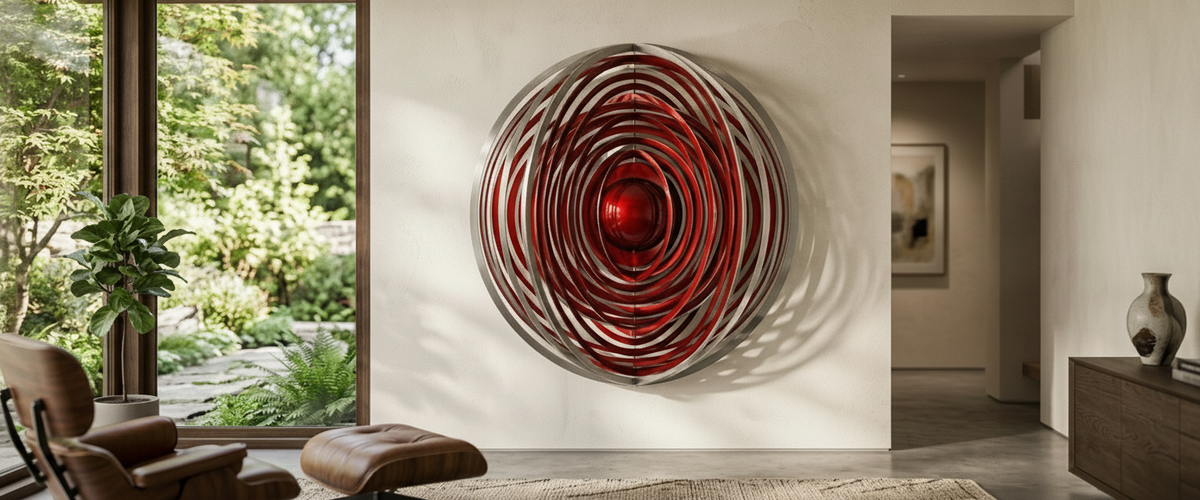

The piece looks perfect in the photo and dead on the wall. That gap is the thing most buyers never see coming, and it is the first thing a good sculptor worries about when a wall art metal commission lands on the bench. A flat image flattens everything: depth, edge thickness, the way a finish throws light at four in the afternoon. The maker is already thinking three steps ahead, picturing the work installed at full size in a real room or on a real exterior wall, because that is where it lives or dies.
Here is what actually goes into the decision before anyone cuts metal, and the questions that separate a piece you love for twenty years from one you quietly take down after eighteen months.

Key Takeaways
- Scale and viewing distance drive every other choice; a design tuned for 10 ft reads differently at 30.
- Material and finish decide longevity, especially for outdoor metal wall art exposed to sun, salt, and frost.
- A proper commission runs through maquette, sample finish, fabrication, then install; skipping stages is where regret comes from.
- Price depends on material, size, layering, finish, engineering, and mounting, so ask for a tailored quote rather than a sticker number.
- The right red-flag questions about fixings and weather protection tell you who actually knows their craft.

What Sculptors Think About Before Taking on a Wall Art Metal Commission
The first conversation is rarely about the artwork. It is about the wall. How big is it, what is it made of, how far back does the viewer usually stand, and is it inside or facing the weather? A large metal wall art panel that will hang in a double-height entrance needs a completely different visual rhythm from the same idea sized for a hallway.
Indoor and outdoor briefs split early. Outdoor metal wall art has to survive UV, temperature swings, and moisture, so the maker thinks in terms of stainless steel, Corten, or marine-grade coatings from the start. Interior pieces open up more finish options because they are not fighting the climate. At Giant Sculptures we treat that indoor or outdoor question as the fork in the road; almost every later decision flows from it.
Then comes composition at distance. A design with fine, busy detail can look intricate up close and turn into visual noise across a big room. Sculptors test this by stepping back, squinting, and asking whether the silhouette still works when the detail drops out. If the shape holds, the piece will read. If it collapses into mush, the design needs simplifying before fabrication begins.

Craft Decisions That Change the Final Result and the Price
Material is the loudest variable. Stainless steel gives you crisp edges, a cool reflective surface, and excellent weather resistance. Corten develops a warm rust patina that suits gardens and softens over time. Bronze brings depth and a patina that conservators have studied for centuries; the way copper alloys age is well documented by institutions like The Met's conservation department, which is part of why bronze remains a serious long-term choice.
Layering and depth come next. Flat single-plane pieces are cheaper to make and ship, but they can look thin on a large wall. Building a piece in stacked layers, with elements floating an inch or two off the backing, creates real shadow and changes through the day. That depth is why a lot of abstract metal wall art uses dimensional spheres and overlapping forms rather than a single cut sheet. Where a wall needs that warmth of light played back across the day, a layered piece such as the Eclat Sphere Red Abstract Metal Wall Art earns its presence from concentric circles catching light at different angles rather than from surface color alone, while a calmer reading might call for the Eclat Sphere Bronze Abstract Metal Wall Art, whose warmer tone sits more quietly in a neutral room.
Finish is the third lever, and the one buyers underestimate. Brushed, mirror-polished, powder-coated, patinated, or clear-lacquered surfaces all behave differently under light and over years. A high-gloss color reads bold in a showroom and can show every fingerprint and scuff in a busy commercial lobby. A brushed or matte finish hides handling and ages more gracefully. Each of these choices moves both the look and the cost, so honest makers walk you through the trade-offs rather than just quoting the prettiest sample.

Why Some Wall Art Metal Pieces Read Right at 10 ft and Wrong at 30
Viewing distance is the most common thing buyers get wrong, and we see it most with metal wall art decor bought for big spaces. A piece sized and detailed for an intimate study will disappear over a 16 ft dining wall. The reverse happens too: a bold, simple design built for distance can feel blunt and oversized when you stand three feet from it.
The fix is to design for the dominant viewing distance. In a stairwell or open-plan space, people mostly see the work from across the room, so silhouette and overall composition matter more than tiny detail. In a corridor where you pass within arm's reach, surface texture and fine work reward the close look. When a brief includes both, the strongest pieces work on two levels: a clean read from far away and a layer of detail that only resolves up close. Where a corridor or entry hall needs that dual reading, a floral piece such as the Fleur Halo Navy Blue Round White Metal Floral Decorative Wall Art holds a strong circular shape at distance while the petal work emerges only as you approach.
Studio Process: Maquette, Sample, Fabrication, Install
A real commission moves in stages, and skipping any of them is the usual source of disappointment.
- Maquette or scaled drawing. Before anything is cut, the design is worked out at small scale or as a precise rendering against your actual wall dimensions. This is where proportion problems get caught cheaply.
- Sample finish. For colored or patinated work, a finish sample on the real metal tells you far more than a screen ever will. Color shifts under different light, and metal reflects in ways paint chips cannot show.
- Fabrication. Cutting, forming, welding, layering, and finishing happen here. For large or layered pieces, the maker also engineers the mounting at this stage so the fixings suit the weight and the wall.
- Install or delivery. Big metal wall art is heavy and awkward; the studio should supply a mounting system and clear guidance, or arrange installation for very large work.
One commission sticks in mind: a multi-panel exterior metal wall art piece headed to a coastal property where salt spray was a daily reality. We pushed the client toward marine-grade stainless and sealed fixings, and reworked the layout so wind could pass through gaps rather than push against a solid sail of metal. Two years of weather later, it still looks the way it left the studio. That is the kind of thinking a flat product photo never reveals.
Red Flags Buyers Should Ask About Before They Commit
The questions you ask tell a maker whether you have done this before, and the answers tell you whether they have. Push on these.
- What exactly is the metal and the finish? Vague answers like "steel" or "hand-finished" without specifics are a warning sign for outdoor work.
- How does it mount, and is the hardware included? Large metal wall art needs a real fixing system rated for the weight, not picture hooks.
- For exterior pieces, what stops corrosion? You want to hear about grade of stainless, coating type, or a deliberate Corten patina, plus how the fixings themselves resist rust.
- What does long-term care look like? Even durable metal benefits from occasional cleaning; conservation bodies such as the American Institute for Conservation publish sensible guidance on caring for metal objects.
- Can I see a finish sample before full fabrication? A confident studio says yes.
How to Hang Metal Wall Art Without Regret
For lighter interior pieces, locate the wall studs and use fixings rated above the actual weight, then check the piece sits level before you commit the final screws. For heavier or layered work, the studio should specify the mounting points, and you may need a French cleat or a back-mounted bracket system spread across more than one fixing. On masonry or exterior walls, use appropriate anchors and stainless fixings so the hardware does not rust and stain the wall. When in doubt on anything large, ask the maker for the install spec rather than improvising.
People often ask about themed work too, like a Don Quixote metal wall art panel; the same rules apply. A figurative subject still lives or dies on silhouette, finish, and how it is mounted. If you fancy a do-it-yourself metal wall art project for a small interior piece, that is a fine weekend job. A 7 ft (about 2.1 m) layered exterior commission is not, and a good supplier will tell you so.
Where to Start
If you are weighing options, browse our metal wall art range to see how layering and finish change a piece, then look at the outdoor wall art and decor collection if your wall faces the weather. From there, a bespoke brief is straightforward: send us the wall dimensions, the location, and the mood you are after, and we will talk through material, scale, and finish before anything is made. That conversation is where good metal wall art decor actually begins.
For wider placement ideas, What Sculptors Actually Think About Before Taking a Metal Wall Art Commission is useful companion reading before finalising the setting and sightlines.