























































































A fiberglass sculpture that looks perfect in a photo can look wrong the moment it lands in a garden. The reason is rarely the material; it is the decisions made months earlier, at the clay stage, before anyone touched a mold. If you want to understand how to make fiberglass sculpture that holds up under real light, real weather, and a client walking around it at close range, you have to think like the studio does, not like a catalog.
We build and commission large-scale work in bronze, stainless steel and stone, and we also make fiberglass sculpture when the brief calls for a big form, a bold color, or a shape that would be impractical to cast in metal. This is the honest version of the process, including the parts that change the price and the questions worth asking before you sign anything.
The clay master decides the silhouette long before any resin is poured.

Key Takeaways Before You Commission
Fiberglass earns its place when you need large scale, light weight, or saturated color, not when you simply want cheap.
The maquette decides everything. Silhouette, proportion, and viewing distance are locked long before fabrication.
Finish is a craft, not a coat. Automotive-grade paint and UV protection separate a piece that lasts from one that chalks in two summers.
Scale changes the rules. A form that reads well at 10 ft (3 m) can collapse visually at 30 ft (9 m).
Budget depends on material, scale, engineering, and finishing. Ask for a tailored quote rather than a headline number.

What Sculptors Think About Before Taking on a Fiberglass Commission
The first conversation is never about resin. Before you make fiberglass sculpture, it is about where the piece will stand, who will see it, and from how far. A fiberglass garden sculpture destined for the end of a lawn has different demands than a reflective form in a courtyard where guests pass within arm's reach.
We ask about sun exposure, prevailing wind, salt air, and whether the piece will be lit at night. Fiberglass is a composite of glass fiber and resin, strong for its weight but only as durable as its outer skin. The gelcoat and topcoat carry the UV load, so a coastal install and a shaded inland garden call for different specifications from the start. Skip that conversation and you inherit problems later.
Scale ambition matters too. Artists like Anish Kapoor have shown how fiberglass and composite forms can hold enormous curved surfaces with a mirror-clean finish, something metal alone would struggle to deliver affordably at that size. Studying an Anish Kapoor fiberglass sculpture sets client expectations high, which is useful, as long as everyone understands the finishing work behind those surfaces.

How to Make Fiberglass Sculpture: The Craft Decisions That Change the Result
Here is where cost and quality actually live. Two studios can quote the same shape and deliver wildly different objects, because the choices below are invisible in a rendering. Learning how to make fiberglass sculpture well starts with respecting these hidden stages.
Sculpting the Master
Everything begins with a physical or digital master. Traditional studios sculpt in clay or foam; others carve a CNC-milled pattern from 3D data. The master defines every curve, so time spent refining it pays back at every later stage. Rush it, and the flaws multiply across the whole surface.
Mold Making
A mold is taken off the master, usually in silicone backed by a rigid fiberglass jacket. For large or complex forms the mold splits into sections, and every seam becomes a line you will have to hide later. Fewer, cleverly placed seams mean a cleaner final piece. This is craft judgment, not a spec sheet.
Layup and Lamination
The fiberglass itself is built up in layers inside the mold: gelcoat first, then chopped strand or woven mat saturated with resin, laid by hand for control on statement pieces. This is the stage where you truly make fiberglass sculpture rather than just paint a shell. The number of layers, the resin system, and any internal steel armature all decide whether the finished sculpture flexes in wind or stands rigid for decades. A hollow shell with a properly engineered internal frame is what turns a fiberglass resin sculpture from a prop into a permanent installation.
Hand layup gives control over layer count, resin system, and internal armature.
Finishing and Paint
Raw fiberglass is dull and needs sanding, filling, and priming before color goes on. For outdoor work we specify automotive or marine-grade systems with UV inhibitors, because standard paint chalks and fades. If a client wants the deep gloss you see on custom fiberglass sculptures at art fairs, that surface is built up and flatted back by hand, sometimes over several passes. Conservation guidance on modern painted surfaces is a useful reminder that coatings, not the core, usually fail first (getty.edu/conservation).

Why Some Pieces Read Right at 10 ft and Wrong at 30
This is the mistake I see most often. A design is approved at desk size, scaled up, and then it does not work outdoors. The problem is that our eyes read silhouette and proportion differently as viewing distance grows. Anyone planning to make fiberglass sculpture at monumental size has to design for the far view first.
At 10 ft (3 m), fine detail carries: fingers, feathers, folds of drapery. Push the same form to 25 or 30 ft (7.5 to 9 m) and viewed from across a lawn, that detail vanishes and the outline does all the work. If the silhouette is fussy or the proportions were tuned for close viewing, the piece looks weak from a distance and busy up close. We deliberately exaggerate certain masses on large fiberglass garden sculpture so they hold their shape against sky and trees.
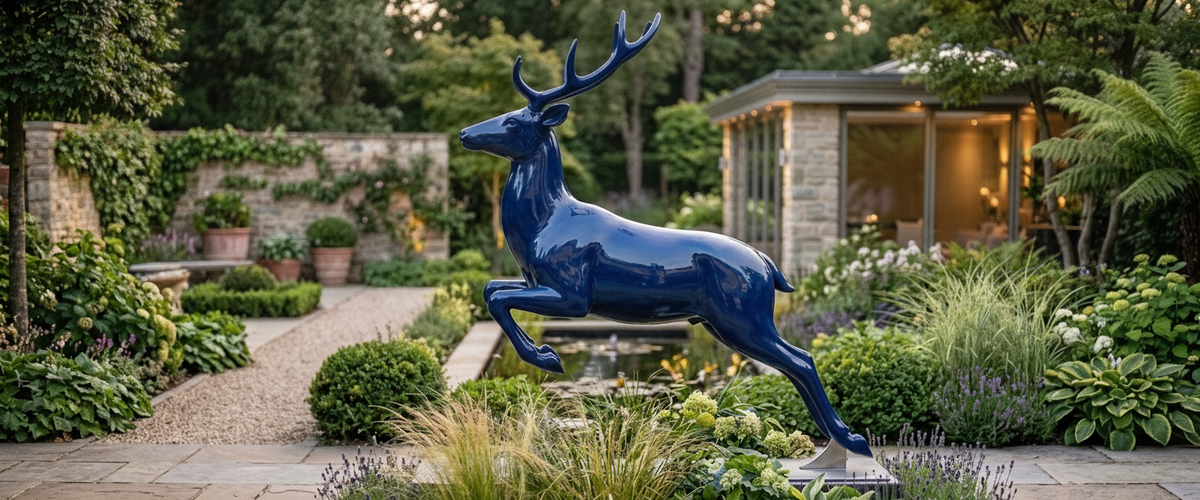
Fiberglass animal sculptures show this clearly. A leaping stag at garden scale can keep delicate antlers; the same stag at monumental scale needs thicker, simplified forms or the antlers disappear and look fragile. Seasonal work has the same trap. Fiberglass Christmas sculptures for a retail forecourt are read at speed by people in cars, so bold shapes and clean color beat intricate modeling every time.
Our Studio Process, Step by Step
When we make fiberglass sculpture on commission, the sequence below keeps surprises out of the final delivery.
Maquette. A scale model in clay, printed resin, or digital form. We approve silhouette, proportion, and pose here, tested at the intended viewing distance, not on a desk.
Material sample. A finished sample panel in the real color and gloss level, checked outdoors in daylight. Color that looks right under studio lights can shift badly in sun.
Fabrication. Master, mold, layup, internal armature, assembly. Progress photos at each stage so nothing is a surprise.
Finishing. Sanding, priming, painting, and sealing with UV-stable coatings, plus concealed fixing points designed for the site.
Install. Crating, freight, and placement. Large hollow forms are light for their size but awkward; we plan lifting points and ground anchoring before the piece ships.
If you are weighing fiberglass against metal, browsing our fiberglass sculptures alongside pieces in our large garden statues collection is a quick way to see where each material earns its place. Fiberglass wins on scale and color; bronze and stone win on gravitas and multi-generational lifespan.
Honest Red Flags to Ask About Before You Commit
Good studios welcome hard questions. If you plan to make fiberglass sculpture that lasts, vague answers to these are worth noting.
What internal structure does it have? A large piece with no steel armature will move, crack at stress points, or sag over time.
Which resin and gelcoat system, and is it UV-stable? Interior-grade resin outdoors is a false economy.
How are seams handled? Ask to see the mold split lines on a finished example.
What paint system, and can it be refinished? A repairable coating extends the life of the piece by years.
How is it anchored? Wind load on a tall hollow form is real. Ground fixing should be engineered, not improvised on install day.
Can I see a sample panel outdoors before full production? Any studio confident in its finish will say yes.
One lesson we learned the hard way: a client approved a high-gloss deep blue under gallery lighting, and in full afternoon sun on their terrace it read almost black. We now insist on an outdoor sample check for every saturated color, no exceptions. It costs a little time and saves a lot of regret.
Is Fiberglass the Right Choice for Your Piece?
Choose to make fiberglass sculpture when you want large scale without huge weight, strong color, or a curved reflective form that would be costly to cast. Choose bronze, stainless steel, or stone instead when permanence and weight are the point, or when the piece will take heavy contact in a public setting. Many of the outdoor commissions we ship end up as a mix, with fiberglass for the big gesture and metal for the details that must survive hands and weather. Our outdoor sculptures collection shows how those choices play out across different sites.
However you decide, the material is only half the story. When you make fiberglass sculpture, the piece succeeds or fails on the quality of the master, the honesty of the engineering, and the care in the finish. Get those right and you own a fiberglass sculpture that looks intentional for decades. Get them wrong and no amount of clever color hides it.
For wider placement ideas, Large Garden Statues: How to Get the Scale Right Outdoors is useful companion reading before finalising the setting and sightlines.