























































































The fastest way to end up with a disappointing piece is to fall in love with a small render and assume it will scale cleanly to 20 feet. It rarely does. To make a fiberglass sculpture that reads well at real size, someone has to think about proportion, weight, wind, seams, and finish long before a single layer of resin goes down. That is what it takes to make fiberglass sculpture that lasts, and that planning is where the good pieces separate from the ones that look tired within a season.
We build large-scale and bespoke work at Giant Sculptures, and while our core is bronze, stainless steel, Corten and stone, fiberglass earns its place for certain briefs: lightweight forms, bold color, complex organic shapes, and pieces that need to move or ship without a crane at every turn. When you set out to make fiberglass sculpture at this scale, the process runs a specific way. Here is how it actually goes, and what to ask before you commit.
Layup in progress on a large sectioned piece.

Quick Answer: What Making a Fiberglass Sculpture Involves
When you make a fiberglass sculpture, the work breaks into these stages.
Design and maquette: a scaled model to lock proportion and pose before fabrication.
Mold or armature: a mold for repeatable forms, or a built-up armature for one-offs.
Layup: fiberglass matting saturated with resin, built in layers for strength.
Finishing: filling, sanding, priming, then paint or gelcoat color.
Sealing and install: UV-stable topcoats, hidden fixings, and a base that handles wind load.
That is the shape of it. The detail is where the money and the quality live, and where the choice to make fiberglass sculpture well pays off.

What Sculptors Think About Before Taking a Fiberglass Commission
Before quoting, the first questions are rarely about the sculpture itself. They are about site and life expectancy. Is this going indoors in a Dallas lobby or outdoors in a Napa garden with full afternoon sun? Coastal salt air in the Hamptons behaves very differently from a sheltered courtyard in NYC. The material is durable, but the resin and the topcoat carry the burden of UV and moisture protection, so the environment sets the specification for anyone planning to make fiberglass sculpture that stays outside.
The second question is scale and viewing distance. A piece read from 40 feet across a plaza needs different surface treatment than one you can touch. The third is handling: how does it get through the gate, and can two people lift a section, or does it need engineered lift points? A good studio maps all of this before drawing, because retrofitting a fix later is expensive and usually visible.
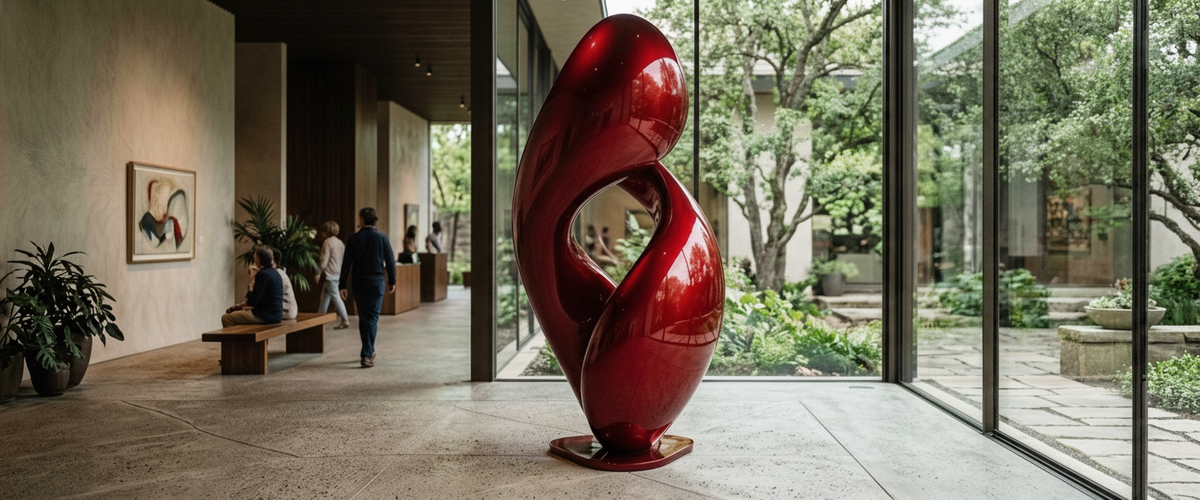
When people picture a fiberglass sculpture, they often think of the mirror-smooth, seamless forms associated with an Anish Kapoor fiberglass sculpture: a surface so clean it hides how it was made. That finish is achievable, but it is a deliberate and labor-heavy choice, not a default. If you want that, say so early, because it changes the mold work, the sanding hours, and the price.

Craft Decisions That Change the Result (and the Price)
Fiberglass sounds like one material. In practice, the choice to make fiberglass sculpture is a stack of choices, and each one moves the outcome.
Solid Color vs. Painted Finish
Color can be built into the gelcoat, so it runs through the outer surface and resists chipping, or it can be applied as automotive-grade paint over primer. Gelcoat is tough and forgiving of minor scuffs. Paint gives you sharper control over metallic, pearlescent, and multi-tone effects. For a custom fiberglass sculpture with a very specific brand color or a mirror-polish look, painted and clear-coated systems usually win, but they demand more upkeep.
Layup Thickness and Reinforcement
More layers and internal ribbing mean more strength and less flex, which matters at scale and outdoors. A thin layup keeps weight and cost down but can oil-can (flex visibly) on large flat panels. This is the single most common corner that gets cut on cheap work, and you cannot see it from a photo. Anyone paying to make fiberglass sculpture at size should ask about it directly.
Seams and Joints
Large pieces are made in sections and joined. Where those seams fall, and how well they are filled and blended, decides whether the sculpture looks monolithic or like a kit. On fiberglass animal sculptures with flowing muscle lines, a seam across the wrong plane is glaring.
Weathering and UV Package
Outdoor work needs UV inhibitors in the resin and a UV-stable topcoat. Without it, colors chalk and fade and the surface can go brittle over years. The American Composites Manufacturers Association has good general guidance on how composite laminates are built and protected, and it is worth understanding the basics before you sign off on a spec.
A finished garden piece with an engineered base for wind load.

How to Make a Fiberglass Sculpture: The Studio Process Step by Step
This is the honest version of how to make a fiberglass sculpture at commission quality, not a hobby-scale shortcut.
Brief and design. We agree the subject, pose, scale, finish, and site conditions. Reference images and a placement plan matter here.
Maquette. A scaled model, physical or digital, locks proportion. This is where a client catches that the gesture feels too static or the head reads too small, while it is cheap to change.
Sample panel. For color-critical work we produce a finish sample. Seeing the actual gelcoat or paint under natural light prevents the classic surprise where a screen color turns out cold or plasticky in person.
Pattern or armature. For repeatable or symmetrical forms, we build a master pattern and pull a mold. For a true one-off, the form is sculpted over an armature and glassed directly.
Layup and cure. Fiberglass matting is saturated with resin in layers, with reinforcement added where loads concentrate. Each stage cures before the next.
Filling and fairing. The raw surface is filled, sanded, and re-checked repeatedly. This is the slowest, least glamorous stage and the one that decides quality.
Finish. Primer, then color, then a protective UV-stable topcoat. For high-gloss work, wet sanding and polishing follow.
Fixings and install. Hidden internal mounts and a base engineered for wind load. A tall, light form catches wind like a sail, so the base and anchoring are structural, not decorative.
Follow those steps and you make a fiberglass sculpture that holds up. You can see the range of forms fiberglass supports across our fiberglass sculptures collection, from clean abstract shapes to figurative and animal work.
Why a Piece Reads Right at 10 Feet and Wrong at 30
Scale is not a slider you drag. Enlarge a maquette uniformly and the proportions that charmed you at tabletop size can look wrong outdoors. Heads shrink visually, limbs thin out, and fine detail disappears at distance while unwanted bulk becomes obvious. This is the part that trips up first-timers who make fiberglass sculpture from a single small model.
Sculptors correct for this by adjusting proportion as they scale, exaggerating features that carry at distance and simplifying detail that would only muddy the silhouette. A fiberglass garden sculpture viewed across a lawn lives or dies on its outline, not its texture. Get the silhouette strong and the piece works from the driveway; fuss over surface detail nobody sees from 30 feet and you have spent budget in the wrong place.
This is also why seasonal and display work behaves differently. Fiberglass Christmas sculptures for a retail atrium are usually seen close and photographed constantly, so surface finish and color accuracy dominate. A landmark garden piece is about mass and gesture. Same material, very different priorities when you make a fiberglass sculpture for each setting.
Fiberglass vs. Bronze, Steel and Stone: A Buyer's Decision Guide
Fiberglass is the right answer for some briefs and the wrong one for others. Use this to decide honestly before you commit to make fiberglass sculpture over another material.
Choose fiberglass when you need light weight, bold or custom color, complex organic shapes, faster turnaround than casting, or a piece that must move between sites.
Lean toward bronze or stone when you want a multi-generational heirloom, museum-grade permanence, or the natural patina and gravity of traditional material. Our bronze sculptures suit collectors who want the piece outliving them.
Consider stainless steel or Corten when you want a modern architectural read, mirror reflectivity, or a rusted-surface aesthetic that ages on purpose.
A fiberglass resin sculpture is not a downgrade; it is a tool. The mistake is treating it as a cheap stand-in for bronze and then being surprised it needs different care. Budget depends on material, scale, complexity, engineering, finishing, and installation, so the only honest number comes from a tailored quote against your actual site and design.
How to Paint a Fiberglass Sculpture So the Color Lasts
If you are refinishing or specifying paint on a fiberglass sculpture, the sequence matters more than the brand. Clean and de-grease the surface, key it with a light sand so primer grips, then apply an adhesion primer suited to composites. Build color in thin coats rather than one heavy pass, and finish with a UV-stable clear coat for anything living outdoors. Skip the primer or skip the UV topcoat and you will be repainting far sooner than you planned.
Red Flags to Raise Before You Commit
These are the questions that separate a studio that will still answer your call in five years from one that will not, and they matter whenever you set out to make fiberglass sculpture on commission.
Ask about the UV package. If they cannot explain how the piece resists fading and chalking outdoors, walk.
Ask to see a finish sample, not just a render. Screen color lies. Insist on physical proof for color-critical work.
Ask where the seams fall and how they are blended. A vague answer usually means visible joints.
Ask about the base and wind loading. Tall, light forms need engineered anchoring, and this is a safety issue outdoors.
Ask about repairability. Fiberglass can be repaired well, but only if the studio documents the layup and finish system.
Ask about maintenance. An honest supplier tells you a painted gloss piece needs more attention than a gelcoat one.
Good large-scale work is a long-term relationship, not a one-off transaction. We would rather steer a client toward bronze or steel when fiberglass is the wrong fit than sell a piece that ages badly and comes back as a complaint.
Where This Leaves You
Learning to make fiberglass sculpture at a serious level is really about learning to plan: scale, finish, seams, UV, and mounting all decided before fabrication starts. Get those right and the material gives you form and color that few others can match at that weight. Get them wrong and no amount of sanding saves it. If you want to make fiberglass sculpture for a specific piece or site, talk it through with a studio that builds at scale before you commit, and ask for a tailored quote against your real conditions.
For wider placement ideas, How to Make a Fiberglass Sculpture: An Insider Look at the Craft is useful companion reading before finalizing the setting and sightlines.