
























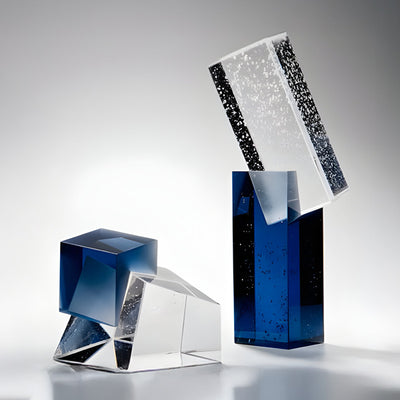













































































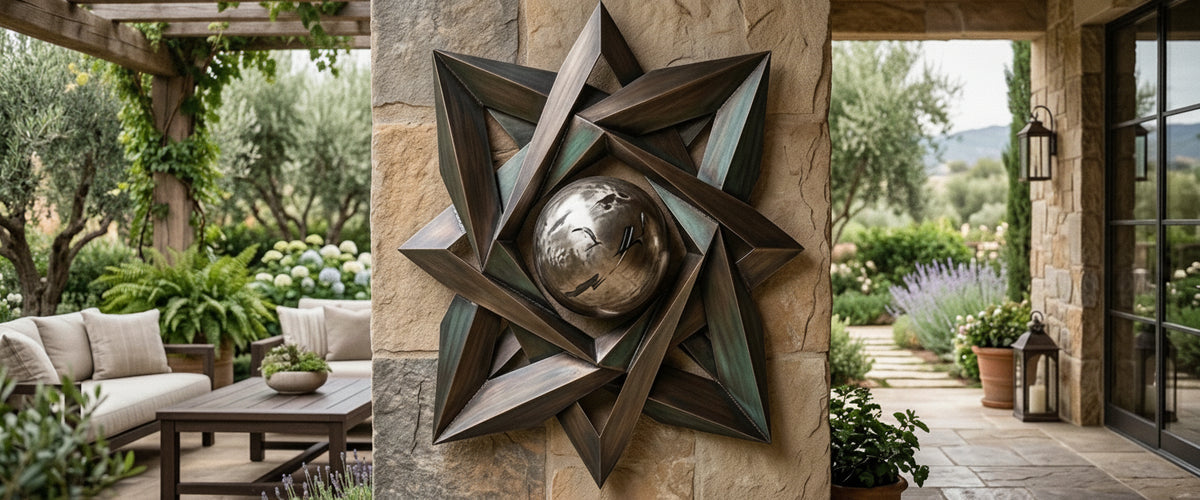

A crisp render of an abstract geometric metal piece can lie to you. On screen the angles look clean, the finish glints, the composition sits balanced inside a tidy frame. Then it lands on a 30 ft (9 m) gallery wall in a Napa tasting room and reads flat, because nobody thought about how the eye travels across that much space. The design was never wrong. The planning was.
We build a lot of abstract geometric metal work, from single-wall pieces to large exterior installs, and the difference between a commission that sings and one that disappoints is almost always decided before anyone cuts a panel. Here is how the thinking actually goes inside the studio.
Layered facets are what keep an abstract geometric metal panel alive as the light shifts through the day.

Quick Answer: What Makes Abstract Geometric Metal Work
Scale drives everything. A composition tuned for 6 ft (1.8 m) rarely holds up at 20 ft; depth and relief have to grow with the wall.
Material sets the mood. Stainless steel throws light, Corten reads warm and matte, brushed aluminum stays quiet and modern.
Finish is a design decision, not a coat added at the end. It changes how sharp the geometry looks from across a room.
Relief and layering give the piece life when light moves; a flat cutout looks dead by late afternoon.
Fixing and structure matter as much as the front face, especially outdoors.

What Sculptors Actually Think About Before Taking a Commission
The first question is never "what shape?" It is "where does this live, and who sees it from where?" A geometric metal wall art piece for a double-height NYC lobby has a different job than the same idea over a fireplace in a Texas ranch house. In the lobby, people read it at distance and at speed. Over the fireplace, they sit with it for an hour.
We ask about sightlines, viewing distance, natural and artificial light, and what sits around the piece. Geometry is unforgiving. A slightly off angle on a curved canvas is forgiving; the same error on a hard-edged abstract geometric metal panel screams. So before we commit, we map the wall, the light path through the day, and the dominant colors in the room. That last one decides whether a warm bronze finish or a cool steel one is going to fight the space or settle into it.
Color is where a lot of buyers move first, and fairly so. Where you want the wall to be the event, a saturated sphere-based composition such as the Eclat Sphere Red Abstract Metal Wall Art pulls a room toward it. Where the metal should support the space rather than dominate it, a quieter tone like the Eclat Sphere Bronze Abstract Metal Wall Art holds presence without shouting. Same family of abstract geometric metal, very different room behavior.

Craft Decisions That Change the Result (and the Price)
Every choice in fabrication moves two dials at once: how the piece looks, and what it costs to make. Buyers deserve to know which levers matter.
Material gauge. Thin sheet is cheaper and lighter, but it can oil-can (ripple under its own weight) on larger panels and looks flimsy up close. Heavier gauge holds its lines and reads solid, at more weight and more cost.
Layering and depth. A single flat plane of geometric metal is the least expensive route and the least interesting. Stacked planes with air between them cast shadows that change through the day, which is what makes an abstract geometric metal composition feel alive rather than printed. More layers, more labor.
Edge treatment. Laser-cut edges can be left raw, deburred, or fully finished. On a piece people walk past within arm's reach, edge quality is the detail that separates studio-grade from mass-produced.
Finish samples in brushed steel, bronze patina and powder coat, judged under the buyer's own light before fabrication begins.
Finish system. Brushed, mirror-polished, powder-coated, patinated, or clear-coated. Each behaves differently in light and each has a different maintenance profile. Where the setting calls for a cool, contemporary reflection rather than warm patina, a steel-toned piece of abstract geometric metal such as the Eclat Sphere Blue Abstract Metal Wall Art is closer to the right design language. For outdoor pieces, the coating choice is also a longevity choice: a quality powder-coat over correctly prepared metal is what keeps color stable against UV over years, a point echoed in coating performance guidance from ASTM.
None of this maps to a fixed price, and any studio that quotes a geometric commission before knowing size, material, finish, and install conditions is guessing. Budget follows material, scale, complexity, engineering, and installation. Ask for a tailored quote rather than a headline number.

Why Some Abstract Geometric Metal Reads Right at 10 ft and Wrong at 30
This is the most common miss we see, and it is worth its own section. A composition designed at desk scale often has fine internal detail: thin struts, small facets, tight gaps. At 10 ft (3 m) those details do real work. At 30 ft (9 m) they vanish into visual noise, and the piece loses the crisp read that made it appealing in the first place.
Large-format geometric wall art metal needs bolder gestures, deeper relief, and fewer, stronger elements. We often strip detail out of a big-wall abstract geometric metal design rather than add it. The eye at distance wants clear silhouette and shadow, not filigree. When a client sends us a small piece they love and asks us to scale it four times up, we usually redraw the composition rather than photocopy it larger. It is the same instinct a muralist uses: the mark that works at arm's length is the wrong mark from across the plaza.
The reverse trap exists too. A bold, sparse design built for a big lobby can feel empty and unresolved when shrunk to a den. Scale is a design input for any abstract geometric metal piece, not a slider you drag at the end.
Studio Process: Maquette, Sample, Fabrication, Install
A serious bespoke abstract geometric metal wall art commission moves through clear stages, and skipping any of them is where projects go wrong.
Concept and maquette. We work up the composition to scale, often as a physical or digital maquette so you can judge proportion against the real wall, not against a floating image.
Material and finish sample. Before we build the full piece, we produce a finish sample in the exact metal and coating. A powder-coat color on a swatch under your own light beats any screen preview. This step catches disagreements early, when they are cheap to fix.
Fabrication. Cutting, forming, layering, welding, finishing. For layered pieces this is where the shadow behavior is locked in.
Mounting design and install. The back of the piece is engineered for the wall it is going on, whether that is drywall, masonry, or an exterior facade with wind load to consider. We spec fixings, standoffs, and where needed a concealed cleat system.
One abstract geometric metal commission we shipped to a coastal California home taught us to always ask about salt air up front. The client wanted a mirror-polished steel piece near an open terrace. We steered them to marine-grade stainless and a protective finish instead of standard steel, because polished mild steel by the ocean would have shown corrosion within a season. The design did not change; the specification did, and the piece still looks right years on.
Honest Red Flags Buyers Should Ask About
If you are commissioning metal geometric wall art at any real size, these are the questions that separate a confident maker from a risky one.
"Show me a finish sample in my chosen coating." A studio that resists this is asking you to trust a render. Don't.
"How is it mounted, and who supplies the fixings?" Vague answers here mean surprises on install day. Weight and wall type must be part of the conversation early.
"What is the outdoor rating?" If it is going outside, ask specifically about the metal grade and coating for your climate. Aspen snow load, Gulf Coast humidity, and desert UV are three different problems.
"Will this composition hold up at my viewing distance?" A good maker will happily tell you if your design is too detailed for the wall, or too sparse.
"What does long-term care look like?" Every finish has a maintenance rhythm. Corten weathers and stabilizes; polished steel wants occasional cleaning; powder-coat wants gentle washing, not abrasives.
For care specifics on metal artwork over time, museum conservation resources such as the Smithsonian's Museum Conservation Institute are a sober reference point on how metals and coatings age, and they apply just as well to an abstract geometric metal piece.
Where to Start Browsing
If you want to see how color and finish shift the feel of the same geometric idea, the full metal wall art range is the clearest way to compare abstract geometric metal designs side by side. For softer, more sculptural forms, the wider geometric art and abstract art collections show how far the geometry can push before it stops being wall art and becomes freestanding sculpture.
Giant Sculptures builds these abstract geometric metal pieces as bespoke commissions as well as ready designs, which means scale, material, and finish can all be tuned to your wall rather than the other way round. Send the wall dimensions, the light, and a photo. That is genuinely where the good decisions start.
For wider placement ideas, Metal Abstract Garden Sculpture: What Sculptors Weigh up Before They Cast a Single Piece is useful companion reading before finalising the setting and sightlines.