






















































































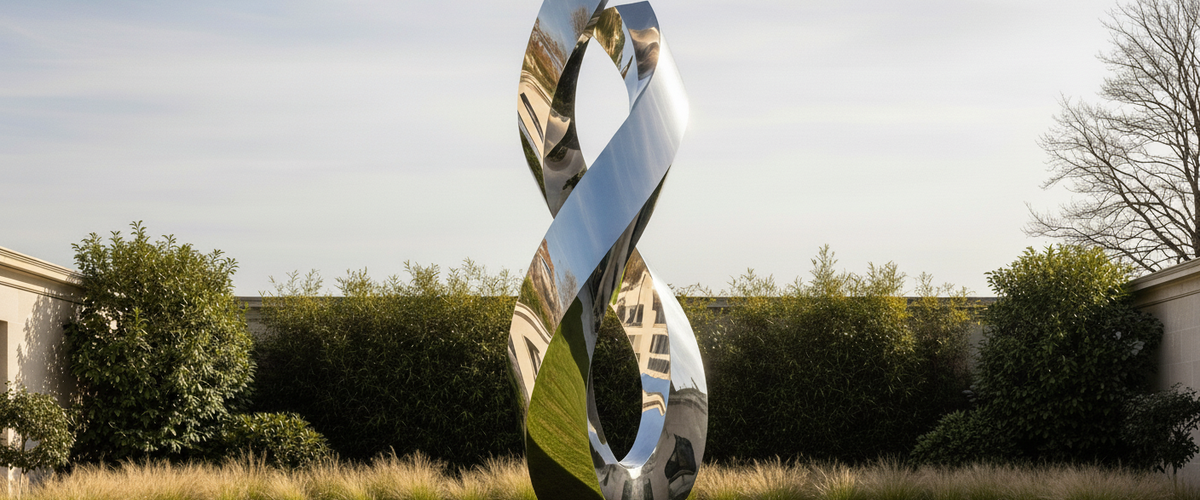

A stainless steel sculpture lives or dies by two things: the quality of the weld lines and the quality of the light it catches. Get those right and a single piece will hold a courtyard, a lobby or a lawn for decades. Get them wrong and you have a polished object that looks tired by its third winter. This guide is for buyers, designers and architects who want the long version, not the showroom pitch.
At Giant Sculptures we fabricate and ship large stainless steel work to private gardens, hotels and corporate campuses, so most of what follows comes from commissions we have actually crated and installed, not theory.

At a Glance: What Matters Before You Buy
- Grade: 316 marine grade for coastal or pool sites, 304 for most inland gardens and interiors.
- Finish: Mirror polish for drama and reflection, satin or brushed for a softer architectural read, colored PVD or patinated for warmth.
- Scale: Outdoor pieces usually need to be larger than buyers first think. Under 4 ft (1.2 m) tends to disappear in open landscape.
- Base and fixings: Engineered for wind load, frost and the specific substrate (lawn, paving, deck, pond edge).
- Lead time: Bespoke stainless steel sculpture is a fabrication project, not stock pulling. Plan months, not weeks.

What Stainless Steel Sculpture Actually Is
Stainless steel is an iron alloy with at least 10.5% chromium, which forms a thin passive layer that resists corrosion. In sculpture, that translates to a material you can polish to a mirror, brush to a soft gray, or color through PVD coating and trust outdoors for generations. The worldstainless association sets out the basic metallurgy if you want the full chemistry, but the short version for buyers is this: stainless steel is the closest thing the sculpture trade has to a fit-and-forget exterior material.
Sculpture stainless steel typically arrives at the studio as sheet, plate, tube or bar. The artist cuts, rolls, hammers and welds it into form, then grinds, polishes or coats the surface. The finishing stage is where the hours go. A mirror polish on a 6 ft (1.8 m) abstract form can take a skilled finisher a full week of progressive grit work.

Grades, Finishes and Scale Decisions
Grade: 304 vs 316
304 stainless is the workhorse for most stainless steel metal sculpture. It polishes beautifully and handles rain, snow and the usual garden chemistry. For coastal homes in the Hamptons, Malibu or anywhere within roughly a mile of salt spray, specify 316. The added molybdenum in 316 fights chloride pitting, which is what causes those small rust freckles you sometimes see on cheaper outdoor stainless steel sculpture after a few seasons by the ocean. The same logic applies around chlorinated pools and any stainless steel water fountain sculpture.
Finish: Mirror, Satin, Colored
Finish changes the entire personality of a piece. A mirror-polished form behaves like a sky-and-garden mirror; on an overcast day it goes pewter, at golden hour it turns molten. Where a residential entry or pool deck calls for that reflective behavior at a workable scale, a piece such as the Whisper Silver Abstract Steel Sculpture at around 118 cm is closer to the right brief than a monumental form. A satin or brushed finish reads more architectural and hides fingerprints and pollen far better, which matters for pieces installed near seating or entrance doors. PVD-coated work in gold, bronze or copper tones gives you the warmth of bronze with the weight and weldability of steel; where the setting wants that warmer register without going to a patinated bronze, the Whisper Gold Abstract Steel Sculpture is a useful study in how a colored finish shifts through the day.
Scale
This is where most first-time buyers misjudge. A 3 ft (90 cm) abstract on a wide lawn looks like a garden ornament. The same form at 6 to 9 ft (1.8 to 2.7 m) becomes the anchor of the space. For open ground, a taller layered form such as the Strata Copper Abstract Steel Sculpture - 165/220cm at 165 to 220 cm earns its footprint in a way a half-height piece cannot; for a courtyard or pool deck, the 80 to 120 cm range usually carries.
Where to Place Stainless Steel Sculpture
For wider placement ideas, Stainless Steel Sculpture: Mirror Polish or Brushed? is useful companion reading before finalising the setting and sightlines.
Stainless steel needs something to reflect. A polished sculpture marooned in a flat gravel forecourt with no planting, no sky view and no movement will read as a hard, cold object. Place the same piece where it can pick up a Japanese maple, a pool surface, a stretch of lawn or the changing sky and it becomes kinetic without any moving parts.
A few placement rules we use in commissions:
- Give it sky. Polished and mirror pieces want an open sight line upward. Avoid burying them under dense tree canopy.
- Plant softly around the base. Ornamental grasses, low box, lavender. Hard paving right to the base makes the piece look dropped in.
- Walk around it. Stainless steel outdoor sculpture is almost always 360-degree work. Site it where guests can move all the way around, not pinned against a wall.
- Think night. A small uplight at the base transforms a mirror-finish form after dusk. Plan the electrics before you pour the footing.
- Mind the heat. South-facing mirror surfaces can throw concentrated reflections onto adjacent siding or glass. Test sight lines in summer sun.
Indoors, stainless steel sculpture works hardest in double-height lobbies, stair voids and at the end of long sight lines. A compact geometric piece such as the Cubic Geometric Steel Sculpture - 75cm can hold a console or plinth in a residential entry without dominating it; larger forms suit commercial reception areas where the ceiling height earns the scale.
Figurative, Abstract and Kinetic Options
Abstract forms dominate the category because steel takes to curves and twists in a way that few materials match. Rolled and welded ribbons of steel can carry real visual weight without looking heavy, which is the appeal of pieces in the spirit of the Eternal Twist abstract form.
Figurative stainless steel work, including the stainless steel dog sculpture and stag pieces that clients often ask for, leans on the contrast between a literal subject and a high-tech surface. Our stainless steel sculptures collection shows how a luminous stag or polished hound reads very differently from a bronze of the same subject; the steel keeps the form young, almost graphic.
Kinetic work is the third path. A stainless steel mandala kinetic sculpture, or any wind-driven mobile, adds literal motion to the reflected motion you already get from a polished surface. It demands more engineering: bearings, balance, wind load calculations. Worth it on the right site.
Budget, Commissioning and Delivery
Stainless steel sculpture pricing depends on far more than size. The main drivers are sheet thickness and grade, complexity of the form (every compound curve is hand-rolled), finish hours, internal armature and base engineering, crating, freight and on-site installation. A 6 ft (1.8 m) mirror-polished abstract and a 6 ft brushed geometric piece can sit in very different price territory because of finishing time alone. Rather than guess, ask for a tailored quote with the site details, preferred finish and any constraints on lead time.
On weight: a solid 8 by 8 ft slab of stainless steel would be impractical, so sculptors fabricate hollow forms over an internal frame. As a rough guide, a hollow stainless steel sculpture in the 8 ft range commonly lands somewhere between 200 and 600 lbs (90 to 270 kg) depending on plate thickness and internal structure. Always confirm the engineered weight before specifying a plinth or footing.
What to Send a Studio When Requesting a Quote
- Photos of the intended site, including the wider view.
- Approximate footprint and the height range you are considering.
- Substrate: lawn, concrete pad, paving, pool deck, interior floor.
- Exposure: coastal, urban, rural, indoor.
- Finish preference and any color references.
- Target install window so the studio can map fabrication time.
Care: Keeping a Stainless Steel Sculpture Looking New
For general conservation principles, Canadian Conservation Institute outdoor object care is a useful external reference, though the final care routine should always follow the material and finish specified for the individual commission.
Stainless steel is low maintenance, not no maintenance. A simple routine keeps a piece looking the way it did the day it was uncrated.
- Rinse quarterly with clean water to remove pollen, salt and atmospheric grime.
- Wash twice a year with warm water and a pH-neutral soap, using a soft microfiber cloth. Always wipe in the direction of the grain on satin and brushed finishes.
- Dry with a clean microfiber to prevent water spots, especially on mirror polish.
- Spot-treat fingerprints on mirror finishes with a dedicated stainless steel cleaner. Avoid chloride-based products and steel wool, which will scratch and can introduce free iron that later rusts.
- For coastal sites, rinse monthly in the salt season. Conservation guidance from the Getty Conservation Institute on outdoor metalwork is a useful reference for owners of significant pieces.
If a piece picks up tea-stain discoloration near the coast, that is surface contamination, not failure of the steel. A specialist clean restores it. Resist the urge to attack it with abrasives.
How Giant Sculptures Approaches Bespoke Stainless Steel Work
We work as both gallery and studio. That means you can buy a finished piece from our stainless steel sculptures range, or brief us on a one-off. Most of our larger commissions follow the same arc: site visit or detailed photo survey, concept sketches, a scaled maquette, engineering drawings, fabrication, finishing, crating and supervised install. For clients comparing stainless steel sculpture manufacturers, the questions worth asking are simple. Who welds the piece? Who finishes it? What grade is specified, and why? How is the base engineered for the actual site, not a generic spec?
One lesson from the studio worth passing on: the cheapest stainless steel sculpture is rarely the cheapest sculpture to own. Thin gauge plate, undersized internal frames and rushed polishing show up within a few seasons, usually as oil-canning (visible flexing of the surface) or as dull patches that no amount of cleaning will lift. Specify properly the first time and the piece outlasts the house.
If you are weighing stainless steel against bronze, Corten or stone for a major site, our outdoor sculptures and metal sculptures collections are a useful side-by-side. Steel gives you light and motion. Bronze gives you weight and warmth. The right answer depends on the site, not the trend.