





































































































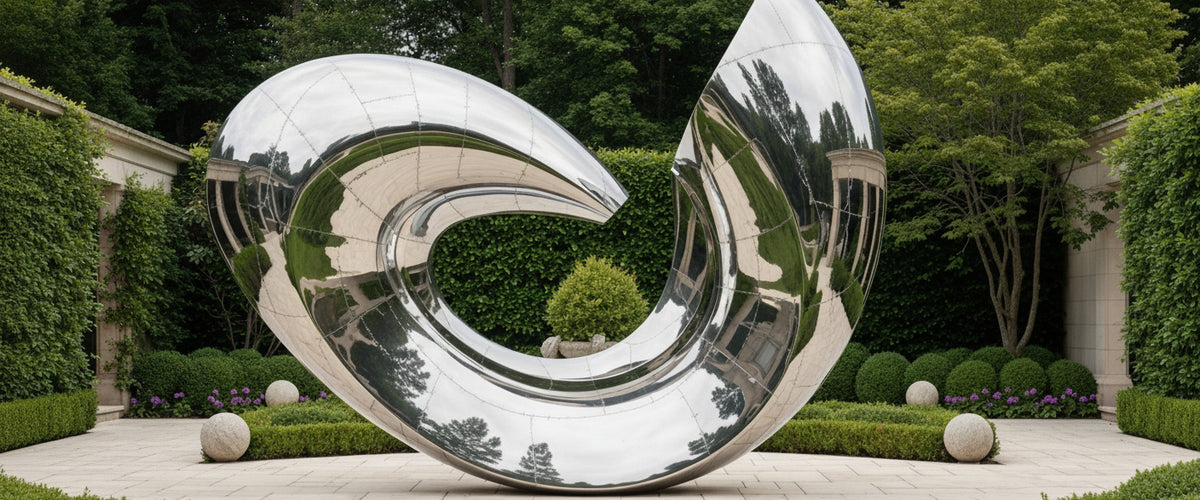

Walk into a contemporary Napa winery courtyard at noon and a mirror-polished stainless steel sculpture will hand you back the sky, the vines, and a stretched version of yourself. Walk past the same form in brushed satin and you get something quieter, more architectural, almost soft. Same alloy. Same shape. Completely different room. That single decision, mirror polish or brushed, drives more buyer regret than any other choice in commissioning a stainless steel sculpture, so it deserves more than a passing thought.
At Giant Sculptures we build large-scale, bespoke metalwork for collectors, designers, hotel groups and private estates, and the finish conversation is always the first one we have with a serious client. Below is the editorial version of that conversation.

Key takeaways at a glance
- Mirror polish reflects its surroundings and reads as bold, kinetic, almost theatrical.
- Brushed or satin reads as architectural and absorbs scratches gracefully over time.
- Grade 316 belongs near coasts, pools and salt air; 304 is fine for sheltered inland sites.
- Reflections are a design tool, not a side effect. Plan the view the sculpture will steal.
- Weld quality and seam blending separate gallery-grade pieces from fabrication-yard work.

Why stainless steel sculpture reads as contemporary, even when the form is classical
Stainless steel is a young material in art-historical terms. Bronze has three thousand years of memory attached to it; marble carries antiquity in its weight. Stainless arrived with mid-century engineering and never shed that association. Even a classical figure or a traditional animal study, rendered in stainless, immediately reads as a contemporary statement. That is why a stainless steel dog sculpture in a Beverly Hills entry court feels like art rather than ornament, and why a stainless figurative piece in a Connecticut sculpture garden punctuates the lawn instead of blending into it.
The lesson for buyers is simple: stainless steel pulls every form toward the present. If your interior or landscape already leans modern, this is an asset. If your setting is traditional and you want a counterpoint rather than a continuation, stainless is your most efficient lever.

Mirror, satin and brushed finishes compared in real light
Finish is not a swatch decision. It is a behavior decision, because each surface treats light differently across a day.
Mirror polish
True mirror polish is achieved by progressive abrasive grits followed by buffing compounds, taking the surface to a near-optical reflectivity. In a Hamptons garden it turns into liquid sky at dusk. In a glass-walled penthouse it doubles the view. The trade-off is honesty: every fingerprint, water spot, and pollen dusting shows. Mirror finishes reward owners who are willing to wipe down the piece on a routine.
Satin and brushed
Brushed finishes are produced with directional abrasives that leave a fine grain. The surface diffuses light instead of bouncing it. The piece reads as solid, sculptural, calm. Crucially, brushed surfaces age well: new scratches blend into existing grain rather than announcing themselves. For a busy hotel lobby or a public courtyard, brushed is the pragmatic choice.
Colored and PVD finishes
Stainless can also be tinted through PVD coating or heat-treated to produce gold, bronze, copper and graphite tones. These are not paint; they are vacuum-deposited at the molecular level and behave like the underlying steel. Where the brief calls for warmth against stone or timber rather than a cool silver reflection, a tonal piece such as Whisper Gold Abstract Steel Sculpture sits closer to the right palette than a true mirror finish. For larger, landscape-scale commissions, a copper-toned form like Strata Copper Abstract Steel Sculpture - 165/220cm shows how PVD can carry across two metres of vertical presence without reading as paint.

316 vs 304 grade: which actually belongs outdoors
This is the most expensive question buyers fail to ask. Both 304 and 316 are austenitic stainless alloys. 316 contains roughly 2 to 3 percent molybdenum, which dramatically improves resistance to chloride pitting. Translation: if your sculpture will live within a few miles of saltwater, beside a chlorinated pool, near de-icing salt, or in industrial air, specify 316. For a sheltered Aspen courtyard or an inland Texas garden far from salt exposure, 304 is generally acceptable.
The visible difference is essentially zero. The long-term difference can be the appearance of tea-stain rust freckles on a piece that should have been delivered in marine-grade alloy. For technical context on pitting behavior, the Nickel Institute publishes accessible guidance on stainless steel grade selection in corrosive environments. Reputable stainless steel sculpture manufacturers will state grade in writing on the proposal, not just in conversation.
Reflections as a design choice: borrowing the view
A stainless steel sculpture, particularly in mirror or high-satin finish, does not stand in front of its setting. It absorbs and re-broadcasts it. That makes site selection an act of curation. A piece placed against a hedge will wear a green coat all summer. A piece placed at the end of a reflecting pool will double the water. A piece installed in a courtyard with raw concrete walls will look like sculpted concrete at midday and like polished silver at sunset.
This is also where the stainless steel water fountain sculpture genre earns its enduring popularity: moving water plus reflective steel creates a continuous, never-repeating image. Before commissioning, walk your site at three times of day. The view the sculpture will steal is the view you have to be willing to look at, reframed, for the next thirty years.
Welds, seams and the craftsmanship details collectors look for
Stainless steel sculpture is built, not cast. Large pieces are formed from rolled, hammered, hydroformed or CNC-cut panels, then TIG-welded along their seams. A skilled fabricator will grind, blend, and re-finish each weld until it disappears entirely into the surrounding surface. A less skilled one will leave a ghost line that catches light forever.
When you inspect a piece, mentally run a finger along the curves and ask: can I see where one panel ends and the next begins? On a flowing organic form such as Swan Silver Abstract Steel Sculpture - 80/108cm, a single visible seam will pull your eye every time, which is why this kind of continuous silhouette is the hardest test of a fabricator's weld blending. On a faceted geometric piece, seam lines may be deliberately expressed as part of the design language. Either is valid; the test is intention versus accident.
Other craftsmanship markers worth asking about:
- Internal armature: how the shell is stiffened against wind load and impact.
- Base and anchor system: stainless plinth, concealed pin into footing, or threaded rod into a poured pad.
- Drainage: does any water that enters the form have a way out?
- Finish continuity: is the inside of the form finished, or only the visible exterior?
Buyer's checklist for commissioning a stainless steel sculpture
- Decide mirror, satin, brushed or colored PVD before discussing form.
- Specify grade in writing: 304 inland, 316 marine and pool environments.
- Confirm welds will be ground and blended, with photos of comparable past work.
- Walk the site at three times of day and note what the surface will reflect.
- Plan the anchor and foundation early; large pieces need engineered footings.
- Agree a delivery, rigging and craning plan before the piece is fabricated.
- Ask for a written care routine specific to your finish and climate.
Where a sculpture stainless steel commission actually goes wrong
The most common regrets we hear are not about the sculpture itself. They are about decisions made around it. A mirror finish chosen for a pollen-heavy garden. A 304 piece sent to a Malibu cliffside. A weld line left visible on a flowing form. A footing under-engineered for a tall, sail-shaped silhouette. A spectacular outdoor stainless steel sculpture installed without thinking about night lighting, then invisible after dark.
None of these are fixable cheaply. All of them are avoidable during the brief. A good bespoke supplier will push back on a brief that contains a contradiction, rather than quietly building what was asked for.
Budget, scale and lead time
Pricing a stainless steel metal sculpture honestly requires the brief in front of you. Cost is driven by grade, sheet thickness, overall scale, complexity of the form, the amount of hand-finishing on welds, the finish itself, internal engineering, base design, crating and shipping. A six-foot abstract in 304 satin is a different proposal from a fifteen-foot mirror-polished figurative piece in 316 with an integrated water feature. Rather than quoting a band, we recommend sharing your site, scale ambition and finish preference and requesting a tailored quote.
For inspiration across scales and forms, the full stainless steel sculptures collection shows how different finishes and silhouettes change the character of the same material, and the broader outdoor sculptures catalog is useful when weighing stainless against bronze, Corten or stone for an exterior site.
A final word on living with stainless
A stainless steel sculpture is a long ownership. Properly specified, it will outlast most of the architecture around it. The finish you choose now is the conversation the piece will have with light, weather and visitors for decades. Mirror polish is the extrovert. Brushed satin is the architect. Choose for the room you live in, not for the photograph.
For wider placement ideas, Metallic Marvels: Abstract Sculptures That Shine in Gold and Silver is useful companion reading before finalising the setting and sightlines.
For general conservation principles, Canadian Conservation Institute outdoor object care is a useful external reference, though the final care routine should always follow the material and finish specified for the individual commission.