






















































































Walk into ten design meetings and you will hear the phrase modern art used ten different ways. One client means a Brancusi-style bronze. Another means whatever was hanging in the gallery last week. A third just means "not classical." The word has drifted, and that drift costs buyers money, because dealers know exactly which definition flatters the piece in front of you.
This piece is for the collector, designer, or architect who wants to use the term precisely, buy in that idiom with confidence, and understand where the modern label adds genuine value to a sculpture and where it just inflates the invoice.

Key Takeaways
- Modern art is a historical period (roughly 1860 to 1970), not a style or a mood.
- Contemporary art means work made now, by living artists. The two words are not interchangeable.
- Abstract describes a visual approach. Plenty of modern work is figurative, and plenty of contemporary work is abstract.
- A modern sculpture in a traditional room can read as wit; a traditional piece in a modern room can read as gravitas. Both work when scale and material are right.
- The modern label adds value when provenance, edition, and foundry are documented. It adds price (not value) when the piece is a decorative reproduction with a fashionable silhouette.

Modern, Contemporary, Abstract: The Words Collectors Keep Mixing Up
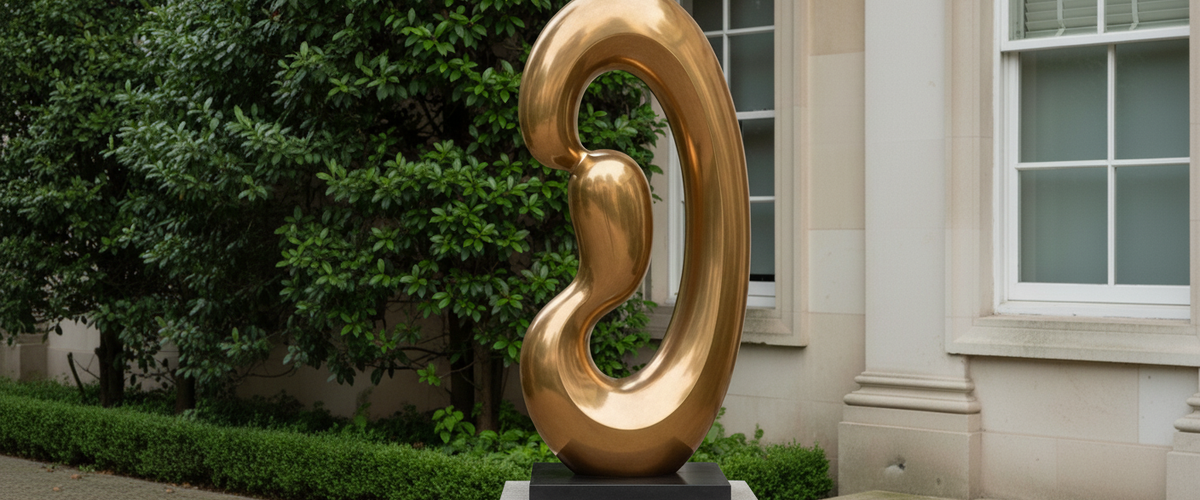
Start with the cleanest distinction. Modern art is a period term. It covers work made between roughly the 1860s and the late 1960s, from Manet through to the late Minimalists. Contemporary art is the work made after that, by artists who are still alive or were recently active. Abstract is neither a period nor a market category; it is a visual decision to step away from literal representation. A Henry Moore reclining figure is modern and semi-abstract. A photorealist bronze made last year is contemporary and figurative. A polished steel piece in a winery courtyard might be any of the three depending on who made it and when.
The reason this matters at the point of purchase: pricing, insurance, conservation advice, and resale all hinge on which bucket a work actually sits in. Calling a 2019 stainless steel commission "modern" because it looks like Brancusi is harmless in conversation and expensive in a contract.

What Is Modern Art, Really? The 1860 to 1970 Window
The conventional art-historical window for modern art runs from the realism of the mid-nineteenth century through to the conceptual turn of the late 1960s. Inside that century-long span sit Impressionism, Post-Impressionism, Cubism, Futurism, Constructivism, Dada, Surrealism, Bauhaus, Abstract Expressionism, and Minimalism. Museums like MoMA still organize their permanent collections around roughly that arc.
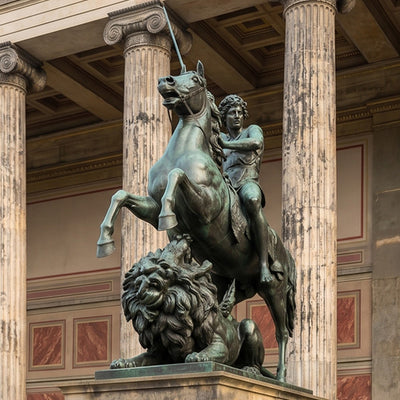
For sculpture specifically, the window is when the discipline shed its obligation to depict. Rodin loosened the surface. Brancusi reduced the form. Picasso welded scrap. Calder hung it from the ceiling. Moore drilled holes through the figure. By the time Donald Judd was stacking aluminum boxes, the rules of what a sculpture had to be had been comprehensively rewritten. That is what people mean, usually without knowing it, when they say a piece feels modern: it carries the visual logic of that hundred-year reinvention.

What Is Modern About Modern Art?
Three shifts define the period and still drive how collectors read a piece today.
The first is the move from depicting subjects to interrogating form. A modern sculpture is allowed to be about its own mass, balance, negative space, or surface, without needing a saint, a general, or a horse to justify it. The second is the embrace of industrial material. Bronze and marble stayed, but steel, aluminum, concrete, plywood, and welded sheet entered the studio on equal terms. The third is scale as content. A monumental Calder stabile is not just a big sculpture; the size is part of the argument. Those three shifts are why a modern piece reads instantly different from a Victorian bronze even when both are figurative.
Movements That Quietly Shape What People Call Modern Sculpture
You do not need to memorize the full chronology, but knowing which movement a silhouette is borrowing from will sharpen every conversation with a dealer.
- Cubist and Constructivist work gives us faceted planes, welded geometry, and the sense that a sculpture has been assembled rather than carved.
- Brancusi and the reductive tradition gives us the egg, the column, the bird-as-arc; pure forms in polished bronze or stone.
- Surrealism gives us biomorphic curves, melting silhouettes, and the dreamlike figure (think early Moore, Arp, Giacometti).
- Abstract Expressionism and post-war American sculpture brings welded steel, gestural assembly, and a raw, worked surface.
- Minimalism gives us the unembellished cube, the repeated unit, and the industrial finish.
Most "modern" sculptures sold today are descendants of one of those families, even when the piece itself was made last month.
How a Modern Piece Behaves in a Traditional Room (and Vice Versa)
The single most useful thing to understand before buying is how the piece will behave in the room it lives in. Modern sculpture tends to demand negative space around it. Drop a polished bronze ovoid into a fully decorated drawing room and it can read either as a witty correction or an awkward intrusion, depending entirely on the sightlines and how much breathing room it gets. The same piece in a minimal ski house disappears unless the scale is pushed up.
The reverse holds too. A figurative classical bronze in a stripped-back loft can carry remarkable gravitas precisely because the room is not competing. We have shipped a life-size figurative bronze to a client whose architect had spent two years removing every visible detail from the space; the piece became the room's only argument, and it worked.
Where the room's walls are doing most of the talking and a freestanding sculpture would crowd the floor, a graphic wall piece such as CineLuxe Modern Muse Black & White Fashion Portrait Wall Art carries the modern idiom in two dimensions without consuming the negative space a bronze would need.
Practical rules from the studio:
- Give a modern sculpture at least three times its own width as clear floor or surface around it.
- If the room has busy pattern or heavy joinery, push toward larger scale, not smaller. A tentative modern piece in a busy room looks like an accident.
- For outdoor placement, modern silhouettes read best against a single dominant texture (lawn, gravel, water, or a long stone wall), not against mixed planting.
Buying Modern Work Without Buying a Reproduction by Accident
This is where collectors lose money. The market is full of pieces that look modern, borrow a modern silhouette, and are sold with language that flirts with the period without ever quite claiming it. There is nothing wrong with a contemporary sculpture inspired by Brancusi or Moore. There is something very wrong with paying period prices for one.
A short due-diligence checklist:
- Ask who made it and when. A clear answer, with a date and a maker, is the floor. Vague provenance is a red flag.
- Ask about the edition. Modern bronzes are typically cast in numbered editions. A piece described as "limited" without an edition number and foundry mark is not really limited.
- Look for the foundry stamp. Reputable foundries sign their work. So do most serious contemporary sculptors.
- Check the material claims. Solid bronze, hollow cast bronze, bronze-finished resin, and cold-cast bronze are four different products at four different price points. The Getty Conservation Institute publishes useful background on how genuine cast metals behave over time.
- Ask what happens in thirty years. A real bronze develops patina you can conserve. A composite with a metallic coating does not.
For buyers who want the visual language of modern work without the auction-house premium, commissioning is often the honest answer. A bespoke piece, built in bronze, stainless steel, Corten, or stone, with documented provenance from day one, sidesteps the reproduction trap entirely. At Giant Sculptures we build large-scale commissions in exactly that idiom, with the engineering, foundry work, and installation handled as a single project rather than a stack of suppliers. Our modern art collection is a useful starting point for buyers who want to see the range before discussing a bespoke version.
What Are the Modern Arts, Beyond Sculpture?
Buyers sometimes ask whether the term covers more than painting and sculpture. It does. The modern arts, in the period sense, include painting, sculpture, printmaking, photography, architecture, ceramics, textiles, furniture, and graphic design, all reshaped by the same century of experiment. A Bauhaus chair, a Le Corbusier plan, a Lee Miller photograph, and a Brancusi marble all belong to the same conversation. That breadth is why a single modern sculpture can sit so naturally next to mid-century furniture, architectural lighting, or even a well-chosen contemporary LED piece: the underlying visual grammar is shared.
How to Sculpt Modern Art: The Studio View
For clients curious about how a modern commission actually gets made, the process is less mystical than the gallery framing suggests. It usually starts with a brief and reference imagery, moves to a small maquette in clay or 3D, then to a full-scale armature, then to casting or fabrication in the chosen material. Bronze goes through lost-wax casting and patination. Stainless steel is fabricated, welded, ground, and polished or brushed. Stone is roughed out with power tools and finished by hand. Each route has its own timeline, its own tolerances, and its own long-term behavior, which is why material choice should be settled before silhouette is finalized, not after.
Where the Modern Label Adds Value, and Where It Just Adds Price
To close the loop. The modern label adds genuine value when the work is from the period, by a documented maker, with a clear edition and conservation history. It adds reasonable value when the piece is a contemporary commission in the modern idiom, built in durable material, with provenance documented from the studio outward. It adds only price, not value, when the word is being used as a mood-board adjective to justify a markup on a decorative object with no maker, no edition, and no material honesty.
Budgets for serious modern sculpture vary widely depending on material, scale, engineering, finishing, and installation. Rather than chase a number online, the more useful move is to define the room, the sightlines, and the longevity you want, then ask for a tailored quote against that brief. That is the conversation where the word modern starts to mean something specific again.
For wider placement ideas, What Modern Art Actually Means When You're Buying Sculpture is useful companion reading before finalising the setting and sightlines.
For general conservation principles, V&A sculpture techniques is a useful external reference, though the final care routine should always follow the material and finish specified for the individual commission.