





































































































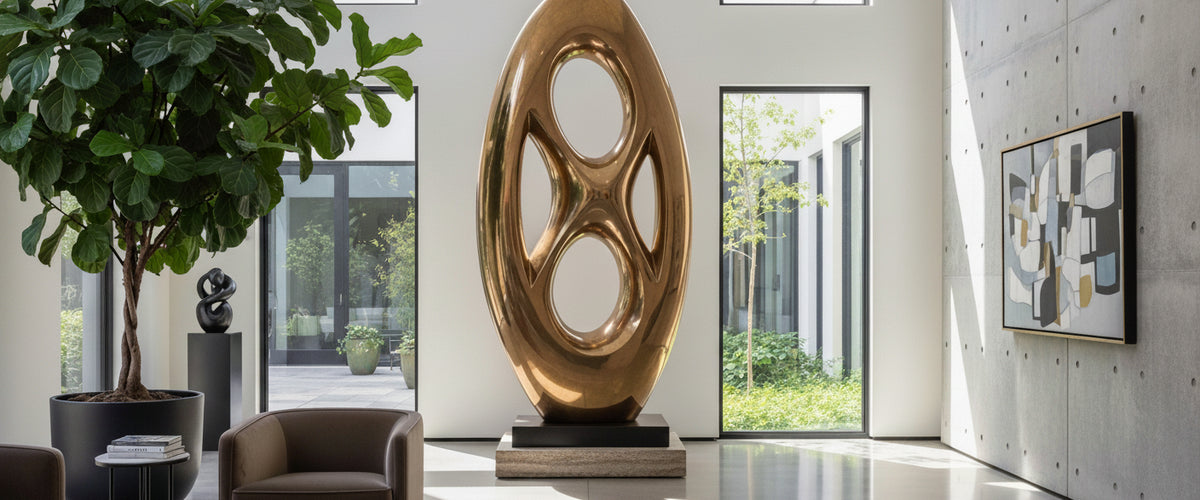

Half the pieces sold as "modern art" were made last Tuesday, and half were cast before your grandfather was born. The label has become so elastic that it tells a buyer almost nothing about what they are actually looking at. If you are spending serious money on a sculpture, you need a sharper vocabulary than the one most galleries use on their wall cards.
This is the conversation we have at the studio most weeks: a client points at a polished bronze abstract on our floor and asks whether it counts as modern art. The honest answer is yes and no, and the difference matters when you are commissioning a piece that will sit in your garden or lobby for the next fifty years.

Quick Answer: What Modern Art Means in Sculpture
- Modern art in the academic sense covers roughly 1860 to 1970, from Rodin's break with classical realism through Brancusi, Moore, Hepworth, Calder and the Minimalists.
- Contemporary art is everything made from around 1970 onward, including most of what living sculptors produce today.
- In the trade, "modern" is also used loosely to mean any clean, abstract, or non-traditional piece, regardless of date.
- For buyers, the useful question is not the label but the form, material, and intent of the work.
- A well-made modern sculpture in bronze, stainless steel, Corten, or stone should outlast the building it sits next to.

Modern vs Contemporary: The Distinction Dealers Keep Blurring
Art historians use "modern" to describe a specific period, not a style. It starts when sculptors stopped trying to make marble look like skin and started treating the material as the subject. Rodin left thumbprints in the bronze on purpose. Brancusi polished a bird down to a single curve. Henry Moore cut holes through reclining figures so you could see the landscape through the body. That is modern art in the textbook sense.
Contemporary art is what came after, and it is what most living artists make. The boundary is fuzzy on purpose, because mid-century figures like Louise Bourgeois kept working into the 2000s. The Tate's definition is a sensible reference if you want the museum line.
Here is what this means commercially. When a dealer in Aspen or the Hamptons describes a piece as "modern," they may mean it was made in 1955, or they may mean it looks clean and abstract. Ask. The provenance and the date change the value, the conservation needs, and often the engineering of the base.

The Materials That Defined Modern Sculpture
Modern sculptors were obsessed with material in a way their classical predecessors were not. The era opened up four categories that still dominate serious outdoor work today.
Bronze
Bronze remained the workhorse, but modern sculptors stopped hiding the casting process. Rodin's surfaces are rough on purpose. Moore's bronzes carry the texture of his plaster originals. A well-patinated bronze will sit outdoors for centuries with minimal intervention, which is why we still recommend it for any piece intended as a generational purchase. Our contemporary and modern sculptures collection leans heavily on bronze for exactly this reason.
Stainless Steel
Polished stainless became the signature material of late-modern and early-contemporary work. It reflects sky, foliage and architecture, which means the sculpture changes character through the day. The catch is that fingerprints, water spotting and minor scratches show on mirror finishes, so placement in a high-traffic courtyard needs thinking through.
Corten and Raw Steel
Weathering steel arrived with the Minimalists and stayed. The rust layer self-seals, the color shifts with the seasons, and the material reads as honest in a way that suits modern architectural homes in California or the Pacific Northwest. Specify drainage carefully; Corten bleeds rust onto pale stone for the first two years.
Stone and Marble
Hepworth and Noguchi both worked in stone, treating the block as something to negotiate with rather than impose on. For a buyer, stone is unforgiving on installation (a six-foot marble piece can weigh 2,000 lb / 900 kg) but rewards patience with surfaces that age beautifully.
Reading a Modern Piece: Form, Negative Space, and Intent
Classical sculpture is read through subject. You recognize Apollo, you note the contrapposto, you move on. Modern sculpture is read through three other things, and learning to see them changes what you buy.
Form is the silhouette and mass. A good modern piece looks resolved from at least four angles. Walk around it before you commit. If it collapses into a flat shape from one side, the sculptor has not finished the job.
Negative space is what the sculptor cut away. Moore's pierced reclining figures are the obvious example, but you see it in almost every abstract bronze worth owning. The void is part of the composition. When we are commissioning, we often spend more studio time on the openings than on the solid mass.
Intent is harder to articulate but easier to feel. Modern work usually has a clear formal idea behind it: a study of balance, a meditation on a single curve, a play between weight and lift. If the artist or the studio cannot tell you what the idea is in one sentence, the piece is probably decorative rather than serious.
Where Modern Sculpture Sits Well
Modern pieces want room. They were conceived for white-walled galleries and open lawns, not crowded interiors stuffed with antiques. A few placement principles we use with clients:
- Architectural homes in Napa, Marin, or coastal Connecticut read modern sculpture as an extension of their geometry. A polished bronze abstract on a low plinth at the end of a sightline works almost every time.
- Traditional gardens need careful handling. A modern piece in a formal English-style garden can work brilliantly as a deliberate counterpoint, but only at a scale that earns its place. Half measures look like a mistake.
- Commercial lobbies and hotel courtyards are natural homes for larger modern work. The scale of the architecture absorbs an 8 ft / 2.4 m piece without crowding.
- Sculpture should be sited, not stuffed in. Plan the approach: how the viewer first sees it, what is behind it, what time of day the light hits the front face.
If you want to browse pieces that already sit comfortably in these contexts, our modern art collection is a useful starting point before you commit to a commission.
Commissioning a Modern Work: What to Brief, What to Leave Open
The most common mistake we see is a client trying to art-direct every curve. Modern sculpture works because the artist resolved the form. If you over-specify, you end up with a committee decision in bronze. Here is the brief structure we recommend.
Specify Tightly
- Site: exact location, sightlines, surrounding materials, plinth height.
- Scale: overall height and footprint, with a clear maximum.
- Material and finish: bronze with a specific patina, mirror-polished stainless, Corten with a sealed base, and so on.
- Engineering constraints: wind loading for tall pieces, weight limits if the site is on a roof terrace, mounting and drainage details.
- Budget framework: bespoke modern work pricing depends on material, scale, complexity, engineering and installation; the studio will quote against your brief rather than a fixed list.
Leave Open
- The specific form. Give the artist a mood, a reference, a feeling, then step back.
- Surface detail. Tool marks, polish levels and patina depth are decisions best made at the maquette stage.
- Minor proportional adjustments. A good sculptor will refine the silhouette as the piece grows.
A bespoke commission with Giant Sculptures typically runs from initial brief through maquette, full-scale model, casting or fabrication, finishing, and installation. The earlier you involve the studio, the better the result, particularly on engineering-heavy pieces where the base and the form have to be designed together.
Buyer Checklist Before You Commit
- Confirm the date and provenance if the piece is described as "modern" in the historical sense.
- Walk around the work, or its maquette, from every angle.
- Ask what the formal idea is. Expect a clear answer.
- Match the material to the site: bronze and Corten for the long outdoor view, polished stainless for architectural courtyards, stone for sheltered settings.
- Plan the plinth and the approach before you sign off on the sculpture itself.
- Budget for installation. A 1,500 lb (680 kg) bronze does not arrive on a pallet truck.
- Get the conservation schedule in writing. Even bronze benefits from an annual wax.
Modern art, properly understood, is a discipline of restraint. The pieces that hold up over decades are the ones where the sculptor knew exactly what to leave out. When you are buying at this level, your job is to brief that restraint into being, then trust the studio to deliver it.
For wider placement ideas, Rustic vs Modern: Choosing the Right Iron Art Style for Your Space is useful companion reading before finalising the setting and sightlines.
For general conservation principles, V&A sculpture techniques is a useful external reference, though the final care routine should always follow the material and finish specified for the individual commission.