





































































































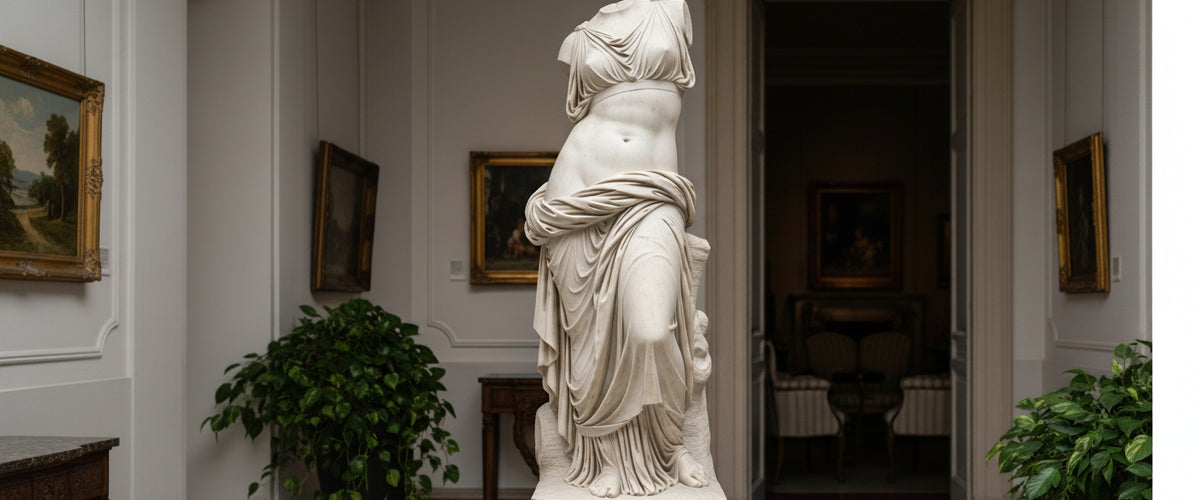

Marble is the most unforgiving material a buyer can choose, and the most rewarding. A poor block, a rushed carver or the wrong placement will show within a season. A good piece, sited well, will outlive everyone who argues about where to put it. If you are looking at marble sculpture for sale and the choice feels overwhelming, this guide is the conversation we usually have with collectors and designers before a commission begins.

Key Takeaways at a Glance
- Stone grade matters more than size. Statuario, Carrara and Calacatta behave differently under chisel and weather.
- Scale changes the rules. A 60 cm tabletop study and a 230 cm garden figure are different engineering problems.
- Indoor versus outdoor dictates finish, sealing and base design from day one.
- Antique, 19th century and modern pieces each carry different provenance and condition risks.
- Bespoke commissions usually take several months; build that into your project timeline early.

What Marble Sculpture for Sale Really Means
The phrase covers a wide range. At one end sits genuine antique marble sculpture, often 18th or 19th century, sold through auction houses and specialist dealers with documented provenance. At the other end sits new carving from working studios, either editioned figurative work or bespoke commissions to a client's brief. In between you will find modern marble sculpture for sale by living artists, kinetic marble sculpture for sale where balanced elements move with air or touch, and decorative pieces such as the marble pillow sculpture for sale that has become a fixture of contemporary interiors.
Each category attracts a different buyer. A collector chasing a 19th century marble sculpture for sale is buying art history and condition. A designer specifying for a Napa winery is buying scale, weather behavior and sightlines. A private client commissioning a memorial figure is buying a one-off object that has to mean something for decades. The questions you ask should match what you are actually buying.
How to Compare Marble Sculpture for Sale Options
Before you commit to a piece, run it through four filters: stone, hand, condition and paperwork.
Stone. Italian marble sculpture for sale is still the benchmark, and for good reason. Statuario from the Apuan Alps carves cleanly and holds fine detail in drapery and hair. Carrara is softer in tone, slightly more forgiving, and what most buyers picture when they think of classical work. Calacatta brings dramatic veining that suits modern, simpler forms. Greek Thassos and Portuguese Estremoz also turn up in the trade and have their own character. Ask where the block came from, not just where the carver is based.
Hand. Marble shows the carver. Look at the transition from a polished cheek to a chiselled curl, or the inside of a folded sleeve. Sharp undercuts, confident tool marks and crisp edges where soft meets crisp are signs of a maker who has done this for years. Flat, slightly soapy surfaces with no tonal shift usually mean heavy machine work followed by aggressive polishing to hide it.
Condition. For any antique marble sculpture for sale, ask for raking-light photographs and a written condition report. Hairline cracks across a wrist or ankle are common in older figures and not always a deal-breaker, but they affect value and need to be disclosed. Old repairs done with iron pins can rust and split the stone later; modern stainless pinning is preferable.
Paperwork. Provenance, export history and, for older works, any cultural property documentation. Reputable dealers and studios provide this without being asked.
Materials, Finishes and Scale Decisions
Finish is where a lot of buyers get it wrong. A high polish reads as luxurious in a showroom but can look plasticky on a figurative piece, flattening the modelling the carver worked hard to put in. A honed or satin finish keeps the depth in the form and ages more gracefully outdoors. For abstract marble sculpture for sale, polish can be the right call because it emphasises line and reflection rather than anatomy.
Scale is the other lever. A 160 cm figure reads as a human presence in a room, which is very different from a 230 cm piece that dominates a stair hall or courtyard. As a rule of thumb, anything under about 3 ft (90 cm) sits well on a plinth or console, 4 to 5 ft (120 to 150 cm) holds a garden alcove or interior corner, and anything above 6 ft (180 cm) starts to need architectural breathing room. Where a brief calls for a single dominant figure in a double-height entry or stair hall, a piece on the scale of the Classical Woman Lamp Marble Sculpture - 230cm needs a clear sightline from at least 15 ft (4.5 m) away to be read properly; crowd it and the modelling disappears.
Finish choice often follows from subject. Heavily draped figurative work like the Veiled Woman Marble Sculpture - 180cm argues for a honed surface rather than a mirror polish, because the eye needs tonal shift across the folds to read the veil at all. A high-gloss finish on the same form would close that depth down.
Weight matters too. Solid marble runs around 170 lb per cubic foot (about 2,700 kg per cubic meter). A life-size figure can easily clear 800 to 1,200 lb (360 to 545 kg). That has consequences for floor loading on upper levels, for crating, and for the crew you need on installation day.
Where to Place Marble Sculpture for the Strongest Impact
For wider placement ideas, What Is a Figurative Marble Sculpture? a Collector's Guide to Form, Stone and Placement is useful companion reading before finalising the setting and sightlines.
Indoors, marble likes natural light from the side. North light in a New York apartment, or filtered afternoon light in a Texas hill-country room, will pull every plane of the carving forward. Direct overhead downlights flatten the work; avoid them or balance with wall washers. Plinth height should put the focal point of the sculpture at roughly the average viewer's eye level, which for a seated study on the scale of the Seated Bathing Woman Marble Sculpture - 80cm usually means a plinth between 30 and 36 in (76 to 91 cm).
Outdoors, marble is more sensitive than buyers expect. It is calcium carbonate, which reacts with acid rain and pollution over time. The Smithsonian's conservation guidance on outdoor marble is worth reading before you site anything in a coastal or urban location (see the Smithsonian's Museum Conservation Institute). In practice, that means choosing a sheltered position, avoiding sprinkler overspray, and committing to gentle cleaning once or twice a year. A Hamptons garden under tree cover, an Aspen courtyard with snow management planned in, or a shaded Napa terrace all work well. An exposed Florida coastline does not.
For garden work, we often recommend siting a figure where it can be seen from inside the house as well as in the garden itself. A figure at the end of a lawn axis earns its keep all year, including the months no one is sitting outside, which is part of why a dynamic pose tends to outperform a static one in that role. The Garden Statues collection brings the outdoor-rated options together if you want to compare poses side by side.
Budget, Commissioning and Delivery
Honest answer: marble pricing depends on block size and quality, complexity of the carving, hours on the tools, base and pinning engineering, crating, freight and on-site installation. A small honed abstract from a single block is a different proposition from a life-size draped figure with undercut hands and a separately carved attribute. Rather than guess at a band, we quote each project after a short brief and reference images. To calibrate what is available off the shelf versus what needs commissioning, the Marble Sculptures and Statues collection is a good starting point.
Commissioning timelines usually break down roughly like this:
- Brief and references (1 to 2 weeks): mood, scale, setting photographs, any constraints.
- Concept sketches or a small maquette (2 to 6 weeks): the stage to make changes cheaply.
- Block selection: we choose and reserve the stone, and confirm veining and colour tolerance with you.
- Carving (typically several months for a life-size piece): progress photographs at agreed milestones.
- Finishing, sealing and crating: including base design if the piece will be installed outdoors.
- Freight and installation: sea or air to the US, then bonded customs clearance and white-glove delivery.
One lesson from a recent shipment to a private client in California: brief the installation crew on weight and access at concept stage, not on delivery day. We have rebuilt schedules around a staircase that turned out to be 2 in (5 cm) too narrow for the crate. Measure twice, ship once.
Buyer Mistakes Worth Avoiding
- Choosing on size alone. A 200 cm figure in a 12 ft (3.6 m) ceilinged room can feel oppressive. Match scale to the architecture, not the listing photo.
- Ignoring the base. A beautiful figure on a thin, underweight plinth looks unfinished and is a tipping hazard. Bases are part of the sculpture, not an afterthought.
- Outdoor placement without sealing. Unsealed marble in a frost-thaw climate will spall at the edges within a few winters.
- Skipping condition reports on any 19th century or antique piece.
- Buying on screen only for high-value works. Studio visits or detailed video walk-arounds are standard for a reason.
Care Checklist for Long-Term Ownership
For general conservation principles, V&A sculpture techniques is a useful external reference, though the final care routine should always follow the material and finish specified for the individual commission.
- Dust indoor pieces with a soft, dry brush or microfibre. Avoid household sprays; many contain acids that etch polish.
- For outdoor work, rinse gently with clean water and a soft brush in spring and autumn. The Getty Conservation Institute publishes useful background on stone care if you want to go deeper.
- Re-seal exterior marble every two to three years, or sooner in harsh climates.
- Inspect pins and fixings annually for any sign of staining around joints.
- Wrap and crate properly if the piece is being moved; marble does not tolerate point loads.
How Giant Sculptures Approaches Marble Commissions
We work with carvers in Italy and elsewhere who have spent decades in stone, and we project-manage from brief to installation. That includes block sourcing, engineering of internal armatures and pinning for large or extended poses, lighting advice, plinth design, export paperwork and US delivery. Whether the brief is a classical figure, a modern marble sculpture for sale, an abstract piece, or a kinetic study that needs precise balance, the process is the same: get the brief right, choose the right hand for the job, and pick a block worth the time it will take.
If you are weighing options now, start with the pieces on the site to calibrate scale and style, then talk to us about whether the right answer is one of those, a variation, or a full bespoke commission. Marble is a long conversation. We are happy to begin it.