



























































































A nine-foot stainless steel stag at the end of a Napa driveway does more work than any landscape lighting scheme or front-door upgrade. That is the quiet power of large metal animal sculptures: they fix a view, give a garden a heart, and tell visitors something specific about the people who live there. The trade-off is that getting one wrong, in scale, finish or siting, is an expensive mistake to live with. This guide is for buyers who want the piece to look right in year ten, not just on the day it lands off the truck.
Looking for the full range in this category? Browse our Garden Statues collection for every available finish, size, and configuration.

At a Glance: Choosing Large Metal Animal Sculptures
- Material: Bronze for heirloom warmth, stainless steel for sharp modernism, Corten for sculptural mass at a friendlier weight.
- Scale: Outdoor pieces almost always need to be larger than buyers first imagine. Plan for the sculpture to read from 60 to 100 feet (18 to 30 m) away.
- Placement: Anchor a long sightline, terminate an axis, or sit a piece where the eye already wants to rest.
- Engineering: Foundations, fixings and wind loading matter as much as the casting itself.
- Lead time: Commissioned work runs in months, not weeks. Budget time as carefully as money.

What Large Metal Animal Sculptures Actually Are, and Who They Suit
The phrase covers a wide spread of work: cast bronze stags and horses with classical modeling, mirror-polished stainless steel hares and elephants in the contemporary idiom, fabricated Corten steel bears and bison built up from cut plate, and the playful pop register of a large balloon animal sculpture in chromed finishes. What unites them is presence. Once a piece passes roughly five feet (1.5 m) in any direction and is rendered in metal, it stops being decoration and starts shaping the space around it.
The natural buyers are the people who own the view: ranch and estate owners in Texas and Montana, garden clients in the Hamptons and Aspen, hospitality groups commissioning lobby and forecourt pieces, and collectors building a sculpture walk through mature grounds. Architects and landscape designers tend to specify metalwork when they want a focal point that survives weather, kids, dogs and decades. Giant Sculptures works regularly with all of these audiences, and the brief tends to come back to the same three questions: which metal, how big, and where exactly does it stand.

Materials and Finishes: What Each Metal Actually Does Outdoors
Material choice is the first real decision, because it sets the visual register and the maintenance reality for the life of the piece.
Bronze
Bronze is the traditional answer for figurative animal work, and there is a reason it has held that position for several thousand years. Cast properly and patinated by hand, a bronze horse or stag develops a living surface that shifts with light and weather. A protective wax coat applied annually keeps the patina stable; left alone, bronze drifts toward green over decades, which some clients prize and others fight. The Getty Conservation Institute has good public material on outdoor bronze care if you want to understand what you are committing to.
Stainless Steel
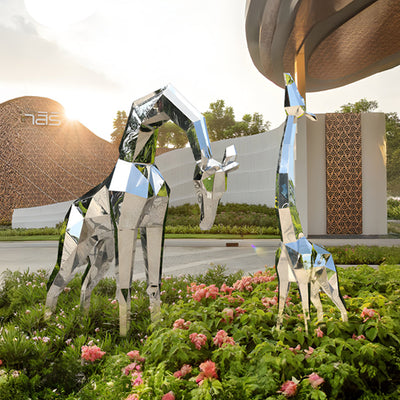
Stainless, especially 316 marine grade, is the contemporary workhorse. Mirror-polished, it throws sky and foliage back at the viewer and reads as pure form. Brushed or satin finishes calm that reflectivity and suit quieter gardens. Stainless is the right call for coastal sites in Malibu or Cape Cod where salt air would slowly chew lesser alloys. Pieces in the spirit of a balloon dog sculpture almost always live in stainless because that mirror finish is the whole point of the genre.
Corten and Fabricated Steel
Corten weathers to a deep oxide russet and then stabilizes, giving you sculptural mass at a lower weight than solid bronze. It pairs beautifully with prairie planting, gravel gardens and modern architecture in board-form concrete. Standard mild steel can be powder-coated in any color, useful for branded commercial commissions or for clients who want a graphic black or white silhouette against green.
A Word on Wood and Resin
Clients sometimes weigh metal options against large wooden animal sculptures, usually chainsaw-carved oak or cedar. Wood has real charm and a shorter life. Resin and composite pieces exist at lower budgets but rarely hold up at large outdoor scale over many winters. For a sculpture that has to anchor a garden for the next generation, metal is the honest answer.

Getting the Scale Right
The single most common mistake we see is buyers ordering a piece that looked enormous in the studio and lands looking modest in a 40-acre garden. Open sky and mature trees absorb scale ferociously. A useful test: stand where the sculpture will live, then walk to where the primary viewing point will be, often a terrace, kitchen window or driveway approach. If that distance is more than 50 feet (15 m), the sculpture probably needs to be at least life-size, and often larger.
For large outdoor metal animal sculptures, we usually push clients toward generous proportions. A standing stag that reads beautifully at seven feet (2.1 m) tall on a small lawn would look apologetic on a Napa hillside. Indoor commissions move the other way: a polished steel hare at four feet (1.2 m) in a double-height entrance hall can do as much work as a twelve-foot piece outside.

Placement: Where the Sculpture Earns Its Keep
For wider placement ideas, Animal Sculpture: Ideas, Materials, Placement and Buying Tips is useful companion reading before finalising the setting and sightlines.
Large animal garden sculptures work hardest when they sit at the end of an existing sightline rather than competing with the architecture. Some patterns we return to:
- Axial terminus: At the end of a long lawn, allee or pool, where the eye naturally travels.
- Arrival moment: Set back from a driveway curve, glimpsed and then revealed.
- Threshold pair: Two pieces, usually matched or mirrored, framing an entrance or gate.
- Wild placement: A bronze bear half-hidden in a wooded edge, encountered rather than displayed.
- Water edge: Stainless or mirror-finished work near a pond or pool, doubled by reflection.
Avoid the center of an open lawn unless the piece is genuinely monumental. A sculpture marooned in the middle of a flat green field reads as smaller than it is. Give it something to relate to: a hedge line, a tree group, a change in level, a path.

Engineering, Foundations and the Bits No One Photographs
A large piece is only as good as what holds it down. For most large outdoor animal sculptures we specify a reinforced concrete pad below grade, with stainless steel studs or a flange plate engineered to the work's weight and sail area. Wind loading matters more than most clients expect: a tall, broadside animal like a horse or moose catches gusts the way a sail does. In hurricane and high-wind zones (parts of Florida, the Carolinas, the Gulf), engineering calculations should be signed off before the foundation is poured.
Ground conditions vary. Sandy soils in the Hamptons behave differently from the clay around Dallas or the decomposed granite of much of the West. A short site visit, or at minimum good photographs and a soil note, lets us size the pad properly the first time.
Budget and Commissioning: How to Think About Cost
We are deliberately careful with numbers here because every commission is different. The honest variables are material (bronze tends to sit highest because of casting and metal cost, Corten lowest), scale, complexity of the animal (a coiled snake is easier than a rearing horse), surface finish, engineering, crating, shipping and on-site installation. A small edition piece from stock is one conversation; a one-off ten-foot commissioned bronze with a custom patina is another. Ask for a tailored quote rather than trusting any online price you see for "similar" work; the variation is enormous.
What you should expect from a serious supplier:
- A written brief sign-off before any modeling begins.
- Maquette or 3D visualization stage with revisions built in.
- Clear milestones for clay or digital model approval, casting or fabrication, finishing, and crating.
- Documented engineering for the fixing detail.
- White-glove delivery and installation, or a clear handover to a local rigger.
How Giant Sculptures Approaches Bespoke Animal Work
Most of our commissioned pieces begin as a conversation about a specific place. A client sends photographs of the site, sometimes a survey, and a sense of the animal and posture they want. From there we develop a maquette, agree material and finish, and move into full-scale modeling and casting or fabrication. We ship worldwide, and a meaningful share of our work travels to the US, so crating, customs and inland freight are familiar ground rather than an afterthought. You can browse the broader metal sculptures catalog for a sense of finish quality, and the animal sculptures collection for figurative range, but the strongest large metal animal sculptures we make tend to be the ones that never appear on the website because they were built for one specific garden.
One recent lesson worth passing on: a client in Colorado asked for a stainless steel elk at what they thought was an ambitious size. We pushed for an additional eighteen inches in height after seeing the site. On install day they admitted it was still, if anything, slightly under-scaled for the view. Generosity of scale almost never reads as a mistake outdoors. Restraint almost always does.
Buyer Checklist Before You Commission
- Have you photographed the site from every likely viewing point, including upstairs windows?
- Do you know the prevailing wind direction and worst-case wind speeds?
- Is the access route wide enough for a crated piece on a flatbed and a small crane?
- Have you decided whether you want the patina or finish to age, or to be maintained as-new?
- Is there a power source nearby if you plan to light the sculpture?
- Have you agreed who handles annual maintenance, and what that involves?
- Have you allowed realistic lead time, typically several months for a true commission?
Get those answers in place and the rest of the process, choosing the animal, the metal, the pose, becomes the enjoyable part. Which is, after all, the reason most clients commission large metal animal sculptures in the first place.
For general conservation principles, Canadian Conservation Institute outdoor object care is a useful external reference, though the final care routine should always follow the material and finish specified for the individual commission.