



































































































Most geometric wall art fails for the same boring reason: it is too small for the wall it sits on. A 24-inch (61 cm) panel above a 9-foot (2.7 m) sofa reads like a postage stamp, no matter how clever the pattern. Get the scale right and a geometric piece can anchor an entire room, soften a hard architectural shell, or carry a double-height stairwell on its own. Get it wrong and you have spent good money on visual clutter.
Looking for the full range in this category? Browse our Metal Wall Art collection for every available finish, size, and configuration.
This guide is written for buyers, designers and architects who want a geometric wall art piece that earns its place. We cover what the category actually means, how wood, metal and mirrored finishes behave over time, where these works land hardest visually, and what to expect when you commission a bespoke piece through Giant Sculptures.

At a Glance: Geometric Wall Art Key Takeaways
Scale first. Aim for roughly two-thirds the width of the furniture below, or 60 to 75 percent of the wall it sits on.
Material drives mood. Wood feels warm and tactile, metal feels architectural, mirrored finishes feel light and reflective.
Depth matters. 3D relief and faceted surfaces throw shadows that flat prints cannot match.
Bespoke beats off-the-shelf when you have an unusual ceiling height, a curved wall, or a specific color story to honor.
Budget is driven by material, size, complexity of geometry, finishing and installation. Ask for a tailored quote rather than assuming a price band.

What Geometric Wall Art Actually Means
The term covers a wide family. At one end, you have crisp minimalist geometric wall art: a single circle, a grid of squares, a quiet tessellation in one tone. At the other end, abstract geometric wall art layers triangles, arcs and faceted relief into something closer to sculpture than picture. Most pieces sit somewhere between, using repeated shapes (hexagons, diamonds, concentric rings, parametric waves) to create rhythm without imagery.
Geometric abstract wall art works well in interiors that already lean modern, but it also pulls its weight in transitional and even classical rooms. A faceted wood panel above a carved console can settle the conversation between old and new better than another landscape painting would. The geometry reads as pattern, not statement, which is why it ages so well.
Who is it best for? Buyers who want presence without narrative. Collectors who already own figurative work and want a counterweight. Hospitality designers who need a piece that flatters multiple guests rather than one taste. Architects finishing a project where a representational artwork would compete with the building.

Materials and Finishes: Wood, Metal, Mirror
Geometric Wood Wall Art
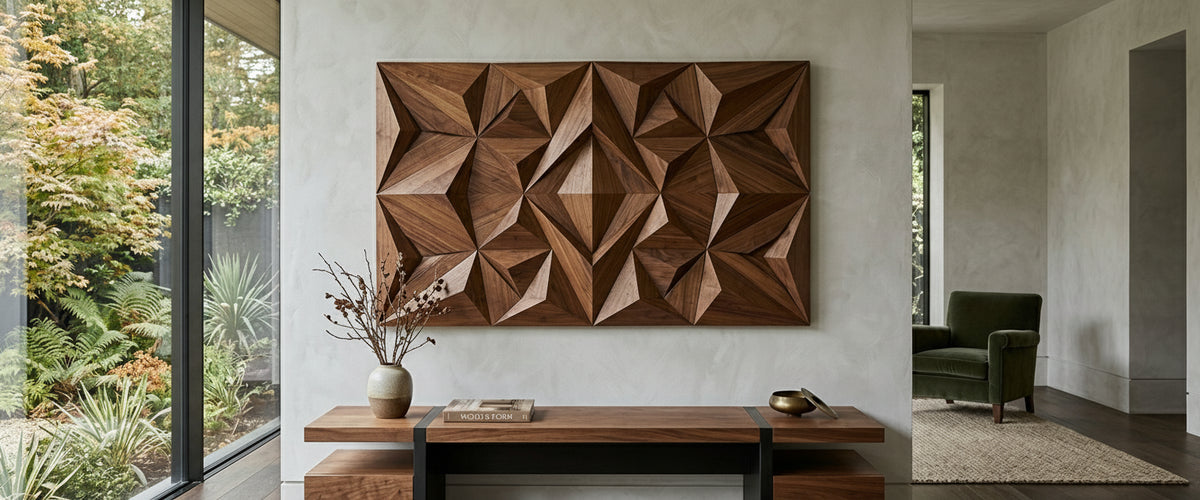
Wood is the most forgiving material in this category. It absorbs light rather than bouncing it, which softens a room and stops the geometry from feeling cold. Carved wood wall art in geometric forms (faceted reliefs, layered slats, parametric curves) brings depth that flat painting cannot. A horizontal relief such as the Varelo Horizontal Geometric Relief 3D Wall Art uses that depth to create shadow play that shifts through the day as the sun moves, which is behaviour you simply cannot get from a printed canvas.
Practical points for wood wall art geometric pieces: keep them off walls that get direct, prolonged sun unless the finish is UV-rated, and avoid bathrooms or unheated rooms where humidity swings will move the timber. Hardwoods carved as relief are stable in normal interior conditions and only need a soft dust now and then. The American Institute for Conservation publishes guidance on humidity ranges for wood objects in domestic interiors if you want to go deeper.
Geometric Metal Wall Art
Metal reads as architecture. Brushed stainless, blackened steel, brass and copper finishes all give geometric metal wall art a precision that wood cannot match. Edges stay sharp. Reflections are crisp. The piece feels engineered, which suits offices, lobbies, kitchens and modernist living rooms. Where the setting calls for a more graphic, high-contrast piece rather than the warmth of carved timber, an acrylic-and-metal composition like the Orbit Multicolor Geometric Acrylic 3D Wall Art is closer to the right design language.
The trade-off is that metal records every smudge and every screw. Installation needs to be exact. A geometric metal panel hung half an inch out of true will read as a mistake from across the room, where the same fractional error in a softer wood piece would be invisible. For larger metal works we recommend a French cleat or recessed mounting bracket fitted by a professional, especially when the piece weighs more than 30 pounds (about 13.5 kg).
Mirrored and Mixed-Material Pieces
Mirrored geometric wall art is the trickiest category to specify well. Done correctly, it doubles the apparent light in a room and gives a faceted, almost crystalline quality. Done badly, it reflects something ugly: a ceiling vent, a TV cable, the back of a lamp. Before you commission a mirrored piece, stand on the spot where it will hang and look at what the mirror will actually show. If the answer is a blank ceiling or a window onto a garden, you are in good shape. If it is the kitchen extractor, choose another material.
Mixed-material works (wood with metal inlay, painted relief with a brushed copper accent) sit in a useful middle ground. A piece like the Prismetal Copper Flow Wood Carving 3D Wall Art shows how a metallic flow line through a carved wood ground can break the geometry without losing its discipline.

Scale: The Decision Most Buyers Get Wrong
We see the same pattern every week. A client measures the artwork on a website, decides it looks generous on screen, and then unboxes something that feels lost on a 15-foot (4.6 m) wall. Geometric pieces are especially vulnerable to this because the repeating pattern needs room to read.
A working rule for scale:
Above furniture: the artwork should be 60 to 75 percent of the width of the sofa, console or bed below. A 96-inch sofa wants an artwork around 60 to 72 inches wide.
On a feature wall: aim for the piece to fill 60 to 75 percent of the available wall width, with breathing room on either side.
In a double-height space: think vertically. For a stairwell or tall entryway where horizontal works disappear, a vertical relief such as the Varelo Vertical Geometric Relief 3D Wall Art carries the height in a way a square panel cannot.
For grouped installations: treat the group as a single shape and apply the same percentages.
Ceiling height changes everything. A 7-foot 6-inch (2.3 m) ceiling will not hold a 6-foot-tall vertical piece without looking compressed. Conversely, a 12-foot (3.7 m) ceiling makes a 3-foot panel look like a placemat.
Placement: Where Geometric Wall Art Earns Its Keep
For wider placement ideas, 3d Metal Wall Art: A Buyer's Guide to Scale, Finish, and Placement is useful companion reading before finalising the setting and sightlines.
The strongest places for a geometric piece are not always the obvious ones. Above the sofa is the default; it is also the most predictable. Some of the best installations we have shipped have gone to less expected walls.
A faceted wood relief at the end of a long hallway turned a dead corridor into a destination. A blackened steel hexagonal panel anchored the wall behind a dining table where a mirror used to live, and quieted the room because it stopped reflecting motion. A mirrored diamond array in a pool house caught water reflections and threw them back onto the ceiling.
Other walls worth considering: the long wall in an open-plan kitchen-living space, the wall facing the front door (the first thing every guest sees), the wall above a fireplace where the mantelpiece sets a clean horizontal line, and the wall at the top of a staircase where the eye lands naturally.
Avoid: walls behind televisions, walls that hold a thermostat or light switch in an awkward place, and walls that get direct afternoon sun for several hours unless the material is rated for it.
Budget, Commissioning and Delivery
Budget for geometric wall art depends on material, size, complexity of the geometry, finishing and installation. A modest hand-carved wood panel sits at one end of the spectrum; a five-foot mirrored or mixed-metal commission with bespoke color matching sits at the other. Rather than chase a price band, send us the wall dimensions, a photo of the room and any color or material constraints, and we will quote against the actual brief.
For bespoke commissions, expect the following stages: brief and reference gathering, concept sketches or renders, material and finish samples, production, finishing, crating and freight. Lead times vary by material and complexity. Wood reliefs and metal panels generally move faster than mirrored or mixed-material commissions, which involve more finishing steps.
Delivery is the stage buyers underestimate. Large geometric pieces ship crated, often on a pallet, and need either two-person delivery or a small install crew. Confirm doorway widths, stairwell turns and elevator dimensions before production starts. We have re-routed more than one shipment because a client's freight elevator turned out to be two inches too narrow on the diagonal.
How Giant Sculptures Approaches Bespoke Geometric Wall Art
Giant Sculptures is a bespoke sculpture studio working at scale, which means most of our geometric wall art briefs start with an unusual constraint: a curved wall, a 20-foot atrium, a brand color that has to be matched exactly, or a tessellation that has to align with a specific architectural module. Off-the-shelf pieces rarely solve those problems. Bespoke does.
Our process starts with the wall, not the artwork. We ask for photographs, dimensions, lighting conditions and the rest of the room's palette. From there, our design team proposes geometry, material and finish options, and we sample before we commit. For abstract geometric wall art at architectural scale, we engineer the mounting system as part of the commission so that installation is a single clean afternoon rather than a week of improvisation.
If you want to see the range before commissioning, the Geometric Art collection shows current pieces across wood, metal and mixed materials. The 3D Wall Art collection is the right place to start if depth and shadow play matter more to you than pattern alone.