























































































Most garden statues fail for one of two boring reasons: they are too small for the space, or they are made of something that looks tired after two winters. Neither problem shows up in a product photo. Both show up in your garden. If you are browsing garden statues for sale and want a piece that still earns its place a decade from now, the decisions that matter happen before you add anything to a cart: material, scale, and where the thing actually stands.
We ship large-scale work from our studio to private gardens, estates and commercial sites across the US and beyond, so this guide is written from what we see go right and wrong in real installations, not from a catalog description.

Garden Statues for Sale: Key Takeaways
- Material decides longevity. Bronze and stainless steel handle decades outdoors; softer stone and cast composites need more thought and, often, more care.
- Scale is the number one mistake. A statue that looks large indoors usually reads as small in an open garden. Buy bigger than instinct suggests.
- Placement is a design decision, not an afterthought. Sightlines, backdrops and approach paths do more for impact than the sculpture alone.
- Budget depends on the piece. Material, size, engineering, finishing and installation all move the number, so a tailored quote beats any published range.
- Bespoke is worth considering when scale, subject or site is unusual. Off-the-shelf is fine when it genuinely fits.

What "Garden Statues for Sale" Really Covers, and Who It Suits
The phrase spans everything from a knee-high cast figure to a life-size bronze that anchors an entire lawn. For our clients, garden statues for sale usually means a considered focal piece: something bought once, placed deliberately, and kept. Private collectors want a signature at the end of a view. Landscape designers want an element that resolves a composition. Venue and estate owners want a piece that reads at distance and survives public exposure.
If you want a quick decorative filler, a small ornament from a garden center will do. If you want a sculpture that behaves like architecture in your garden, holding a space and improving with age, you are in the territory this guide is written for. Our garden statues collection sits at that end of the market, and it rewards a slower buying process.

How to Compare Garden Statues for Sale Before You Buy
Run every candidate through four questions before price enters the conversation.
Will it survive your climate? Freeze-thaw cycles, coastal salt air and harsh sun are the three big destroyers. Bronze shrugs off most of them. Marble and limestone are beautiful but porous, and water sitting in carved detail can crack over repeated freezes. If you are in the Northeast or mountain West, material choice narrows fast.
Does the scale match the site, not the showroom? Open sky and lawn swallow objects. A figure that feels commanding in a studio can vanish on a wide Napa terrace. We routinely advise clients to size up one full step from their first instinct.
Is the finish honest? A good bronze patina is chemically bonded and sealed, not painted on. A quality stainless piece is properly welded and polished, not filled and sprayed. Ask what is underneath the surface.
Can it be installed properly? Weight, base type and ground conditions determine whether a piece needs a concrete footing, a hidden steel plate or a crane on delivery day. A sculpture that cannot be anchored safely is not really available to you; it is a problem waiting to tip over.

Materials, Finishes and Scale Decisions
Material is where most of the long-term value lives, so it deserves more than a glance.
Bronze
Bronze is our default recommendation for permanent outdoor figures, and for good reason. Cast bronze has been used for outdoor monuments for centuries and develops a protective patina that actually shields the metal beneath. The Smithsonian's outdoor sculpture conservation work exists precisely because well-made bronze is expected to last generations with modest care. For a classical figure that needs to hold fine detail through decades of weather, a piece like the Life-Size Classical Seated Mermaid on Rock Bronze Sculpture - 200cm at 200cm shows the point of bronze: the same casting quality that captures a face also resists the elements.
Stainless steel and Corten
For contemporary gardens, polished stainless steel and weathering (Corten) steel are the strong choices. Stainless reflects sky and planting, so it changes through the day. Corten forms a stable rust-toned surface that suits naturalistic and modern schemes alike. Both are structurally forgiving at large scale, which matters when a piece needs to read from 100 feet (30 m) away.
Stone and marble
Carved marble and stone bring a classical weight nothing else matches. The trade-off is care. Porous stone wants sealing, drainage and, in hard-frost regions, sometimes winter protection. Placed well, in a sheltered courtyard or a mild California garden, stone ages gracefully.
Scale, in plain numbers
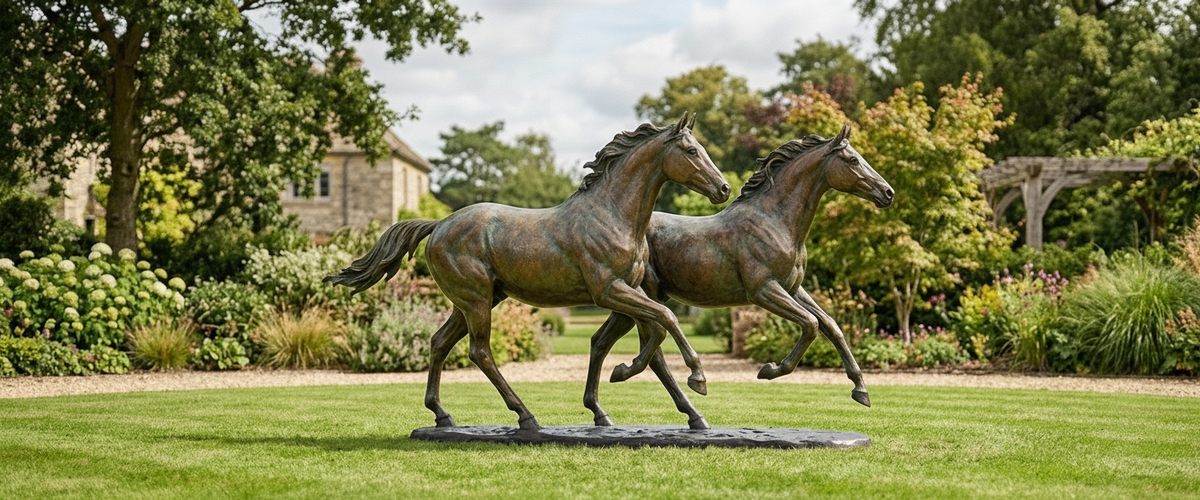
As a rough guide, a lawn focal piece usually wants to stand at least 5 to 6 feet (1.5 to 1.8 m) to hold its own, and larger for long approaches. Paired and grouped pieces can go bigger still because the eye reads them as a set. Where a single figure would ask too much of an open lawn, a paired composition like the Large Contemporary Cantering Horse Pair Bronze Sculpture - 180cm at 180cm carries the space more comfortably, because two figures create movement and mass together.
Where to Place Garden Statues for the Strongest Impact
For wider placement ideas, Bronze Garden Statues: A Buyer's Guide to Scale, Finish, and Placement is useful companion reading before finalising the setting and sightlines.
Placement is half the purchase. A superb sculpture in the wrong spot underperforms a modest one placed with intent.
End a sightline. The strongest position is the natural stopping point of a view: the end of a path, the far side of a lawn, the axis from a main window. The eye travels, then lands.
Give it a backdrop. A dark hedge behind a pale stone figure, or open sky behind a polished steel piece, sharpens the whole thing. Busy planting directly behind a detailed bronze fights it.
Use water where it fits. Movement and reflection do a lot of work. Near a pond or pool, a piece with implied motion such as the Large Contemporary Leaping Dolphins Bronze Sculpture - 300cm at 300cm reads as though it belongs to the water rather than sitting beside it. If you want the sound and motion too, our garden fountains and water features range shows how sculpture and water can be planned together rather than bolted on.
Mind the approach. How you walk toward a piece matters as much as how you see it from the house. A statue revealed around a corner has more impact than one visible from everywhere at once.
One lesson from an installation we handled for a Hamptons garden: the client had chosen the right sculpture but positioned it dead center on a wide lawn with nothing behind it. Moved 20 feet toward a mature hedge line, the same piece suddenly looked deliberate and grounded. Nothing changed but the backdrop.
Budget, Commissioning and Delivery
There is no honest flat price for garden statuary, and anyone quoting one before knowing your piece is guessing. Cost is driven by material, size, casting or fabrication complexity, surface finishing, base engineering and installation access. A large bronze with intricate detail carries more foundry labor than a simpler form of the same height. The sensible move is to shortlist pieces you like, then request a tailored quote so the number reflects the actual work.
Delivery is its own line item worth planning early. Large-scale sculpture is heavy and often needs specialist handling, palletized freight and sometimes lifting equipment on site. Tell us about gate widths, ground conditions and access before delivery day, not on it. A tall piece needs both a proper footing and a clear route in; getting that wrong is the most avoidable delay we see.
Where to Find Unique Garden Statues, and How Giant Sculptures Helps
Genuinely unique garden statues for sale tend to come from makers who cast and fabricate at scale rather than resellers moving generic stock. At Giant Sculptures we work as a bespoke sculpture supplier: we hold a large catalog of finished bronze, stone and metal pieces, and we commission new work when a client's site or idea calls for something that does not exist yet.
Bespoke makes sense when your space has unusual proportions, when you want a subject or pose that is not in any catalog, or when a piece needs to match existing architecture or a family motif. We have taken commissions from a rough sketch and a set of site photos through to a finished cast figure installed and anchored. For collectors who want to browse first, the large garden statues and bronze garden statues collections are the best starting points, and any of those forms can usually be adapted in size or finish.
A Quick Buyer's Checklist
- Confirm the material suits your climate and exposure.
- Size up one step from your first instinct; measure the site, not the showroom.
- Choose a placement with a clear sightline and a supportive backdrop.
- Ask how the finish is applied and sealed.
- Plan the footing, anchoring and delivery access early.
- Request a tailored quote rather than trusting a published price.
- Consider a bespoke commission if nothing off-the-shelf truly fits.
Buy on those terms and the sculpture stops being an ornament and starts doing structural work in your garden, the kind you notice every day and never tire of.