





































































































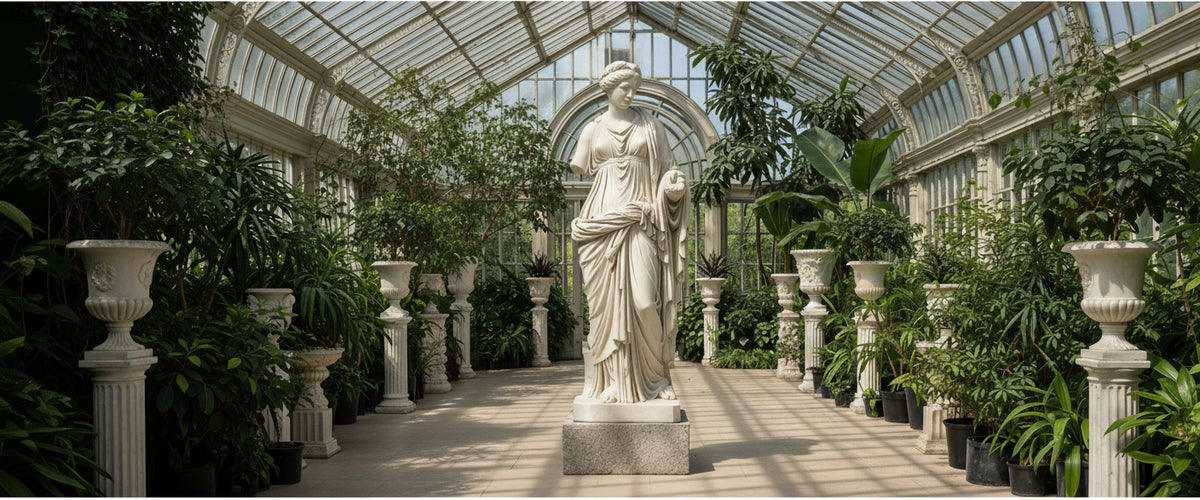

Most classical statues fail in private homes for one reason: they are too small. A 3 ft Venus tucked beside a 9 ft hedge looks like a garden gnome with ambition. Get the scale right, however, and a single carved marble figure can anchor an entire courtyard, terrace or gallery wall. This guide is for buyers who want classical statues to do real architectural work, not just sit politely on a plinth.

Quick Answer: What to Know Before You Buy
- Period matters. Classical Greek statues (roughly 480 to 323 BC) favour contrapposto, idealised anatomy and restrained drapery. Classical Roman work leans into portraiture, armour and narrative reliefs.
- Marble is the default, but not the only option. Bronze, cast stone and Corten reinterpretations all have a place outdoors.
- Scale should respond to its surroundings. As a rule of thumb, a freestanding garden figure wants to read at roughly two-thirds the height of the nearest vertical feature.
- Bespoke is often cheaper than you think once you compare it to importing a stock piece that almost fits.
- Plan the base and the route in before you fall in love with the figure.

What "Classical Statues" Actually Means
The phrase gets used loosely. Strictly, classical period statues refer to Greek sculpture between the end of the Archaic period and the death of Alexander the Great, with Roman copies and adaptations extending the tradition for centuries afterward. A dominant characteristic of statues of the classical period is the shift away from rigid frontality toward naturalism: weight shifted onto one leg, the hips and shoulders angled in opposition, drapery that suggests the body beneath. The Metropolitan Museum's overview of Greek art is a useful primer if you want to sharpen your eye before commissioning.
For buyers, the practical takeaway is this. When you say you want a classic statue, decide whether you mean Greek classical statues (idealised gods, athletes, draped women), Hellenistic drama (the Laocoön school), Roman portraiture, or the Neoclassical revival of the 18th and 19th centuries. Each reads very differently in a Napa courtyard or a Manhattan entry hall.
Who Classical Statues Suit Best
They reward formal architecture: symmetrical facades, axial gardens, colonnades, double-height entry halls. They also work as deliberate contrast inside very modern interiors, where a single carved marble figure against board-formed concrete becomes the only ornament in the room. Where they struggle is in busy, eclectic settings; the figure starts to compete instead of compose.
Materials and Finishes: What to Specify
Material choice drives cost, weight, longevity and how the piece weathers over decades. The four we work with most often:
- White marble (Carrara, Statuario, Bianco P). The canonical choice. Cool, luminous, takes fine carving for hair, drapery and fingernail detail. Best in sheltered courtyards, loggias or interiors. In freeze-thaw climates it needs siting care.
- Bronze. The serious outdoor answer. A correctly patinated bronze figure will look better at 50 years old than at five. Allow for weight: a life-size bronze can run 600 to 900 lb (270 to 410 kg) before the base.
- Cast stone and reconstituted marble. Sensible for larger garden ensembles where multiple matching figures are needed. Honest about what it is; do not pretend it is hand-carved.
- Corten and stainless steel reinterpretations. For clients who want classical silhouettes but a modern material conversation. We have shipped Corten torsos to desert properties where white marble would have glared.
On finish, decide early whether you want a high polish, a honed matte surface, or a deliberately aged patina. The American Institute for Conservation's outdoor sculpture guidance is worth reading before you commit to anything that will sit in full sun and rain.
Getting the Scale Right
This is where most buyers slip. A 4 ft figure looks generous on a coffee table render and lost in a real Hamptons garden. Some working numbers from commissions we have delivered:
- Tabletop or console: 18 to 30 in (45 to 75 cm). For studies, libraries, gallery shelving.
- Entry hall or stair landing: 4 to 6 ft (120 to 180 cm). Should clear the head height of an average adult on approach.
- Courtyard or terrace centerpiece: 6 to 8 ft (180 to 245 cm) including base. Read against surrounding planting and architecture.
- Axial garden focal point: 8 to 12 ft (245 to 365 cm). Anything less disappears down a 100 ft sight line.
For a podium in an entry hall or a niche in a library, a piece in the range of the Classical Female Figure in marble at 120 cm sits comfortably with normal ceiling heights without crowding the room. Push the same composition to 3 m and the calculation changes entirely; something like the Classical Woman Five-Arm Lamp Marble Sculpture - 300cm is built for an axial corridor, a grand stairwell or a hotel lobby where it has both height and a working architectural function as a light source.
Placement: Where Classical Statues Earn Their Keep
For wider placement ideas, Contemporary Sculpture: A Buyer's Guide to Materials, Scale, and Placement is useful companion reading before finalising the setting and sightlines.
Formal Gardens
Classical garden statues do their best work at the end of a sight line, at the intersection of paths, or framing a flight of steps in pairs. Symmetry is your friend; classical figures were designed for it. Plant low and architecturally at the base (boxwood, lavender, clipped yew) so the figure reads cleanly against foliage rather than fighting it.
Pool Surrounds and Loggias
Seated figures suit covered loggias and pool houses where they read at eye level from a lounger, and where a standing figure would feel imposing in a setting meant for rest. Where a reclined or seated pose is the better answer, the Seated Classical Woman Marble Sculpture - 130cm is closer to the right register than a full-height standing figure on a plinth. Avoid placing marble directly in chlorine splash zones; the salts will dull the surface over time.
Interior Halls and Stairs
Double-height entrance halls in the California and Texas houses we have shipped to often have one perfect spot, usually under a chandelier or at the bend of a stair, where a 6 to 7 ft figure becomes the room's reason for being. A classical lamp sculpture, where the figure holds a working light source, doubles up usefully here.
Commercial and Hospitality
Hotels, private members' clubs and restaurants use classical statues to signal permanence. The trick is to commit. One serious 8 ft figure beats four small ones every time.
Budget, Commissioning and Delivery
We deliberately avoid quoting bands because the same brief can swing wildly depending on six variables: material, scale, complexity of carving, engineering for the base, finishing, and shipping route. A 6 ft hand-carved marble figure in Statuario with detailed drapery sits in a very different place than a 6 ft cast version of a simpler pose. Request a tailored quote and you will get a real number, not a guess.
What to Brief the Studio
- Final installed height including plinth.
- Indoor or outdoor, and the climate zone (freeze-thaw, salt air, desert UV).
- Reference images, ideally three to five, showing the pose, drapery style and finish you respond to.
- Site photos and a basic floor plan or garden layout.
- Access constraints: door widths, stair turns, crane access, HOA rules.
Delivery Realities
A life-size marble figure typically ships in a custom timber crate on a wooden pallet, often 1,000 to 1,500 lb (450 to 680 kg) all in. Most clients underestimate the last 50 ft of the journey: getting from the truck to the plinth. We always ask for site photos and a route walkthrough before we confirm a ship date, because a beautifully crated 8 ft figure that will not fit through a 30 in side gate is everyone's problem.
Common Buyer Mistakes
- Buying the figure before designing the base. The plinth is half the composition. It needs to relate to nearby coping, paving or skirting.
- Mixing periods carelessly. A Greek classical Aphrodite next to a Baroque cherub next to an Art Deco torso reads as a junk shop, not a collection.
- Ignoring sight lines. Walk the approach. Where will guests first see the piece? Where will they see its back?
- Underestimating lighting. A classical figure with no night lighting disappears for half its life. Specify uplighting at the commissioning stage.
- Skipping the maintenance conversation. Marble outdoors needs annual cleaning and occasional consolidant treatment. Bronze needs wax. Plan for it.
How Giant Sculptures Approaches Bespoke Classical Commissions
Most of what we ship is either a scaled adaptation of a recognised classical work or an original figure designed in a classical idiom for a specific site. The process usually runs: brief and reference, CAD or clay maquette for sign-off, full-scale carving or casting, finishing, crating and white-glove delivery. We work in marble, bronze, cast stone and Corten, and we will tell you honestly when a material is wrong for your site rather than take the order.
If you are starting research, the classic sculptures collection and the marble sculptures collection are the most useful starting points for shaping a brief. Save three or four pieces you respond to and send them across with your site photos; that is enough for us to come back with a real direction.
Final Thought
Classical statues are one of the few decorative decisions that genuinely outlast the people who commission them. Buy with that timescale in mind. Choose the material that will still look right in 40 years, the scale that respects the architecture you already have, and the maker who will tell you when you are wrong. The piece will do the rest.