





































































































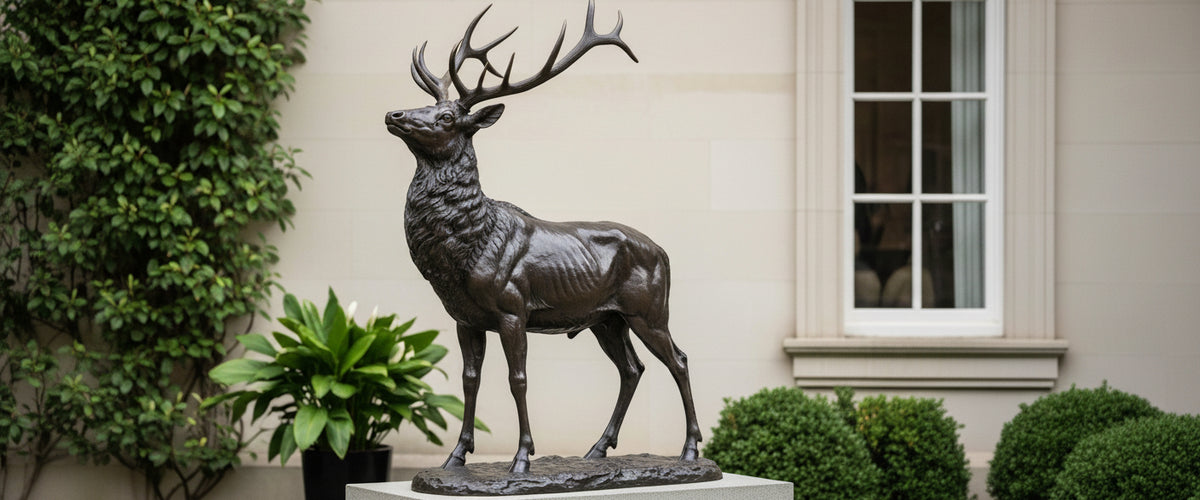

A great animal sculpture does something a painting cannot. It commands a room, anchors a lawn, or stops a guest mid-stride at the end of a driveway. Whether you are drawn to a bronze stag for a Hamptons entry court, a stainless steel hare for a Tribeca loft, or a Corten bear for an Aspen ski lodge, the right animal sculpture works as architecture, focal point and conversation piece at once. The hard part is choosing well, because animals carry meaning, and scale and material will make or break the result.
This guide is written for buyers who want a piece that still feels right in ten years. We cover what animal sculpture really means today, the materials and finishes worth your money, where these works perform best, and how a bespoke commission with Giant Sculptures actually unfolds.

At a glance: animal sculpture key takeaways
- Material drives longevity. Bronze, stainless steel, Corten and stone are the serious outdoor options.
- Scale changes meaning. A life-size horse reads as homage; an oversized one reads as art.
- Pose dictates placement. A walking animal needs space ahead of it; a coiled or seated one anchors a corner.
- Bespoke is not always more expensive. It is often the only way to get the right proportion for a specific site.
- Plan the install early. Foundations, access routes and rigging matter as much as the sculpture itself.

What animal sculpture means, and who it is for
Animal sculpture is one of the oldest categories in art, from cave-era bison to the bronze horses of San Marco. Today, the field stretches from classical equestrian bronzes through hyperreal wildlife studies to the high-gloss pop language of balloon animals. Famous sculptures of animals, think Jeff Koons' mirror-polished balloon dogs, Davide Rivalta's life-size buffalo, or Nina Akamu's monumental horse for the Leonardo project, show how broad the territory is.
The buyers who get the most from animal sculpture tend to fall into a few camps. Private collectors use a single strong piece to set the tone of a garden or hall. Interior designers commission animal works to give a minimal scheme a heartbeat. Landscape architects use them as scale markers across long sightlines. Hospitality clients, hotels, vineyards, members' clubs, lean on them because animals photograph well and become part of the brand. If you fit any of those briefs, you are in the right place.

Materials and finishes that earn their keep
Material is the single biggest decision after subject. It governs cost, weight, lifespan and the kind of light the sculpture throws back at you.
Bronze
Bronze remains the gold standard for figurative animal work. It holds fine detail, from the lift of a horse's vein to the texture of a lion's mane, and develops a patina over decades rather than failing. A traditional brown or verdigris patina suits classical estates; a darker, blacker patina sits well in modern architecture. Properly cast and waxed, a bronze can live outside for generations. The Getty Conservation Institute publishes useful guidance on outdoor bronze care for anyone planning a long-term installation.
Stainless steel
Mirror-polished or brushed stainless is the language of contemporary collectors. It reflects sky, lawn and architecture, so the piece changes mood throughout the day. It is ideal for pop-influenced subjects, where a balloon animal sculpture or oversized rabbit needs that liquid, almost candy-coated surface. Marine-grade 316 is the spec to ask for near coastal homes.
Corten and fabricated steel
Corten weathers to a deep rust orange and is brilliant for stylized or silhouette-led wildlife, stags, wolves, bison, especially in rural or desert settings. It feels at home in Texas ranchland or a Sonoma vineyard.
Stone and marble
Carved limestone, granite and marble suit classical subjects: lions, eagles, hounds. They are heavy, permanent and beautifully still. Plan the foundation early.
Studio and indoor materials
Animal sculpture in clay, terracotta and ceramic has a long studio tradition and is often where artists begin a maquette before scaling up. A clay sculpture animal or smaller animal clay sculpture is wonderful for an interior shelf or library, but for serious outdoor presence we always recommend translating the design into bronze or steel. Chicken wire animal sculptures and similar craft pieces have charm in a children's space or a temporary installation, but they are not the language of a permanent collection.

Scale: the decision most buyers underestimate
Scale is where animal sculpture lives or dies. A 3 ft (0.9 m) bronze hound on a 40 ft (12 m) lawn disappears. A 9 ft (2.7 m) stag in a 12 ft (3.7 m) hallway suffocates the room. As a rough starting point:
- Interior hall or stair landing: 3 to 5 ft (0.9 to 1.5 m) tall works for most subjects.
- Courtyard or pool terrace: life-size, roughly 4 to 6 ft (1.2 to 1.8 m) for medium animals.
- Open lawn, driveway or vineyard: oversized, 7 ft (2.1 m) and up, often the only thing that reads from a distance.
- Lobby or hotel atrium: bigger than your instinct suggests. Tall ceilings eat presence.
Weight follows scale. A life-size bronze horse can run several thousand pounds (well over a metric ton), and that has consequences for foundations, craning and floor loading. A stainless steel piece of the same size may be lighter but needs more careful rigging because of its finish. Talk through these numbers before falling in love with a render.
Where to place animal sculpture for real impact
For wider placement ideas, The Beauty of Animal Art: A Timeless Trend in Wall Décor is useful companion reading before finalising the setting and sightlines.
Placement is choreography. Animals have direction, gaze and gesture, and ignoring those signals is the most common buyer mistake.
- Give walking animals road. A striding horse or pacing big cat needs visible ground ahead of it. Push it back into the planting, not up against a wall.
- Use gaze as a sightline. Position a seated dog or resting deer so its line of sight pulls visitors toward a view, a doorway, or another work.
- Anchor corners with coiled or seated forms. A crouching panther or curled fox settles a dead corner of a garden room.
- Pair with restraint. One strong animal beats three competing ones. If you want a pair, commission them as a designed pair, not two off-the-shelf pieces.
- Light it deliberately. A single low warm uplight on a bronze stag, or a cooler grazing light on polished steel, transforms the piece after dark.
Wall-based animal art can extend the conversation a freestanding piece starts, particularly across longer interior walls where a single sculpture cannot carry the room alone. In a hallway leading to a bronze focal piece, a triptych such as Fantoria 3-Set Animal Fantasy Oil Canvas Wall Art echoes the subject without competing for the eye, and the wider Animal Art collection is worth scanning for that supporting role.
Budget, commissioning and delivery
Budget for animal sculpture depends on material, scale, complexity of pose, engineering, finishing, crating and installation. A small studio bronze and a 10 ft (3 m) fabricated stainless steel piece sit in completely different worlds, so rather than quote bands, we build a tailored quote against your drawings, site photos and timeline. That is the only honest way to do it.
A typical bespoke commission with Giant Sculptures runs through these stages:
- Brief and references. Subject, mood, site, sightlines, surrounding architecture.
- Concept sketches and a maquette. Often modeled first as an animal clay sculpture before scaling.
- Material and finish selection. Bronze patina samples, steel finish samples, stone options.
- Engineering and base design. Internal armature, fixing plates, plinth or direct foundation.
- Fabrication, finishing and quality review.
- Crating, worldwide shipping and on-site installation.
If you are working to a tight deadline, the existing Animal Sculptures & Statues catalog is the fastest way to see what is already in production, and most pieces can be modified in scale, finish or base to suit a specific site. For collectors drawn to the pop language, the Giant Balloon Dog Sculptures range is a useful reference for that conversation.
How Giant Sculptures approaches bespoke animal projects
Our work sits at the large-scale, durable end of the market. That means bronze foundry casting, marine-grade stainless fabrication, Corten and engineered steel, and carved stone, designed and detailed to live outdoors through real weather, real UV and real coastal air. We handle commissions for private estates, hotel groups, vineyards, sculpture parks and corporate campuses across the US and worldwide, and we ship fully crated with installation support.
If you already know the animal you want, we will sketch it. If you only know the feeling you want the space to have, we will help you find the subject. Either way, the goal is a piece that belongs to your site so completely that, in ten years, it is impossible to imagine the place without it.
For general conservation principles, Canadian Conservation Institute outdoor object care is a useful external reference, though the final care routine should always follow the material and finish specified for the individual commission.