





































































































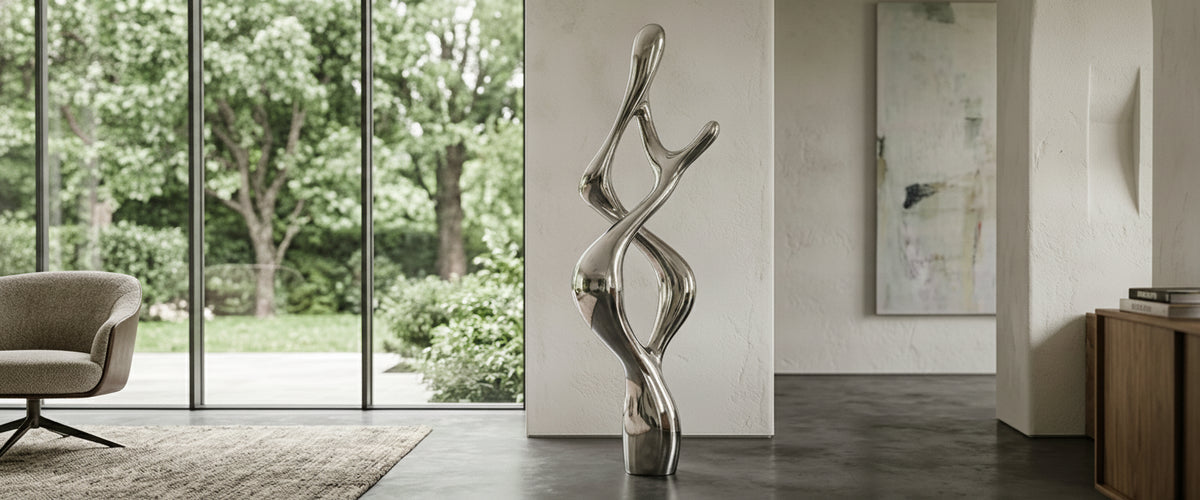

Most abstract sculpture fails for one boring reason: it is too small for the space it lands in. A piece that looked confident in a showroom shrinks against a double-height wall or a wide console, and the room reads it as a knick-knack instead of a focal point. Choosing abstract sculpture for home is really a scale and placement problem first, and a taste problem second. Get the size and site right, and even a quiet form starts to carry weight.
This guide walks through the decisions that matter: what abstract work does for a room, which materials survive real life, where to put a piece so it earns its keep, and how commissioning works when nothing off the shelf fits.

Key Takeaways Before You Buy
- Scale beats detail. A larger, simpler form usually reads better at home than a small, busy one.
- Material sets the mood and the maintenance. Bronze, stainless steel, and stone each age differently and ask for different care.
- Placement is a design choice, not an afterthought. Sightlines, backdrop, and light do more than the sculpture alone.
- Budget follows material, size, engineering, and finish. There is no flat price; ask for a tailored quote.
- Bespoke solves fit. When a stairwell or courtyard has odd proportions, a commission is often the cleaner answer.

What Abstract Sculpture for Home Means, and Who It Suits
Abstract work trades literal subject matter for form, movement, and surface. Instead of a recognizable animal or figure, you are buying a relationship between shape, material, and space. That freedom is exactly why it works so well indoors. A representational piece tells you what to think; an abstract one lets the room and the light keep changing the read.
It suits buyers who want a strong center of gravity without a narrative attached. Collectors like it because a good abstract form rewards a second and third look. Interior designers reach for it because it sits comfortably against modern and traditional interiors alike, from a Napa ranch house to a glass-walled apartment. If your walls are already busy with art, a single sculptural object can settle the whole room down.
Not every abstract piece is fully non-representational, and that is fine. Where a wholly geometric object feels like a leap, a form that keeps just enough of its subject to stay familiar is an easier entry point; a faceted piece such as the Silver Abstract Rhinoceros Sculpture - 35cm holds onto the animal while the planes push it toward pure form.

Materials, Finishes, and Scale Decisions
Material is the first real fork in the road. It changes the mood, the price, the weight, and how the piece behaves over ten years of ownership.
Bronze
Bronze is the classic choice for indoor work with longevity built in. It takes a wide range of patinas, from near-black to warm brown to verdigris green, and it holds fine surface detail. Cast bronze is heavy, so a floor-standing piece needs a floor that can carry it and a base that spreads the load. Our bronze abstract sculptures show how much a patina choice shifts the character of an otherwise simple form.
Stainless Steel
Polished or brushed stainless steel reads modern and reflective. A mirror-polished surface pulls in the room around it, which makes it feel larger and lighter than its actual mass. It is a strong pick for contemporary interiors where you want the sculpture to bounce light rather than absorb it. Where the setting needs suggested motion rather than solid mass, a flowing form like the Silver Abstract Water Splash Sculpture - 100cm uses that reflectivity to hold a moment mid-air.
Stone and Marble
Carved stone and marble bring density and quiet. Each block is unique, so veining and color become part of the composition. Stone loves natural light; a raking morning sun across a carved surface does more than any spotlight. It is also the least reflective option, which suits rooms where you want calm rather than sparkle.
Scale
Here is the studio rule we repeat most: measure the space, then size up. For a console or sideboard, a piece roughly two thirds the width of the surface tends to look intentional rather than lost. For a floor-standing form beside a stair or in an entry, think in feet, not inches. For a double-height entry, a 55 in (140 cm) vertical piece such as the Silver Abstract Tree Branch Sculpture - 140cm holds the void far better than a tabletop object ever could. When clients tell us a piece "disappeared" once installed, scale is almost always the culprit.

Where to Place Abstract Sculpture for Home
For wider placement ideas, Abstract Art Sculpture Home Decor: When a Shape Becomes the Room is useful companion reading before finalising the setting and sightlines.
The right site does half the work. A few placements that consistently land:
- Entry and hallway. The first thing a guest sees sets the tone. A vertical form on a plinth turns a pass-through into an arrival.
- Facing a window. Backlight a reflective or translucent piece and it changes hour by hour. Just watch for glare on nearby screens.
- Stair turn or landing. Odd, tall voids are made for slim vertical work that a painting cannot fill.
- Against a plain wall. A quiet backdrop lets the silhouette do the talking. Busy wallpaper fights the form.
- Dining or living centerpiece. A low, horizontal object anchors a coffee table without blocking conversation across it.
Two practical notes from installs we have shipped. First, give the piece room to breathe; crowding it against furniture kills the negative space that makes an abstract form read. Second, think about the walk-around. These forms usually have no single "front," so the reveal as someone moves through the room is part of the value. Placing one flat against a corner throws that away.
Lighting matters more than people expect. A single adjustable spot at roughly 30 degrees creates shadow and depth; flat overhead light flattens everything. Museums lean on directional lighting for exactly this reason, and the guidance from the Tate on how sculpture depends on viewpoint and light is a useful reality check before you commit to a spot.
Budget, Commissioning, and Delivery
There is no single price for a decorative sculpture, and anyone quoting one flat number is guessing. Cost is driven by material, size, structural engineering, finishing time, and installation complexity. A hand-patinated bronze at seven feet involves far more foundry work than a small polished cast, and a mirror finish takes many more hours of hand polishing than a brushed one. For anything meaningful, ask for a tailored quote rather than assuming a bracket.
A few budget levers worth knowing:
- Size scales cost fast. Doubling height often more than doubles material and handling.
- Finish is labor. Complex patinas and mirror polishing add hours, not pennies.
- Base and fixing count. A heavy floor piece may need a concealed steel plate or plinth engineered for the load.
- Freight is real. Large sculpture ships crated and sometimes palletized; international delivery to the US from our UK studio is routine but should be planned early.
When you buy something existing off the collection, lead time is mostly logistics. When you commission, plan for design, approval, making, and finishing before shipping. Give yourself margin if the piece is tied to a renovation date.
How Giant Sculptures Handles Bespoke Projects
Giant Sculptures is a bespoke supplier of large-scale sculpture, and commissioning is where the odd spaces get solved. A stairwell with a strange proportion, a courtyard that needs a specific height to feel finished, a client who wants an existing form scaled up to twice its catalog size; these are the briefs we take on.
A commission usually runs like this. You share the space, the sightlines, and a reference or a rough idea. We advise on material and scale, then work up the form for approval before anything is cast or fabricated. Engineering for weight and fixing is built in, not bolted on afterward, which matters once a piece passes a few hundred pounds. If you want to see the range of forms first, the abstract sculptures collection is the easiest place to gauge what direction suits your room, and the home decor sculptures collection covers smaller interior pieces.
The larger the piece, the more the studio conversation pays off. A tabletop object forgives a rough guess. A seven-foot floor sculpture in an entry hall does not, and getting the material, scale, and fixing right before making begins is what separates a piece that holds the room from one that quietly underwhelms.