





































































































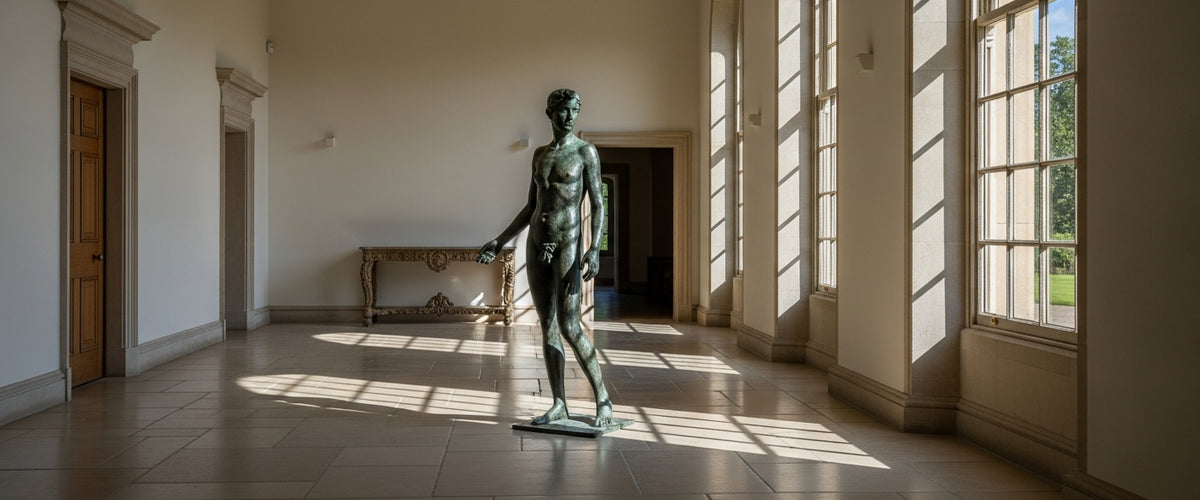

There is a particular moment when you walk into a room and realise the figure in the corner is looking back at you from your own height. That is the trick of life size statues: they don't tower like a monument or sit politely like a mantel piece. They share the room. They occupy your eye line. They make guests slow down. And, handled badly, they unsettle a space the way a stranger standing too close to the door might.
This guide is for the people who are seriously considering bringing a life size statue into a home, garden, hotel lobby, chapel, courtyard or showroom. Not the romance of it, the reality. What changes when art meets you at eye level, and what you need to get right before the crate arrives.

At a glance: what to know before you commission a life size statue
- Scale is psychological, not just physical. Life size statues confront; oversize impresses; small-scale decorates.
- Material decides longevity. Bronze and marble are heirloom-grade. Stainless steel and Corten suit contemporary outdoor settings. Resin and fibreglass are lighter but rarely the right call for a serious commission.
- Weight is the silent dealbreaker. A life size bronze can run into hundreds of kilos (marble, heavier still).
- Access matters more than aesthetics on delivery day. Doorways, lifts, garden gates and ceiling heights stop more installations than budgets do.
- Placement is everything. Life size statues need breathing room, considered sightlines, and a base they cannot sink, tilt or stain.
Why life-size hits harder than scaled-down or oversized
Sculpture works on the body before it works on the brain. A 30cm bronze on a console table is a curio; you look down at it, you own it visually. A four-metre figure in a plaza is a statement of institution; you look up, you feel small. Life size statues do neither. They greet you. They share the space. And because the human eye is wired to read posture, gesture and gaze in other humans, a well-cast life size figure pulls an emotional response that scaled work simply cannot reach.
This is why galleries, chapels and luxury hotels keep coming back to human scale. It is also why the same scale is risky in a domestic room that wasn't designed for it. The figure that feels poetic in a double-height hallway can feel theatrical, even oppressive, in a low-ceilinged living room.
Measuring the room before you measure the statue
Before you fall for a particular piece, measure the space honestly. Three numbers matter more than people realise:
- Ceiling height. A 180cm figure on a 20cm plinth needs more than 200cm of clearance to avoid looking jammed against the ceiling. Always allow visual headroom above the head of the figure.
- Sightline distance. You should be able to step back at least 1.5 times the height of the statue to read it properly. Closer than that and you only ever see fragments.
- Floor or ground footprint. Allow a clear radius around the base so the piece is not crowded by furniture, planting or foot traffic.
In gardens, the rules loosen but the principle holds: life size statues need context (a hedge, a wall, a tree line) to read against. Drop one onto an open lawn and it can look stranded. The Life Size & Large Statues collection includes pieces designed with these sightlines in mind, including marble angels intended to be approached on foot rather than glimpsed from a window.
Bronze, resin, fibreglass: which holds up at human scale
Material is where commissioning gets serious. For life size statues, the difference between a piece that becomes an heirloom and a piece that looks tired in five years is almost entirely about what it is made of.
Bronze
Bronze is the historical default for a reason. Cast properly, with a patina that has been chemically developed rather than painted on, a life size bronze will outlast the building it stands in. It tolerates rain, frost, salt air and decades of being touched by curious visitors. The Victoria and Albert Museum's guidance on caring for bronzes is a good baseline if you want to understand how little maintenance a quality cast actually needs.
Marble and stone
Marble carries a different gravity, literally and figuratively. A carved marble figure has presence that no metal can replicate, and it ages beautifully outdoors when the stone is correctly selected. In a garden setting where the eye should be drawn slowly rather than instantly, a hand-carved piece like the Life-Size Angel Marble Outdoor Sculpture - 180cm catches morning light differently to bronze: softer, slower, more devotional. Marble is, however, vulnerable to acidic rain, frost damage in poorly drained sites, and staining from overhanging trees. Where a client wants the same human scale but a warmer, more decorative finish, say, against a darker hedge line or a stone facade, a gilded variant such as the Gold Life-Size Angel Marble Outdoor Sculpture - 180cm shifts the piece from contemplative to ceremonial without changing the silhouette.
Stainless steel and Corten
For contemporary commissions, mirror-polished stainless steel and weathered Corten steel give you human scale without classical association. They suit modern architecture, courtyards, and corporate forecourts. Stainless reflects its surroundings; Corten anchors them.
Resin and fibreglass
Resin and fibreglass exist, and they have their place in film, retail and temporary display. For serious life size statues intended to last, they are rarely the right choice. UV degradation, surface fading and impact damage all catch up quickly. If a supplier is offering a life size figure at a suspiciously light weight, ask what it is made of.
How much does a life-size statue actually cost?
Budget for a life size statue depends on material, complexity of pose, the level of detail, the finish, engineering for outdoor sites, base and plinth, crating and installation. A finely cast bronze, a hand-carved marble and a fabricated stainless piece will all sit in very different commercial brackets, and bespoke commissions sit higher again than catalogue pieces. Rather than chase a generic price band, request a tailored quote with your site details and intended use. At Giant Sculptures we cost each commission against the specific brief; it is the only honest way to price work at this scale.
Doorways, ceilings and the delivery problems nobody mentions
This is the part of buying a life size statue that surprises first-time clients. The artwork is the easy bit. Getting it into the room is the project.
- Door widths. A figure with outstretched arms or wings may need to be crated in sections and assembled on site.
- Stairs and lifts. Service lifts have weight limits. A 250kg bronze does not negotiate with a domestic lift.
- Garden access. Side gates, lawn protection, soft ground after rain; all of it becomes relevant when you are moving a heavy crate to the back of a property.
- Floor protection during installation. Polished concrete, stone tiles and timber floors all need protection beneath the crate and lifting equipment.
For life size statues destined for upper floors, terraces or roof gardens, structural sign-off should happen before the contract is signed, not after. A good supplier will ask about access before they talk about aesthetics.
Anchoring, weight loading and floor protection
A life size bronze typically weighs between 150kg and 400kg depending on wall thickness and pose. Marble figures of similar height are often heavier still, particularly when carved from solid block. That weight needs somewhere to go.
Indoors, that means checking floor loadings, especially on suspended timber floors or upper levels. Outdoors, it means a properly engineered base: a concrete pad below the frost line, stainless fixings, and, for taller pieces, internal armatures pinned into the foundation. Where access constraints rule out a 180cm piece, a slightly smaller carved figure such as the Life-Size Angel Marble Outdoor Sculpture - 160cm still reads as human-scale while reducing transport weight and base-loading requirements; a useful compromise on upper terraces or in walled gardens with narrow gates.
Never bolt a life size statue into paving alone. Paving moves. Statues this size do not tolerate movement well, and a tilted figure is both a safety risk and an aesthetic disaster.
Where life-size belongs, and where it overwhelms
Some spaces were made for human-scale sculpture: double-height entrance halls, formal gardens with axial sightlines, chapels and memorial gardens, hotel lobbies, courtyards, large landings on a turn of stairs. These rooms expect a figure.
Other spaces resist it. A standard-height living room with a sofa and a television will struggle to accommodate a 180cm figure without the figure dominating, or worse, looking displaced. In domestic interiors, life size statues often work best in transitional spaces (hallways, stair landings, garden rooms, orangeries) where the figure has its own territory rather than competing with daily furniture.
Outdoors, life size statues reward considered placement. A marble angel framed by a yew hedge reads as devotional. The same figure on an exposed lawn reads as garden centre. The setting writes half the meaning.
How life-size statues are actually made
Most life size bronzes are produced by lost-wax casting in sections (head, torso, limbs) which are then welded, chased and patinated. Marble figures are carved, traditionally by hand and increasingly with CNC roughing followed by hand finishing. Stainless steel and Corten pieces are typically fabricated from sheet over an internal armature, then welded, ground and finished.
For bespoke commissions, the process usually begins with a maquette, a small-scale model that lets the client adjust pose, gesture and proportion before any large-scale work begins. This is where a specialist supplier earns its fee: catching the issues at maquette stage that would be expensive to fix in bronze.
Commissioning checklist
- Confirm the intended location, indoor or outdoor, and the surrounding architecture.
- Measure ceiling height, doorway widths, and access routes in advance.
- Agree the material and finish based on environment, not just preference.
- Request a maquette or detailed render before full production begins.
- Plan the base, anchoring and floor protection at design stage.
- Confirm crating, delivery method and installation team before sign-off.
- Budget for ongoing care: bronze waxing, marble sealing, or stainless polishing.
Life size statues are one of the most demanding things you can commission, and one of the most rewarding to live with. Get the scale right, get the material right, get the access right, and you end up with a piece that quietly reorganises the room around it for decades. Get any of those wrong, and you end up moving furniture for the rest of your ownership. Giant Sculptures specialises in bespoke, large-scale and life size work, and we would rather talk you through the constraints early than deliver a piece that fights its setting.
For wider placement ideas on life size statues, The Gacko Bear Revolution: Limited-Edition Life-Size Sculptures by André Gacko is useful companion reading before finalising the setting and sightlines.
For general conservation principles, V&A sculpture techniques is a useful external reference, though the final care routine should always follow the material and finish specified for the individual commission.