




























































































Most people walk into a showroom looking for "a Greek goddess statue" and walk out unsure whether they wanted Aphrodite's softness, Athena's authority, or simply a draped female figure that holds a hallway with quiet drama. The mythology matters, but so does the pose, the material, and the height of the plinth you haven't bought yet. Get those four things right and a goddess feels inevitable in the room. Get them wrong and she looks like a souvenir that escaped the airport.
This guide is for buyers, designers and collectors who want Greek goddess statues to feel considered rather than copied. We'll cover how to tell the goddesses apart, when Aphrodite outperforms Athena, why fuller-figured goddesses are having a moment again, and the practical decisions that separate a serious piece from a forgettable one.

At a glance: choosing Greek goddess statues
- Mood first, myth second: Aphrodite reads as warmth and intimacy; Athena reads as intellect and command.
- Material drives longevity: marble for classical gravitas, bronze for outdoor permanence, resin only for low-stakes interiors.
- Scale changes everything: a 160–180cm figure on a correct plinth lifts the eye to face height and turns decoration into presence.
- Attributes tell the story: owls, helmets, doves, mirrors, cornucopias and wheat sheaves identify the goddess before the label does.
- Bespoke beats off-the-shelf when the room, the pose, or the proportions need to be specific.

How to tell the goddesses apart at a glance
Greek goddess statues are easier to read once you know the attributes. Aphrodite arrives with doves, shells, mirrors or Eros at her ankle; her contrapposto is loose, her drapery slips. Athena wears a helmet, carries a spear or aegis, and is often accompanied by an owl. Demeter and her Roman echo Ceres hold wheat sheaves or a cornucopia. Hera tends to be enthroned and crowned. Artemis carries a bow, sometimes a stag. Persephone holds pomegranates; Hestia, a simple flame.
This matters commercially because most buyers describe what they want in mood terms — "something graceful", "something powerful" — when they actually want a specific iconography. If the brief is abundance and welcome, a harvest goddess with a cornucopia speaks louder than a generic draped figure. Where the entrance hall or hotel lobby needs to read instantly as hospitality, a piece like the Goddess with Cornucopia Marble Sculpture - 180cm carries that message more directly than a generic draped female figure would.
Aphrodite for softness, Athena for authority
An aphrodite greek goddess statue belongs where you want the room to exhale. Bedrooms, dressing rooms, spa interiors, romantic garden alcoves, intimate dining rooms — anywhere the architecture is already doing the heavy lifting and the sculpture should warm rather than dominate. The pose tends to be turned, weight on one leg, drapery falling away. The effect is human scale even when the figure is over life-size.
An athena greek goddess statue does the opposite. She belongs at the top of a stair, in a library, in a boardroom-adjacent reception, or terminating an axial garden walk. Her stance is frontal or near-frontal, her gaze level, her attributes legible from twenty paces. If the brief is "this room needs to be taken seriously", Athena outperforms almost any other classical figure.
Designers sometimes pair them deliberately — Aphrodite in the private wing of a house, Athena in the public wing — because the contrast tells guests something about the owner without anyone having to say it. When clients ask us about greek goddesses statues as a pair or a sequence, that's almost always the underlying logic.
The curvy revival: fuller-figured goddesses are selling again
For a decade or so the market drifted towards lean, neoclassical proportions copied loosely from late 18th-century reinterpretations. That has shifted. Buyers are asking for a curvy greek goddess statue with the fuller hips, softer waist and rounder shoulders you actually see on Hellenistic originals such as the Aphrodite of Knidos tradition or the Venus de Milo's lower body. It reads as more honest, more sensual, and frankly more interesting to live with.
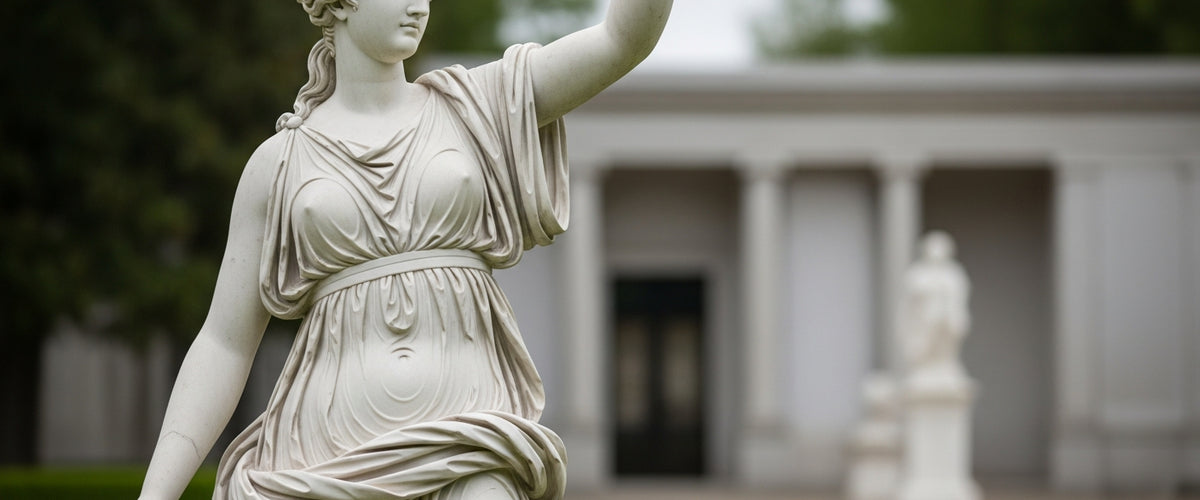
The trend matters when you're commissioning. If you've only ever seen slim Victorian-era reproductions, ask specifically for Hellenistic proportions and reference an original. A figure in motion, such as the Dancing Goddess Marble Sculpture - 160cm, makes the case for fuller proportions visible: the body has to be believable from every angle for the pose to hold, and the drapery only behaves correctly when it has a real form to fall against.
Marble, bronze and resin reproductions compared honestly
Material is where most buyers either commit to a serious piece or accidentally buy a prop. Here is the honest version.
Marble
Hand-carved marble is the default for classical Greek goddess statues for a reason: it holds detail in drapery, hair and fingertips that no cast resin can match, and it ages beautifully indoors. Outdoors it needs more care — marble is calcium carbonate and reacts to acidic rain and pollutants, which is why museums monitor surface condition closely (the Getty Conservation Institute publishes useful guidance on stone weathering). Inside a sheltered courtyard or interior, marble is almost always the right answer. Where a tall plinth is impractical and the figure needs to work as a lower, contained focal point, a seated composition such as the Seated Goddess Marble Sculpture - 130cm at 130cm sits naturally on a console or low base without losing presence.
Bronze
Bronze is the right call for exposed gardens, public landscapes and coastal sites. A properly patinated bronze goddess will outlive several owners. The trade-off is aesthetic: bronze pushes the figure away from the white-marble classical image most buyers carry in their head and towards something closer to a Hellenistic or Renaissance reading. If that suits the architecture, it is the most durable choice you can make.
Resin and composite
For wider placement ideas, The Rising Trend of 3D Floral Wall Art - Here’s Why Everyone Wants One is useful companion reading before finalising the setting and sightlines.
Useful for film sets, events, and temporary interiors. Not what we recommend if you want the piece to read as a long-term acquisition. Resin yellows under UV, chips reveal a non-stone core, and the surface never develops the depth that carved stone or cast bronze does. For Giant Sculptures clients commissioning at scale, resin is almost always the wrong economy.
Plinths, lighting and the height that makes a goddess feel monumental
A 160cm figure is not a 160cm presence. Placed flat on the floor, she reads as slightly under life-size and faintly apologetic. The same figure on a 60–90cm plinth becomes monumental, because her face arrives at the viewer's eye level or just above it. This is the single most common mistake we see in private homes.
Rules of thumb we use when advising clients:
- Indoor figures under 150cm almost always need a plinth. Aim for the goddess's eyes to sit at or slightly above the average viewer's eye line when they enter the room.
- Garden figures can sit lower if they are seen from a distance, but should rise when viewed close-up along a path.
- Lighting from below turns classical features theatrical — sometimes useful, often unflattering. Side or three-quarter top lighting reads more like daylight and respects the carving.
- Avoid hot spots. A single bright downlight kills the modelling. Two softer sources at 45 degrees keep the drapery alive.
- Negative space matters. Give a goddess at least a metre of clear floor or planting around her. Crowding kills scale.
Buying replicas without ending up with a tacky souvenir
The line between a serious classical replica and a gift-shop figurine is not really about price — it is about anatomy, drapery and finish. A few honest checks:
- Look at the hands and feet. Cheap reproductions soften them into mittens and slippers. Good carving keeps the knuckles, tendons and toenails legible.
- Check the back. A serious piece is finished all the way round, because it will eventually be seen from behind. Souvenir-grade work is flat or rough on the reverse.
- Read the drapery. Folds should have logic — gravity, tension, the body underneath. If the cloth looks pasted on, the carver was working from a photograph rather than understanding the form.
- Ask about the marble. Specific quarry names (Carrara, Volakas, Thassos) suggest a real supply chain. "White marble" with no origin usually means reconstituted stone.
- Beware of vague pricing. Reputable suppliers quote against material, scale, complexity and finishing. If a quote arrives without those variables discussed, you are not buying what you think you are buying.
If the room calls for something off-piste — a specific pose, an unusual scale, a goddess holding an attribute you cannot find on the market — that is where bespoke commissioning earns its keep. Giant Sculptures works with carvers and foundries who can develop a piece from a brief, reference imagery and architectural drawings, which is usually how the more interesting greek goddess statues in private collections actually come into being.
Commissioning checklist for Greek goddess statues
- Decide the mood (warm, commanding, abundant, contemplative) before choosing the goddess.
- Confirm the iconography — which attributes must be present for the figure to read correctly.
- Choose the material based on location: marble for sheltered, bronze for exposed, stone composites only for temporary use.
- Plan the plinth and lighting at the same time as the figure, not afterwards.
- Ask for proportions referenced to a named original if a particular silhouette matters.
- Allow lead time for carving and finishing; serious work cannot be rushed.
- Request a tailored quote that breaks down material, scale, complexity, engineering and delivery.
Done well, a Greek goddess statue is one of the few decorative choices that gets better the longer you live with it. The mythology gives the piece its name, but the carving, the scale and the placement are what make her stay.
For general conservation principles, Canadian Conservation Institute outdoor object care is a useful external reference, though the final care routine should always follow the material and finish specified for the individual commission.