






































































































A six-foot bronze can vanish. Put it in the wrong corner of a wide lawn, behind a pale hedge, at eye level with no pedestal, and a piece that felt commanding in the studio reads like garden furniture from the terrace. The search for the best large outdoor sculpture almost never fails on the sculpture itself. It fails on the decisions around it: how big is big enough, where the eye lands, what sits behind the bronze, and how the light hits it at 4pm in October.
We ship large-scale and bespoke pieces to gardens and grounds on both sides of the Atlantic, and the same conversation comes up every time. Buyers pick a subject they love, then underestimate the space that subject has to hold. A large outdoor sculpture asks for planning as much as taste, so this is a placement guide first and a shopping guide second, because the two are inseparable.
Scale and pedestal height decide whether a piece commands its setting.

Key Takeaways
Scale to the view, not the object. A large outdoor sculpture competes with the whole setting, so measure the sightline distance, not just the plinth.
Pedestal height changes everything. Raising a figure 18 to 36 inches (46 to 91 cm) can turn a lawn ornament into a landmark.
Backdrop and contrast decide visual impact more than the material's shine.
Bronze, stainless steel, Corten and marble each read differently outdoors and age differently too.
Most placement mistakes are correctable at the planning stage and expensive to fix once a crane has left.

What the Best Large Outdoor Sculpture Looks Like in Different Settings
The best large outdoor sculptures for gardens are the ones sized to the space they command, not the ones that photographed well in isolation. A 200 cm bronze that anchors a courtyard in Napa would disappear on a five-acre Hamptons meadow, and the same piece would overwhelm a tight walled garden in a townhouse.
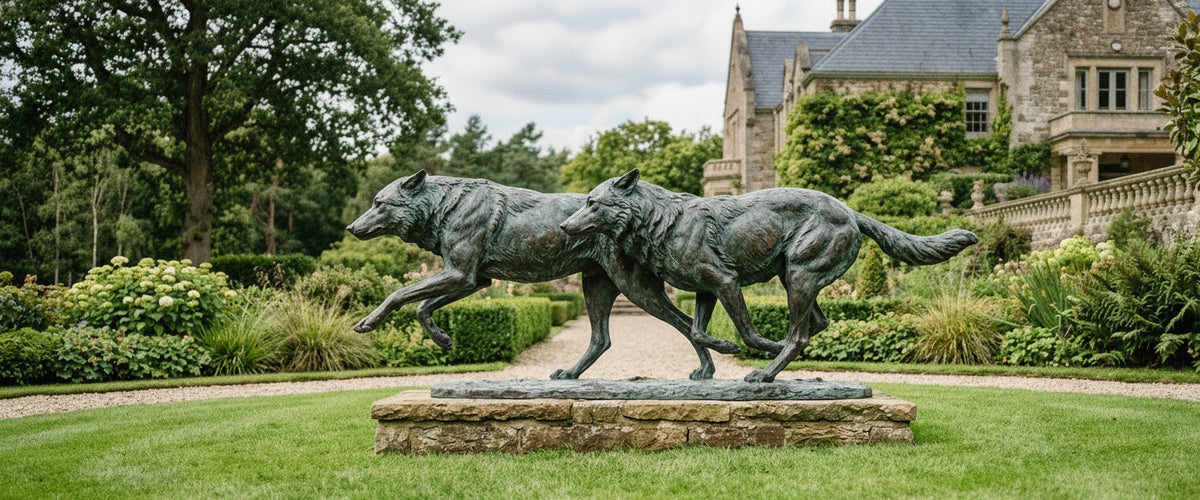
Start with the room the sculpture actually lives in, even outdoors. A formal parterre wants a single strong vertical: a standing figure, an obelisk form, a classical angel. For that kind of setting, a large outdoor sculpture like the Large Guardian Angel marble piece at 180 cm holds its ground because the drapery gives it mass and the height reads clearly against clipped greenery. A wide, informal lawn asks the opposite question. There, movement wins over stillness, which is why a horizontal, motion-led form like the Large Contemporary Running Wolves Bronze Sculpture - 180cm carries a big open space; the eye follows the motion across the distance instead of stopping cold.
Indoors, the calculus shifts again. A double-height entrance hall or a gallery-scale living room in a Texas ranch house can take a tall figure that would feel exposed on open ground. Ceiling height, not lot size, becomes the limiting number.

Scale, Sightlines and Pedestal Height
Here is the rule we repeat most often: the viewing distance sets the scale of a large outdoor sculpture, not the width of the flowerbed. If your main sightline is from a terrace 60 feet (18 m) away, a piece under about five feet tall will look modest no matter how fine the modeling. The eye discounts size at distance fast.
Walk your primary sightline before you buy. Stand where you will actually see the sculpture most often: the kitchen window, the head of the drive, the end of a gravel path. That is where the piece has to perform. A common trick from the studio is to stake out the footprint with a broom handle or a length of cane at the intended height, then look at it from the house. Nine times out of ten the buyer raises the height after that test.
A plinth lifts the gesture above planting and reads as intentional.
Pedestal height is the cheapest lever you have. Lifting a large outdoor sculpture onto a plinth of 18 to 36 inches (46 to 91 cm) does three things: it clears low planting, it lifts the face and gesture to a natural viewing angle, and it separates the piece from the ground so it reads as intentional rather than accidental. A low pose reads very differently here: a kneeling or seated form such as the Large Classical Kneeling Angel Bronze Sculpture (Golden Patina) - 200cm almost always needs a base outdoors, because sitting flat on turf its silhouette dissolves against the grass.
Quick pedestal checklist
Does the plinth lift the key gesture (a face, a raised hand, an arched back) above the surrounding planting?
Is the base wide enough to look stable under a heavy bronze or marble mass?
Have you allowed for a proper foundation? Large pieces need a footing that will not heave in frost or settle in wet ground.
Does the pedestal material agree with the sculpture, or fight it? Pale limestone under white marble, dark stone or steel under bronze.

Indoor Versus Outdoor Placement: When Each Wins
For wider placement ideas, Large Outdoor Metal Sculpture: A Buyer's Guide to Scale, Finish, and Placement is useful companion reading before finalizing the setting and sightlines for a large outdoor sculpture.
Some pieces are happier inside, and pretending otherwise shortens their life. Marble is the clearest case. Fine white marble looks superb outdoors and many classical figures were made for gardens, but acid rain and freeze-thaw cycles are hard on carved detail over decades. The Getty Conservation Institute's guidance on stone notes how soluble marble is to environmental acidity over time (Getty Conservation Institute). If you want a marble figure in a cold, wet climate, either accept a slower softening of the surface as part of its character or plan for winter protection.
Bronze and stainless steel are built for the open air, which is why they make the most durable large outdoor sculpture. A patinated bronze develops its surface over years and rewards being left outside; stainless steel and Corten steel are engineered for weather from the start. That durability is why we steer buyers toward metal when the piece will stand year-round on exposed ground in Aspen or the Northeast.
Placing a work in the open air wins when you want it to change with the seasons: snow on a bronze back, low winter sun raking across a polished steel curve, wet stone after rain. An interior spot wins when the work is delicate, when detail is the whole point, or when you want controlled, consistent light on it every day. Neither is better. They are different jobs for a large outdoor sculpture, and both deserve a plan.

Light, Backdrop and Contrast
Material shine gets too much credit for impact. Backdrop does the heavy lifting. A dark bronze in front of a dark yew hedge disappears; the same bronze against a pale rendered wall or open sky snaps into focus. Before choosing a finish for a large outdoor sculpture, decide what sits behind it at the main viewing angle.
Contrast is the single most reliable tool for reading a big garden piece clearly. Pale marble against dense green planting. Dark patinated bronze against a bright horizon or a light gravel court. Mirror-polished stainless steel wherever there is a good reflection to catch, water, sky, foliage that moves. A reflective piece needs something worth reflecting, or it just looks gray.
Light direction matters as much as light quantity. Side light at the start and end of the day models form beautifully; flat midday light from overhead can kill a piece's depth. If a large outdoor sculpture faces due north and never catches direct sun, factor discreet uplighting into the plan. A pair of narrow-beam ground fixtures raking up one side will do more for evening drama than any change of finish.

Common Placement Mistakes We See in Commissions
The mistakes repeat, which is good news, because it means they are predictable and avoidable.
Buying too small for the sightline. By far the most common. The piece looked right in a photo and vanishes in the garden. Always size your large outdoor sculpture to the viewing distance.
Centering by habit. Dead-center placement can feel static. Offsetting a piece to a natural focal point, the turn of a path, the end of an axis, often reads stronger.
Skipping the foundation. A heavy sculpture on inadequate footing will tilt as the ground moves. This is not the place to save money.
Ignoring the back. A figure has two viewing sides in a garden you walk around. Check the rear silhouette from the return path.
Matching finish to nothing. Choosing a patina or polish without checking it against the actual backdrop. Bring a sample or a render into the real setting.
Forgetting winter. A garden that is lush in July is bare in January. A large outdoor sculpture has to hold the space when the planting is gone.
If you are still narrowing choices, browsing our large garden statues and the wider outdoor sculptures collection by silhouette rather than subject is a useful exercise; you start seeing which shapes hold space and which need a backdrop to survive.

Commissioning at the Right Scale
When nothing in the catalog fits the setting, we commission. The advantage of bespoke work for a large outdoor sculpture is that scale, pose and finish are set to your site from the start, not compromised to an existing mold. We work in bronze, stainless steel, Corten and stone, and we can model a piece to a specific sightline, plinth height and backdrop.
Budget for a large outdoor sculpture commission depends on material, scale, complexity, the engineering behind it, installation and finishing, so we quote each project individually rather than list a figure that would mislead you. The honest answer to what a piece will cost is that we need the site and the brief first. Send us the viewing distance, a photo of the backdrop, and the mood you are after, and we will tell you what the space can carry.