





































































































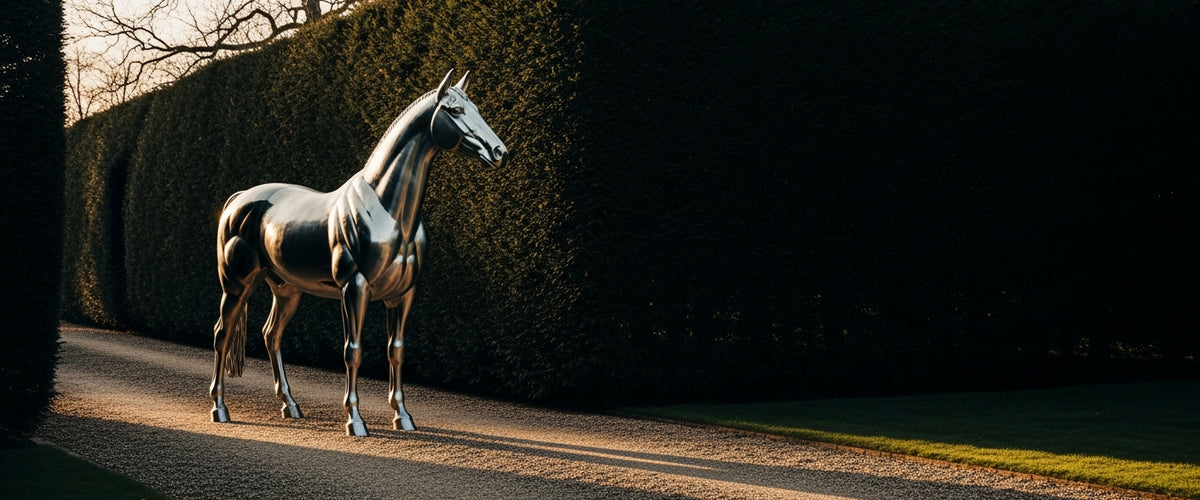

There is a particular kind of garden that quietly asks for a horse. You feel it before you can name it: a long lawn that runs out of ideas halfway down, a gravel sweep that needs a focal point, a paddock edge where the eye keeps drifting and finding nothing to land on. A horse sculpture outdoor is one of the few subjects with enough presence, movement and cultural weight to answer that question properly, and one of the easiest to get wrong if you treat an outdoor horse sculpture as decoration rather than architecture.
At Giant Sculptures we commission and supply large-scale equine pieces for country estates, urban courtyards, hotel grounds and stud farms across the UK and abroad. The brief for an outdoor sculpture of a horse is almost never "a horse". It is usually "this view needs resolving", or "the drive feels unfinished", or "my wife rode for thirty years and I want something that means it". This guide is for buyers thinking about a horse sculpture outdoor along those lines.

Key takeaways
- Scale beats subject. A life-size horse at the wrong distance reads as a toy. Always test the silhouette in situ before ordering.
- Material decides longevity. Bronze, stainless steel, Corten and marble each age differently outdoors, so pick for climate and patina, not just look.
- Placement is half the work. Sightlines, backdrop and pedestal height change a sculpture's reading more than its sculptor does.
- Bespoke takes time. A commissioned outdoor horse sculpture typically moves through maquette, approval, fabrication and installation stages over several months.
- Budget is bespoke. Cost depends on scale, material, complexity, engineering and installation, so always request a tailored quote.

Why a horse sculpture outdoor feels right in some gardens and absurd in others
Horses carry baggage, the good kind. They are read as power, lineage, freedom and quiet luxury before the viewer has consciously processed the form. That is exactly why an outdoor horse sculpture can also misfire. Drop a rearing stallion into a minimalist courtyard built around a single olive tree and you have a clash, not a conversation. Place the same piece at the turn of a yew-lined drive and it becomes inevitable.
Three questions sort the right gardens from the wrong ones. First, does your landscape already have a narrative (rural, equestrian, classical, romantic) that a horse sculpture outdoor extends rather than interrupts? Second, is there a viewing distance of at least fifteen to twenty metres available for a life-size piece? Horses are designed by evolution to be read at distance; crowding them flattens the form. Third, does the architecture behind the sculpture cooperate? A pale rendered wall, a dark hedge, an open sky: these are the backdrops a horse needs. A busy mixed border will fight it.

Scale psychology: when life-size beats monumental
Clients often assume bigger is better. It usually isn't. A life-size horse, roughly 160 to 180cm (5'3" to 5'11") at the withers, is the most psychologically convincing scale for any horse sculpture outdoor because it matches the body memory every viewer already carries. You walk past it and your nervous system briefly agrees it is real. That recognition is the whole game.
Monumental scale (anything above about 2.5m / 8'2") is a different beast altogether, literally. It stops reading as a horse and starts reading as a monument to a horse, which is the right choice for civic plazas, vineyard entrances or estates where the sculpture has to hold its own against significant architecture. For most private gardens, life-size or marginally over does more work. At the human-scale threshold, where the gesture lands without overwhelming the planting around it, a piece such as the Rising Stallion Silver Steel Horse Sculpture - 160cm tends to settle into a garden more convincingly than a 2.5m bronze ever would.
For more contemporary settings, the calculus changes. Where the architecture is modern and the planting graphic, a faceted form like the Horse II Geometric Steel Outdoor Sculpture - 182cm is closer to the right design language than a figurative bronze. The planes catch light through the day in a way classical casting never will, and the slightly-over-life-size scale gives the focal anchor a modern garden needs without resorting to pastiche.

Bronze vs stainless steel vs marble: what materials actually do outdoors
Material choice for an outdoor horse sculpture is where most buyers either save themselves twenty years of trouble or invite it in. Here is the honest version, and it ties directly to how to preserve outdoor sculptures over decades, not seasons.
Bronze
The default for serious outdoor figurative work, and rightly so. A well-cast bronze with a properly applied patina will outlive you, your buyer and probably your buyer's grandchildren. It develops a natural verdigris over time which conservators generally consider part of the work, not a flaw. The V&A's guidance on bronze care is a useful reference for anyone inheriting or commissioning a long-term piece. Bronze does, however, demand correct foundation work; it is heavy, and a sinking plinth ruins the line of a horse faster than anything.
Stainless steel
The right answer for contemporary gardens, coastal sites, and anyone who wants a horse sculpture outdoor that holds its finish without annual attention. Polished or brushed stainless reflects sky and surroundings, which means the piece changes character through the day in a way bronze cannot. Geometric and abstract horse forms work particularly well in steel, and our range of large outdoor metal sculptures for sale leans heavily on stainless for that reason. Where the setting calls for warmth rather than the cooler reading of mirror-polish, a finish like the Horse Gold Steel Abstract Sculpture - 75/250cm carries the material into richer territory without losing its modern edge. Stainless is also genuinely low-maintenance, which matters for second homes or commercial venues.
Corten and weathering steel
For pieces meant to look as if they grew out of the landscape. Corten develops a stable rust-coloured oxide layer that protects the steel underneath. It pairs beautifully with grasses, gravel and rural settings, though it will stain anything porous beneath it for the first couple of years. For buyers comparing outdoor metal sculptures for sale uk wide, Corten is the material that most rewards a rural setting.
Marble
The classical choice, and still the most emotionally loaded. In the right setting (formal parterre, pale gravel, dark hedging) a carved piece such as the Rearing Horse White Marble Outdoor Sculpture - 180cm reads in a way no metal equivalent can replicate. Marble does require more thoughtful siting in the UK climate; freeze-thaw cycles and acid rain are not its friends, and sheltered positions extend its life considerably.
Fibreglass and resin
Worth mentioning only to dismiss for serious outdoor commissions. Resin pieces have their place indoors or for short-term display, but for a permanent garden sculpture intended to survive British winters and earn its keep over decades, they are not the answer. Giant Sculptures works almost exclusively in bronze, stainless steel, Corten and stone for outdoor commissions, and there is a reason for that.

Placement secrets: sightlines, backdrop and the pedestal debate
For wider placement ideas, Metallic Marvels: Abstract Sculptures That Shine in Gold and Silver is useful companion reading before finalising the setting and sightlines for your horse sculpture outdoor.
The single most common mistake buyers make is choosing the sculpture before choosing the spot. Reverse that order. Walk your garden at different times of day. Note where the eye naturally stops. Notice which views feel resolved and which feel restless. That restless view is usually where the outdoor horse sculpture wants to go.
Three placement rules earn their keep:
- Sightline first. A horse should be visible from at least one significant interior view (a kitchen window, a terrace, the end of a corridor). Garden sculpture that only reveals itself when you are already standing next to it is wasted.
- Backdrop second. Dark evergreen hedging (yew, holly, hornbeam) flatters almost any material. Open sky flatters polished steel and pale stone. Mixed borders flatter nothing; the form gets lost.
- Approach third. Horses read best in three-quarter view, not pure profile or pure head-on. Site them so the natural approach path delivers that angle.
On pedestals: the instinct to raise a horse on a plinth is usually wrong. Life-size horses are designed to be encountered at horse height, not lifted into statuary territory. Reserve pedestals for smaller works, or for monumental commissions where civic gravity is part of the brief. A piece like the Horse Geometric Steel Outdoor Sculpture - 130cm sited directly on gravel or stone reads as a presence; the same form on a 60cm plinth slips into ornament.

Commissioning a custom horse: the bespoke route
For buyers whose brief is too specific for an existing piece (a particular breed, a remembered horse, a pose that matches a specific view) a bespoke horse sculpture outdoor commission is the route. The process at Giant Sculptures typically moves through four stages: brief and reference, scaled maquette, full-size fabrication, and installation.
The maquette stage is where most of the creative decisions are made. A small-scale model (usually 30 to 50cm) lets you see the pose, balance and gesture in three dimensions before committing to full-size fabrication. Photographs of intended placement, sample materials, and the maquette together give you everything you need to approve the final brief confidently.
On budget: a bespoke outdoor horse sculpture varies enormously depending on scale, material, anatomical complexity, internal engineering (a rearing horse needs structural calculation a standing horse does not), surface finish and installation requirements. Anyone quoting a flat figure without seeing the brief is guessing. Request a tailored quote; it costs nothing and protects you from the false economy of buying the wrong piece twice.

A practical pre-commission checklist
- Confirm the primary viewing distance and angle.
- Identify the backdrop and test it against material samples or photographs.
- Decide life-size or monumental based on the architecture, not the catalogue.
- Check access; driveways, gateways and crane positions matter at install.
- Establish foundation requirements with your landscaper before the piece arrives.
- Agree a maintenance schedule appropriate to material (bronze waxing, steel inspection, marble sheltering).
- Document provenance and conservation notes for future owners.
Done properly, a horse sculpture outdoor is not a purchase. It is a fixture, closer in spirit to a mature tree than to furniture. Choose the spot, choose the material, choose the scale, and the right horse tends to choose itself.
For general conservation principles, Canadian Conservation Institute outdoor object care is a useful external reference, though the final care routine for any outdoor horse sculpture should always follow the material and finish specified for the individual commission.