






















































































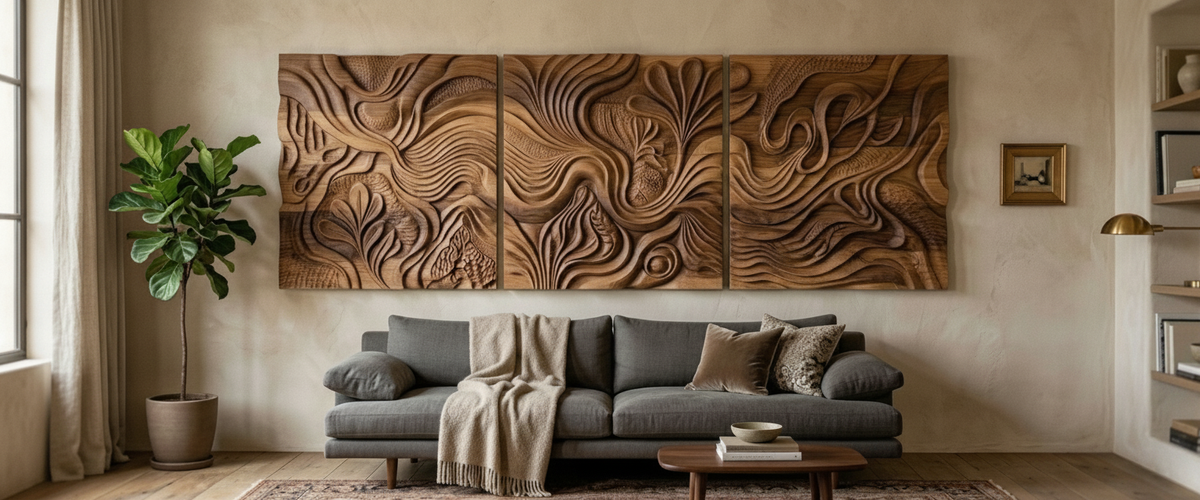

The fastest way to make a living room feel unfinished is to hang something too small over the sofa. We see it constantly: a great couch, considered lighting, then a postcard-sized frame floating in a sea of paint. Wall art living room decisions are the one detail that ties the height, the seating and the architecture together, and it is the one most people rush. Get the scale and finish right and the room reads as designed rather than decorated.
Looking for the full range in this category? Browse our Wall Art and Wall Decor collection for every available finish, size, and configuration. Good wall art living room choices start with knowing the wall before the piece.
This guide is written for buyers who want a piece with real presence: dimensional metal, carved wood, sculptural relief, the kind of work that throws a shadow and changes through the day. Below is the thinking we use with clients before a single fixing goes into the plaster, and it applies to almost any wall art living room brief.

Key Takeaways for Choosing Living Room Wall Art
Scale first. Aim for art that spans roughly two-thirds the width of the sofa or console beneath it.
Pick the finish for the light. Matte and carved surfaces calm a bright room; metallic and polished pieces wake up a darker one.
Hang to the eye, not the ceiling. Center the piece around 57 to 60 inches (145 to 152 cm) from the floor.
Dimensional beats flat in a living room because it works with raking daylight and lamp light rather than fighting reflections.
Budget tracks material, size, complexity and finishing, not a fixed sticker. Ask for a tailored quote.

What Wall Art for the Living Room Really Means, and Who It Suits
Living room wall art is the focal piece on your main seating wall or the wall you see first when you walk in. It is rarely a single small frame. The pieces that earn their place are larger, often dimensional, and built to be looked at from a sofa for years rather than glanced at in a hallway. That is what separates real wall art living room work from filler.
This suits a few buyers in particular. Homeowners furnishing a double-height great room or a wide loft need work that can hold a tall, open wall. Designers specifying for a client want a piece that photographs well and reads as bespoke. Collectors and venue owners want something with maker credibility behind it. If your living room has generous wall space and good light, dimensional wall art living room pieces reward you far more than another framed print.

How to Compare Wall Art for Living Room Options Before Buying
Start with the wall, not the piece. Measure the clear span, note where the light falls at different times of day, and decide whether the art is the hero or a supporting layer next to a window or fireplace. Every wall art living room decision gets easier once that span is on paper.
Then compare on four points. First, proportion: does the work fill enough of the wall to look intentional? Second, depth: a flat canvas and a carved relief read completely differently on the same wall. Third, palette behavior: how the color shifts under your lamps, not just the showroom. Fourth, longevity: whether the finish will still look right after a few years of sun and central heating.
For a calm, organic look across a wide seating wall, a carved wood set such as the Alvarae 3-Panel Flowform Wood Carving 3D Wall Art gives you flow and shadow without shouting. Where the wall is narrower, or a panel set would crowd a fireplace, a single metallic disc like the Astryn Gold Orbit Round Textured 3D Wall Art is closer to the right gesture, introducing one strong circular form with more glint. Both are sound wall art living room moves for the right span.

Materials, Finishes and Scale Decisions
Material does most of the emotional work. Carved wood feels warm and tactile and forgives a busy room; it absorbs light and softens hard architecture. Textured metal does the opposite, catching light and adding a contemporary edge. For larger statement walls we lean toward dimensional metalwork and sculptural relief because they hold up at scale where a flat surface would look thin. This is where wall art living room choices really pay off.
Finish choice should follow your light. A south-facing room with strong daylight can wash out a glossy surface and throw glare across it, so a matte or gradient carved face such as the Bathys Grey Gradient Carved 3D Wall Art tends to read better. A darker, north-facing or evening-lit room benefits from reflective metal or warm metallic leaf that picks up lamplight.
On scale, the common mistake is buying for the box, not the wall. A piece that looks large on a screen can shrink the moment it goes up. As a rule, the artwork or grouping should occupy about two-thirds to three-quarters of the furniture width below it. Over a 90-inch (229 cm) sofa, that points you toward a piece or arrangement around 60 to 68 inches (152 to 173 cm) wide. When in doubt, go larger; under-scaling is the more common regret with wall art living room sizing.
Color matters too. Light, organic tones recede and keep a room airy. Saturated, glossy work, the kind you find in the 3D Wall Art range, becomes the deliberate pop of color in an otherwise neutral scheme. Decide which job the piece is doing before you fall for a palette.
Where to Place Wall Art in a Living Room for the Strongest Impact
For wider placement ideas, Sandstone Art Panels That Redefine 3D Wall Decor is useful companion reading before finalizing the setting and sightlines for your wall art living room layout.
The seating wall is the obvious home, and usually the right one. Center the piece on the sofa rather than the wall if the two are not aligned; the eye reads it against the furniture. Above a fireplace is the second strong position, though watch the heat and the depth of the mantel so a dimensional piece does not feel cramped.
Stairwell-facing walls and double-height returns are made for vertical or oversized work. A tall blank wall in an open-plan room is the one place where a single dramatic piece outperforms a gallery wall, because the architecture is already doing the framing. Avoid hanging anything important on a wall you only see edge-on as you pass; the art deserves a front-on view from where people actually sit.
How to Hang and Arrange Wall Art in a Living Room
Center the piece at 57 to 60 inches (145 to 152 cm) to the middle, measured from the finished floor.
Leave roughly 6 to 10 inches (15 to 25 cm) of clear wall between the bottom edge and the top of the sofa back.
For a grouping, treat it as one shape: tape paper templates to the wall and live with them for a day before drilling.
Keep consistent gaps in a multi-panel set, usually 2 to 4 inches (5 to 10 cm), so it reads as one work.
Match fixings to the weight and wall type. Heavy carved or metal pieces need anchors rated well above the actual load, ideally into studs or masonry.
One lesson from the studio: we shipped a multi-panel carved set to a client with a textured plaster wall, and the uneven surface meant the panels sat proud at one corner. Now we always ask for a photo of the wall surface, not just the dimensions, before a dimensional wall art living room piece leaves us. The Smithsonian's guidance on living with original work makes a similar point about thinking through the wall and environment before you hang, not after.
Budget, Commissioning and Delivery
There is no honest single price for living room wall art, and you should be wary of anyone who quotes one before seeing your project. Cost follows material, overall size, how complex the carving or metalwork is, the finish, and how it is packed and shipped. A modest single panel and a wide bespoke relief sit in very different places. The right approach is a tailored quote against your actual wall and intent.
Lead time depends on whether you buy a catalog piece or commission. Bespoke work needs time for design sign-off, making and curing or finishing, then careful crating. Larger and heavier pieces travel in custom crates, and we ship worldwide, so factor freight and access into your timeline. If you have a tight install date for a new build or a staged sale, tell us early so your wall art living room order lands on schedule.
How Giant Sculptures Helps With Bespoke Living Room Walls
Giant Sculptures is a bespoke supplier of large-scale and statement work, and the living room wall is one of the briefs we enjoy most because the constraints are real: a fixed span, a known light condition, a sofa to work around. We can adjust scale, palette and finish on existing designs or build something from a sketch, then engineer the fixings to suit your wall.
If you are starting from a clean wall, browse the Living Room Art collection for direction, then talk to us about sizing your wall art living room piece correctly. For a warmer, hand-carved direction, the Wood Wall Art range is a good starting point; for contemporary glint, the Metal Wall Art collection shows how finish changes the mood of a piece. From there, a quick conversation about your wall usually settles scale and finish faster than another hour of scrolling.