






































































































A reception desk and a logo wall will tell a visitor your company exists. A well-chosen sculpture tells them what kind of company you are. That is the real job of office sculpture art, and it is why CEOs, facilities directors and interior designers tend to spend longer on this single decision than on most of the furniture around it.
This piece is written for the people actually signing off the commission: the founder fitting out a new Manhattan headquarters, the practice principal specifying a Texas medical campus, the design lead working on a Bay Area tech lobby. The questions are always the same. What material survives a busy lobby? How big is too big? Where should it sit? And how do you brief a studio so the finished piece looks intentional rather than ordered from a catalog?

Key Takeaways for Office Sculpture Art
- Scale beats quantity. One confident large piece reads better than a scattering of small accessories.
- Material drives lifespan. Bronze, stainless steel and stone are the workhorses of serious office sculpture art. Resin belongs in lighter, short-term fit-outs.
- Placement is a sightline exercise. Decide what the visitor sees first, what the camera sees on a tour, and what staff walk past every day.
- Bespoke is closer than people think. A commissioned piece tied to your sector or building often costs the same as a stock import once shipping and installation are added.
- Budget is a function of material, scale, engineering and finish. Ask for a tailored quote rather than a flat list price.
What Office Sculpture Art Really Means
The phrase covers more ground than people assume. At one end you have classic figurative work: an office art statue sculpture of a reading figure tucked into a library corner, or a cast bronze nude in a law firm reception, signalling a collector's eye. At the other end, you have abstract metalwork, kinetic pieces, and sector-specific commissions; the microscope sculpture outside the Vacaville Arts Guild office is a useful example of how a single object can encode an organization's identity for anyone walking past.
Public-sector work sits in the same family. An Art UK public sculpture officer commissions pieces for civic buildings the same way a corporate art consultant commissions for a head office. The decision-making is almost identical: durability, meaning, maintenance, insurance and the politics of how the piece will be read in ten years. Office sculpture art is simply the private version of that conversation.
Healthcare is its own subcategory. Buyers searching for metal art sculptures for doctors office sold in what stores are usually trying to do two things at once: soften a clinical environment and signal investment in patient experience. Off-the-shelf retail rarely solves that brief. A small commissioned bronze in a waiting area, or a stainless steel wall relief behind a reception desk, does the job in a way a framed print cannot.
Materials, Finishes and Scale
Material is the first real decision, because it sets the maintenance contract for the next several decades.
Bronze
Bronze remains the default for serious indoor and sheltered outdoor pieces. Cast in a foundry, patinated by hand, and finished with wax, it ages gracefully and accepts knocks from cleaning crews and rolling cases without flinching. For a corporate lobby that will see twenty years of foot traffic, bronze is rarely the wrong answer. The European Sculpture collection at The Met is a useful reference for how varied a single material can look across centuries.
Stainless Steel
Polished or brushed stainless reads modern, reflects the architecture around it, and works brilliantly in tech, finance and contemporary medical interiors. Mirror-polished stainless is striking but needs disciplined cleaning to keep fingerprints under control in high-traffic zones. Brushed and satin finishes are more forgiving.
Stone and Marble
Carved marble or limestone carries weight, both literally and culturally. For boardrooms, executive floors and law firms, a marble figurative piece signals permanence. Floor loading matters; pieces over a few hundred pounds (around 150 kg and up) need a structural check before delivery, especially above ground floor.
Corten and Outdoor Metalwork
If your office has a courtyard, plaza or rooftop terrace, Corten steel becomes interesting. The rust-stable surface looks excellent against planting and glass facades, and it handles weather without coatings. Reserve it for outdoor or semi-outdoor placement; the run-off can stain stone paving during the first year of weathering, which is worth planning for.
Resin and Composite
For wider placement ideas, Motivational vs. Mindful: What Office Art Style Works for You? is useful companion reading before finalising the setting and sightlines.
Honest answer: resin has a place in temporary fit-outs, pop-up showrooms or hospitality projects with a five-year horizon. For a permanent headquarters, it is the wrong tool. Buyers who start with resin often replace it within a lease cycle.
Scale
Lobbies routinely under-scale their sculpture. As a rough guide, a freestanding piece in a double-height reception wants to sit somewhere between 6 and 9 feet tall (1.8 to 2.7 m). In a standard 9-foot ceiling, 4 to 5 feet (1.2 to 1.5 m) on a plinth reads as intentional. Anything under 3 feet (90 cm) tends to look like an accessory rather than a statement, which is fine in a side gallery but wrong as the hero piece.
Placement: Where Office Sculpture Art Actually Earns Its Keep
Walk the building before you choose the sculpture. The piece should answer a specific sightline question, not float in space.
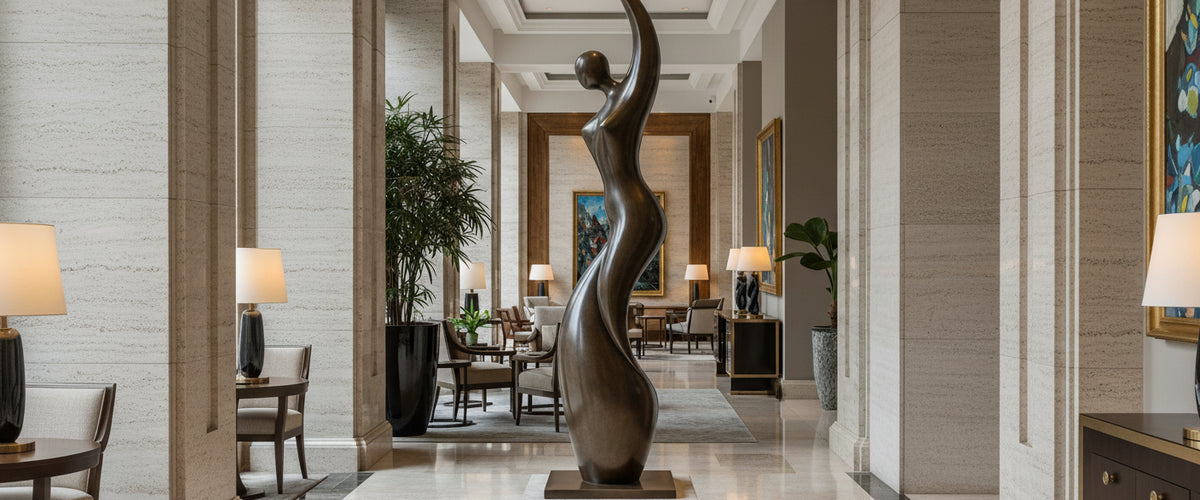
Reception and lobby. The strongest position is usually offset from the front door, visible on entry but not blocking the desk. Visitors should see it as they cross the threshold and again as they wait. A figurative bronze, a polished stainless abstract, or a commissioned piece referencing the company's sector all work here.
Boardroom and executive floor. Smaller scale, higher craft. A carved stone bust on a credenza, or a tabletop bronze on a console, signals confidence without dominating the room. This is where collectors often place pieces with personal meaning.
Corridors and breakout zones. Wall-mounted reliefs and mid-scale floor pieces break up long runs of glass and drywall. A staff corridor is also where you can be braver; this is where an office after 50 years art project sculpture woman, commissioned to mark a company anniversary, lives most effectively, where employees pass it daily rather than visitors glancing once.
Outdoor entrances and courtyards. Plaza-scale work changes the building's relationship with the street. Bronze and Corten are the usual choices. Plan lighting at the same time as the sculpture, not afterward.
If you want to see how indoor placement can work across very different styles, the Indoor Sculptures and Statues collection at Giant Sculptures is a reasonable starting library to browse with your designer. For a more pointed reference, sector-specific work like the pieces in our Medium Astronaut Sculptures range gets used in aerospace, tech and engineering offices where the subject ties directly to what the company does.
Budget, Commissioning and Delivery
Pricing for office sculpture art is driven by five things: material, scale, engineering complexity, finish, and installation. A 7-foot bronze in lost-wax cast with a hand-patinated finish sits in a very different cost band from a 7-foot fabricated stainless piece, even when they look similar in a render. Rather than quoting bands that will mislead you, we work to a tailored quote once the brief is firm.
A workable commissioning timeline looks something like this:
- Brief and concept. Two to four weeks of conversation, reference gathering and sketch development.
- Maquette or 3D visualization. A scale model or rendered preview lets stakeholders sign off before tooling starts.
- Fabrication. Bronze casting, stone carving and large stainless fabrication typically run several months. Plan around your fit-out date, not the other way around.
- Finishing. Patination, polishing or coating happens in the studio under controlled conditions.
- Crating, freight and install. International shipping, customs, rigging and on-site placement are quoted together. For pieces above around 500 lb (230 kg) we coordinate with the building's facilities team in advance.
Common Buyer Mistakes
- Choosing the piece before walking the space. Sightlines decide scale. Scale decides material. Working in that order avoids expensive second-guessing.
- Treating sculpture as the last item on the FF and E list. By that point the lighting is fixed and the floor loading is set. Bring sculpture into the conversation early.
- Buying for the rendering rather than the room. Renders flatter mirror-polish and dramatic angles. Visit a studio or request samples before signing off finishes.
- Underestimating maintenance. Bronze wants a yearly wax. Stainless wants regular wiping. Stone wants careful cleaning products. Build it into the facilities schedule.
How Giant Sculptures Approaches Office Commissions
Most of our office work starts with a conversation about the building rather than the sculpture. We ask for floor plans, ceiling heights, photographs of the intended placement, and a sense of the company's story. From there we propose two or three directions, usually mixing a figurative option, an abstract option and a sector-specific concept, and develop the chosen route into a maquette before any metal is cut or wax is poured.
We have shipped pieces into California tech campuses, Texas medical groups, NYC financial offices and Hamptons private offices, and the pattern is consistent: the projects that work best are the ones where the client treats the sculpture as architecture rather than decoration. Get that framing right and office sculpture art stops being a line item and starts being the thing visitors remember about the building.
For general conservation principles, Canadian Conservation Institute outdoor object care is a useful external reference, though the final care routine should always follow the material and finish specified for the individual commission.