




































































































Your home office wall is the most photographed surface in your house that nobody talks about. It sits behind you on every video call, in the frame for every client pitch, and in your eyeline for eight hours a day. Most people fill it with a print that looked fine in a showroom and reads as flat gray mush across the room on a colleague's laptop. A commissioned piece for your home office wall solves a harder problem: it has to work close up, across the room, and through a webcam that flattens everything. That is a very different design brief, and it is worth understanding before you spend a cent.
Looking for the full range in this category? Browse our Wall Art and Wall Decor collection for every available finish, size, and configuration.
We take on home office wall commissions regularly, and the ones that land are the ones where the buyer thought about how the piece would actually be seen. Below is how our studio approaches a home office wall project, the craft calls that move both the result and the price, and the questions that separate a serious maker from someone who will hand you a heavy problem.
How the piece behind your desk reads on camera matters as much as how it reads in person.

Key Takeaways for a Home Office Wall Commission
Viewing distance drives everything. A piece designed to be seen up close will look busy from across a long room, and vice versa. Say how the room is used before you pick a size.
Material sets the mood and the maintenance. Metal reads sharp on camera; wood and ceramic warm a room but need different lighting.
Weight and fixing are not afterthoughts. A large metal panel on a home office wall needs proper anchoring, not two picture hooks.
Price depends on scale, material, complexity, and install. Ask for a tailored quote rather than trusting a flat catalog number.
Ask the red-flag questions early. Fixing method, edge finishing, and how the piece handles glare all tell you who you are dealing with.

What Sculptors Actually Think About Before Taking on a Home Office Wall Commission
The first thing we ask about your home office wall is not "what do you like." It is "where does the light come from, and where do you sit." A working wall behind a desk with a north-facing window behaves nothing like a lamp-lit interior wall in a study. Directional light rakes across a textured piece and brings out every ridge; flat overhead light kills that same texture and makes it look like wallpaper.
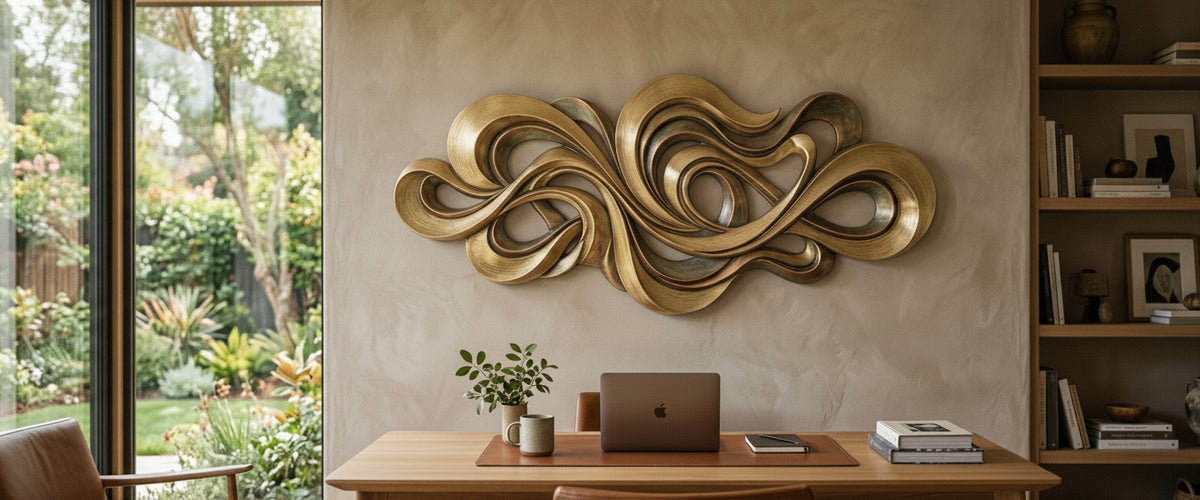
We also ask how the surface gets used on camera. If you spend half your week on video, a highly reflective metal finish can throw hotspots straight into the lens. That does not rule metal out, but it changes the finish we recommend. A brushed or lightly oxidized surface scatters light instead of bouncing it. Where a camera-facing home office wall needs a metal piece whose flowing forms break up reflections rather than presenting one big mirror to the room, Astrid Azure Flow Gold Abstract Wall Art sits closer to the right design language.
The last opening question is proportion. People consistently under-size wall art. A framed print that felt large in a shop shrinks against a nine-foot wall. As a rough studio rule, a statement piece should cover roughly two-thirds of the usable wall width behind the desk. Undersize it and the room reads unfinished on camera.

Craft Decisions That Change the Final Result (and the Price)
Once the brief is clear, a handful of craft calls do most of the work on both look and cost. None of them are optional; they just get decided well or badly.
Relief depth. A wall piece with 3 to 4 inches (roughly 8 to 10 cm) of real depth throws shadows that shift through the day. That movement is what separates a sculpture from a picture. Deeper relief means more material, more fabrication time, and more weight, so it costs more. Shallow work is cheaper and calmer. Neither is wrong; they suit different rooms.
Real relief depth throws shadows that move through the day, which is what carries a piece on camera.
Material. Metal wall art reads crisp and modern and photographs well under office lighting. Wood brings warmth and a domestic softness that suits a study better than a boardroom. Ceramic sits between the two, with a hand-made surface that catches light beautifully but is more fragile in transit and on install. For a home office wall in a room you also live in rather than just work in, a modular wood grid like Artiora Gold Edge & Wood Block Modular Grid 3D Wall Art gives you rhythm and depth without the cold reflectivity of a solid metal panel.
Finish. Gilded edges, patina, powder coat, oil, or wax all change how the surface ages and how it handles fingerprints and dust. A high-gloss finish shows every mark; a satin or textured finish forgives daily life. This is worth spending time on, because you will see this surface more than almost anything else you own.
Modularity. Panels that ship in sections are easier to carry up a stairwell, easier to fix level, and easier to replace if one gets damaged. For anything large, we usually recommend a modular build. It also lets you scale the piece to the exact home office wall rather than forcing a wall to fit a fixed size.

Why Some Home Office Wall Pieces Read Right up Close and Wrong From Across the Room
This is the mistake we see most in home office wall art ideas people bring to us. They fall for a piece with intricate, fine detail, hang it behind a desk, and then wonder why it disappears on video. Fine detail is a close-range pleasure. From across the room, or through a compressed webcam feed, small marks blur into noise.
Scale of pattern has to match viewing distance. If the room is long and the camera sits far back, you want bold forms, strong contrast, and generous negative space. If it is an intimate study where you and the odd guest see the piece from a few feet, fine texture and layered tone reward the closer look. For a home office wall that needs to do both, a textured mosaic such as Arcana Metallic Earth Textured Mosaic Half-Moon 3D Wall Art carries at distance because the half-moon form reads instantly, while the mosaic detail rewards you when you walk up to it. That dual register is exactly what you want.
We once shipped a large piece for a client's home office wall who filmed a lot of content in the room. The first design had lovely fine linework. On a test call it vanished. We reworked the maquette with deeper channels and a bolder rhythm, and it snapped into focus on camera without losing anything in person. That reworking is normal, and it is why the studio process below exists.
Studio Process: Maquette, Sample, Fabrication, Install
A home office wall commission should never jump straight to full build. Ours runs in stages so you can catch problems while they are cheap to fix.
Maquette. A scaled model or digital render that shows form, proportion, and how the piece sits on your specific wall. This is where you test it against a photo of the room and, ideally, against your webcam framing.
Sample. A physical finish and material sample. Screens lie about color and sheen. A gold edge that looks warm on a monitor can read brassy in a cool north-lit room. Hold the sample up at different times of day before you approve it.
Fabrication. The full build. For metal this means cutting, forming, welding, and finishing; for wood, milling, assembly, and sealing; for ceramic, forming, firing, and glazing. Lead time depends on scale and complexity, so agree it in writing.
Install. Delivery, wall assessment, fixing, and leveling. For a heavy home office wall piece this is a two-person job with the right anchors for your wall type. Drywall, brick, and plaster all need different fixings, and getting this wrong is the fastest way to ruin an expensive piece.
If you want to browse finished directions before commissioning, our office art collection and the broader metal wall art range are good starting points for narrowing down material and mood.
Honest Red Flags to Ask About Before You Commit
A confident maker will answer all of these without flinching. Vague answers are the warning.
How does it fix to the wall, and is the hardware included? If they cannot describe the fixing method for your wall type, they have not thought about install.
How are the edges finished? Raw or sharp edges on metal are a safety and quality issue. Ask to see edge detail in the sample.
How does the surface handle glare and dust? Especially important for a working, camera-facing home office wall.
What is the total weight, and can my wall take it? A large metal panel can be surprisingly heavy. Get the number before you fall in love with the design.
Can it ship in sections? Ask early if access is tight or the piece is going upstairs.
What is the repair path if a section is damaged? Modular and clearly documented finishes make future repair realistic.
On surface care, most metal and sealed wood pieces need little more than dry dusting and the occasional recommended treatment; conservation guidance from institutions like the Getty Conservation Institute is a good reminder that gentle, consistent care beats aggressive cleaning every time. Ask your maker for a simple written care note tied to your specific finish.
Turning Office Wall Art Ideas Into a Piece You Actually Want to Look at
The best home office wall art ideas start from how you work, not from a mood board. Map your camera angle, your light, and your viewing distance first. Then choose material and relief depth to match. Then commission in stages so nothing expensive gets decided on a screen. Get those three things right and your home office wall stops being background and starts doing real work, for you and for anyone watching on the other end of the call.
Giant Sculptures builds bespoke, large-scale wall pieces for home offices, studios, and commercial spaces, and we are happy to start with a conversation about your home office wall before anyone mentions size or budget. If you want a tailored quote, share the wall dimensions, the light, and how often you are on camera; those three details tell us most of what we need.
For wider placement ideas, Flower & Plant Art for Modern Homes: How to Style Botanical Wall Paintings Like a Pro is useful companion reading before finalising the setting and sightlines.