
































































































The same marble sculpture can look devotional in a Tuscan chapel and oddly clinical in a Tribeca penthouse. That is not the carving's fault. White stone is a chameleon, and the room (or terrace, or courtyard) does at least half the work. Before clients commission a piece with us, the conversation almost always shifts from "which figure" to "where exactly is it going," because placement decides whether a marble sculpture reads warm and alive or cold and stranded.
This is a placement guide written from the inside of that conversation. It covers how the stone behaves indoors versus outdoors, what weather genuinely does to it over decades, which backdrops rescue white marble and which kill it, and the lessons hiding inside famous marble sculptures most buyers can name.

Key Takeaways Before You Choose a Spot
- Light temperature changes everything. North light makes the stone look blue and severe; west light at 5pm makes it look like honey.
- Backdrop beats lighting. A pale wall behind a pale figure flattens the carving. Depth comes from contrast.
- Outdoor marble ages. Acid rain, freeze-thaw cycles, and pollution all act on calcium carbonate. Siting matters more than sealants.
- Scale is read against the nearest vertical. A 5 ft (1.5 m) figure looks heroic in a 9 ft hallway and lost in a 22 ft atrium.
- Famous carvings were sited deliberately. Michelangelo's Pieta was carved for a specific chapel niche. Borrow the principle, not the pose.

What Is Marble Sculpture, and Why It Behaves Differently to Other Stone
If you are new to commissioning, the short answer to what is marble sculpture: it is figurative or abstract work carved from blocks of metamorphic limestone, prized since antiquity for fine detail, surface translucency, and the way it ages. That last quality is where placement enters the story. Unlike granite or basalt, marble is alive to its surroundings, which is why two identical busts can read so differently in two different rooms.
Why the Same Marble Reads Warm Inside and Cold Outside
Marble is translucent for the first few millimeters of its surface. Light penetrates the crystal structure and bounces back out, which is why a Carrara figure under candlelight or warm tungsten seems almost lit from within. Put the same piece on a stone terrace under flat overcast sky and the same translucency reads as pallor. The stone is doing what it always does; the light is the variable.
Interiors give you control. A figurative carving in a hallway with warm 2700K downlights, set against a deep plaster wall, will look as it did in the workshop. Outdoors, you are at the mercy of season, latitude, and weather. A client in Napa whose courtyard sees direct afternoon sun for nine months of the year gets very different results from a client in coastal Maine where the light stays cool and silver most of the year.
The practical move: decide indoor or outdoor first, then choose the piece. Buying a figure because it looks beautiful in a Florentine showroom and assuming it will translate to an open Hamptons lawn is the most common mistake we are asked to fix.
What Weather Actually Does to Marble Over Ten and Fifty Years
Marble is metamorphosed limestone. Chemically, it is mostly calcium carbonate, which reacts with the mild sulfuric and nitric acids in rain. Over a decade in a clean rural setting, a well-sited piece will lose crispness on its highest points: the tip of a nose, the edge of a veil, the lifted finger. Over fifty years, those same points can soften noticeably. The Smithsonian's conservation guidance on outdoor stone (Museum Conservation Institute) is useful reading if you want the technical side.
Three site factors accelerate that timeline:
- Freeze-thaw exposure. Water enters micro-pores, freezes, expands, and spalls the surface. Climates like Aspen or upstate New York are punishing; Southern California is not.
- Urban air. NOx and SO2 in city air make rain measurably more acidic. A figure on a Manhattan roof terrace ages faster than the same piece in rural Texas.
- Irrigation overspray. Constant wetting and drying from sprinklers is harder on the stone than honest rain.
None of this means avoid outdoor marble. It means choose denser, lower-porosity stone for exterior commissions, raise the piece on a plinth so its base is not sitting in puddles, and accept that a faint patina is part of how the stone tells time. If you want a figurative piece that will look essentially the same in 2070, put it inside.
Three Honest Test Cases: Hallway, Courtyard, Orangery
The Hallway
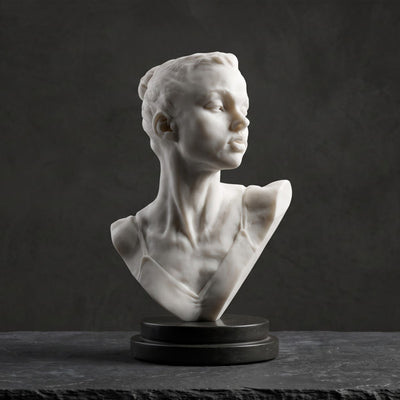
A long interior hallway is the easiest win for a marble bust or smaller figure. You get controlled light, a fixed viewing distance, and a natural sight line. The mistake here is going too small. A 16 in (40 cm) bust on a console at the end of a 30 ft hallway disappears. We typically recommend a piece between 22 and 30 in (55 to 75 cm) for that situation, on a plinth that brings the eyeline to roughly 5 ft 4 in (1.6 m). Something like the Veiled Lady Marble Bust Sculpture - 65cm on a 4 ft plinth reads correctly from twenty feet away; the same bust on a low side table reads like an ornament.
The Courtyard
An enclosed courtyard is the best outdoor location for the stone. Walls buffer wind, reduce direct rain exposure on the figure's profile, and provide the backdrop the carving needs. A central placement only works if the courtyard is genuinely symmetrical; otherwise, push the piece toward a wall and let it anchor a corner. Drainage at the base is the unglamorous detail that protects the work. Standing water is the enemy.
The Orangery
Glasshouses, conservatories, and orangeries are the underrated answer for marble in cold climates. You get daylight, protection from freeze-thaw, and a backdrop of greenery that flatters white stone better than almost any wall finish. The watch-out is humidity. A Napa orangery running misters for citrus trees creates a microclimate that can encourage biological growth on stone. Good ventilation solves it.
Backdrop: How Color Rescues or Ruins White Stone
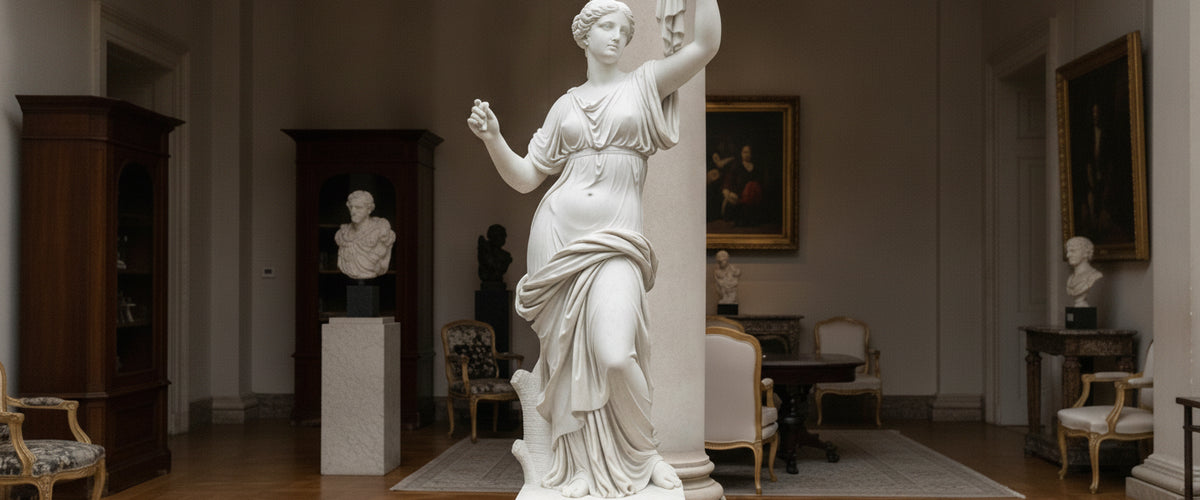
A white marble figure against a white wall is the placement equivalent of mumbling. The carving's shadows, which is where the sculptor's skill actually lives, have nowhere to read. The fix is contrast, and it does not have to be dramatic.
What works, ranked roughly by how often we recommend it:
- Deep, matte plaster in warm neutrals. Clay, ochre, burnt umber, mushroom. These give the stone depth without competing with it.
- Dark green foliage. Boxwood, yew, ivy. The reason classical Italian gardens look the way they do.
- Cool charcoal or near-black walls. Dramatic and gallery-like; best for a single sculptural moment rather than a room with many objects.
- Aged brick or weathered timber. Texture reads beautifully behind smooth stone.
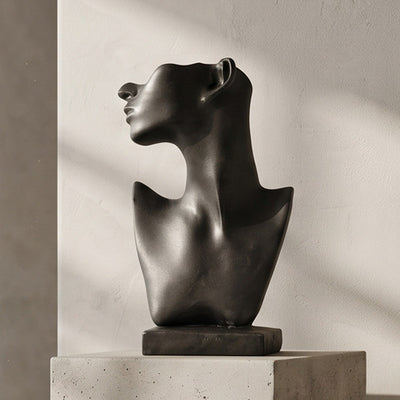
Where the backdrop is already dark and you want the figure to recede rather than glow, a tonal piece such as the Black Marble Veiled Figure bust shifts the logic entirely: now the carving reads as silhouette and edge rather than as luminous surface, which can be the right answer for a contemporary interior with strong architectural shadows.
What rarely works: pure white, glossy finishes, busy wallpaper, and pale gray. Pale gray in particular makes the stone look dingy because the values are too close.
What the Pieta Marble Sculpture and the Marble Sculpture Veil Tradition Teach Us About Siting
Michelangelo's Pieta sits in a niche in St Peter's, raised, slightly back-lit by ambient light, and viewed from a fixed approach. That is not an accident. The composition was designed to be read from a known angle and distance. The Met's overview of Italian Renaissance sculpture is a good primer on how period pieces were sited for specific architecture.
The lesson the Pieta marble sculpture offers buyers is simple: decide the primary viewing angle before you decide anything else. Most figurative carvings are made with a "front" the sculptor wants you to see first. Place the work so that face meets the natural approach to the room or garden, not so a guest's first encounter is the back of a shoulder.
The marble sculpture veil tradition (Antonio Corradini, Giovanni Strazza, and the workshop tradition that followed) is the other instructive case. A veiled figure depends entirely on raking light. Flat overhead lighting kills the illusion. For a salon or entry hall where the piece will be the single focal point, a full-length figure like the Veiled Lady Marble Sculpture - 130cm needs a light source coming in from one side at roughly 30 to 45 degrees; for a tighter interior where a bust is the right scale, the Canova's Veiled Woman Marble Bust Sculpture - 55cm works on the same principle at a fraction of the footprint. That side-angled light is what makes the carved cloth read as fabric rather than as a clouded surface.
Placement Mistakes We Have Been Called In to Fix
For wider placement ideas, Beyond the Vein: Marble Sculptures That Redefine Art and Elegance is useful companion reading before finalising the setting and sightlines.
A short list, from real commissions:
- The double-height atrium problem. A 4 ft figure ordered for a 24 ft ceiling. The fix was a new bronze plinth that added 3 ft of visual mass and brought the piece into proportion with the volume.
- The west-facing terrace. A Carrara bust placed where afternoon sun hit it directly for six hours a day. Surface bleaching within two summers. Moved into a loggia, the piece recovered visually within months.
- The pale gallery wall. A serious collector's marble torso disappearing against a soft-white plaster wall. We repainted the alcove only, in a deep clay, and the work looked like a different (better) sculpture.
- The irrigation line. A garden figure sited beautifully but directly in the spray pattern of a pop-up sprinkler. Constant wetting on the lower legs caused early biological staining. A 90-degree adjustment of the sprinkler head solved it.
None of these were carving problems. All were siting problems. That is the point.
Buyer Checklist Before You Commit
- Have you walked the exact spot at the time of day you will most often see it?
- Is the backdrop providing contrast, or fighting the piece?
- If outdoors, is the work protected from direct irrigation and standing water?
- Does the primary viewing angle meet the figure's strongest face?
- Is the scale calibrated against the nearest vertical (door frame, wall height, hedge line), not the floor plan?
- For climates with freeze-thaw, have you discussed stone density and base detail with your supplier?
If you are working through a bespoke commission with Giant Sculptures, this is the part of the conversation where we send drawings, mock-ups, and sometimes a cardboard volume study to install in the space before a chisel touches stone. Budget for a marble sculpture varies widely with size, stone source, complexity of carving, base, and installation logistics; we quote against a specific brief rather than a list price, because two figures of the same height can involve very different work. The full range of indoor and garden options sits in our marble sculptures collection, and the broader garden statues collection is a good starting point if the brief is exterior.
Get the placement right and a marble sculpture will outlive everyone in the room. Get it wrong and even a brilliant carving will look like it is apologizing for being there.