





































































































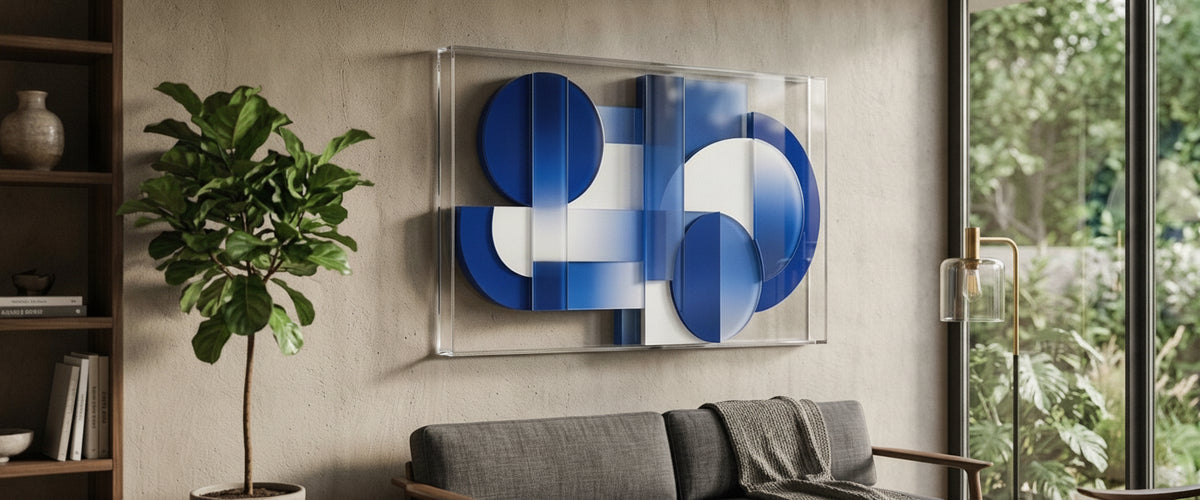

Hang a sheet of acrylic art on the wrong wall and it disappears; hang the same piece where light rakes across its edges and it holds a room. That gap is the whole story with wexel art acrylic. The material is honest and modern, but it is unforgiving about placement. Get the height, backdrop, and lighting right and a floating wexel art acrylic panel reads like layered glass with depth. Get them wrong and it flattens into something you scroll past.
We spend most of our time on large bronze, stainless steel, and stone commissions, so we look at acrylic the way we look at any statement piece: as an object that has to command sightlines, not just fill a gap above a console. That mindset is exactly what most acrylic wall art buyers are missing when they shop for wexel art acrylic.

Key Takeaways for Acrylic Wall Art Buyers
Wexel art acrylic is a floating panel format: art or paint sits inside or between clear sheets, so it appears suspended off the wall.
Scale and eye height matter more than the artwork itself. A small panel on a large wall almost always underperforms.
Acrylic loves side light and hates flat, head-on lighting that kills its depth.
Indoors it wins in most cases; outdoor use is possible but demands shade, ventilation, and honest expectations about heat and UV.
Budget depends on size, layering, framing, and whether the piece is custom, so ask for a tailored quote rather than assuming a fixed price.

What Wexel Art Acrylic Actually Looks Like in a Room
The wexel art acrylic floating frame system holds artwork between clear sheets, so the image or painted layer sits away from the wall with a shadow line behind it. That shadow gap is the trick. It gives the piece a sense of floating depth that a flat canvas or a mounted print never achieves. When people search for acrylic glass wall art or wall art on acrylic, this floating quality is usually what they are picturing, even if they cannot name it.
In a bright living room with pale plaster walls, a clear panel almost dissolves into the surface behind it, letting the artwork hover. In a den with dark paneling, the same wexel art acrylic panel reads as a crisp, glossy object with hard edges. Neither is wrong. They are two different effects, and you choose the room to get the one you want.
Hand-painted layered pieces push this further. Where a grouping needs to create rhythm across a wide wall rather than a single focal point, a set such as the Terracube 3-Set Hand-Painted Framed Acrylic 3D Wall Art - Fixed Sizes uses depth and repetition across panels to carry that width. That is a different placement problem than one large wexel art acrylic panel, and worth planning before you buy.

Scale, Sightlines, and Hanging Height
The most common fix we recommend costs nothing: go bigger, and hang lower than you think. Most people mount acrylic wall art too high, chasing the top of the wall instead of the viewer's eye. Museums generally center work around 57 to 60 inches (145 to 152 cm) from the floor to the artwork's center, and that guidance holds for a home too. The Smithsonian Institution uses a comparable center-line standard across its galleries.
For large acrylic wall art over a sofa or credenza, leave roughly 6 to 10 inches (15 to 25 cm) of breathing room between the top of the furniture and the bottom of the frame. Any more and the piece floats off on its own; any less and it looks propped. On a tall entryway wall, a single generous wexel art acrylic panel beats a cluster of small ones almost every time. Small panels on big walls read as timid.
Sightlines matter as much as the wall itself. Walk the approach. If people see the piece first from a doorway 15 feet (4.5 m) away, its scale has to survive that distance. A wexel art acrylic panel that looks confident from two feet can look like a postcard from across an open-plan room.

Light, Backdrop, and Contrast
Acrylic is a light-driven material. It has edges that catch and glow, and a glossy face that either shows depth or throws glare, depending entirely on where the light comes from. Head-on downlights tend to flatten a wexel art acrylic panel and bounce a hot spot straight back at the viewer. Light raking from the side or from a slight angle catches the edge thickness and the shadow gap, which is where the floating illusion lives.
Backdrop contrast is the other lever. A clear or cobalt panel needs a wall it can push against. Where the setting calls for a saturated panel that reads with real punch against warm off-white or pale gray, the Aurenza Cobalt Blue Acrylic & Metal Frame 3D Wall Art is closer to the right design language, though it can vanish against a busy patterned wall. Before committing, tape a paper template the exact size of the piece to the wall and live with it for a day. You will spot glare and dead zones you would never predict on a screen.
If your room simply lacks good side light, consider an illuminated piece instead of fighting the architecture. A layered LED panel such as the Zenith black 3D framed acrylic LED layered illumination wall art carries its own light source, which solves the depth problem in dim hallways, media rooms, and windowless galleries.
Indoor Versus Outdoor: When Each Wins
Indoors, wexel art acrylic wins in most homes. It is lighter than glass, holds color well, and shrugs off the small knocks that would chip a framed print. For a dining room or an apartment with limited wall depth, its slim floating profile is a real advantage.
Outdoors is where honesty matters. A wexel art acrylic panel can go outside, but it is not the material we reach for on an exposed terrace or a full-sun courtyard. Cast acrylic handles weather better than cheaper extruded sheet, yet prolonged UV, thermal expansion, and heat build-up behind a sealed panel all work against a wall piece over time. Acrylic's clarity and weatherability are genuine strengths, but that does not make every product built for years of direct sun and rain. For a covered loggia or shaded courtyard wall, a well-made panel can do beautifully. For an open wall facing the afternoon sun, we would steer you toward metal wall art or a sculpture in stainless steel engineered for the elements.
This is the same logic we apply to our large outdoor commissions: match the material to the exposure, not to the mood board. If a client wants a wexel art acrylic look outdoors year-round, we usually talk through a bespoke metal-and-acrylic hybrid where the structure carries the load and the panel stays protected.
Common Placement Mistakes We See
For wider placement ideas, How to Place Big 3D Metal Wall Panels That Actually Read is useful companion reading before finalising the setting and sightlines.
Hanging too high. The single most frequent error. Drop it to eye level.
Undersizing. A 24-inch panel on a 12-foot wall looks lost. Scale up or group deliberately.
Fighting the light. Placing a glossy panel directly opposite a window guarantees glare at some point every day.
Ignoring the backdrop. Clear acrylic needs contrast behind it; busy wallpaper cancels the effect.
Weak fixings. Layered and framed panels carry real weight. Anchor into studs or use proper wall plugs rated well above the load.
How to Hang Acrylic Wall Art Properly
Practical steps for a clean install of a wexel art acrylic panel:
Find the studs and mark them. For heavier framed panels, fix into structure wherever possible.
Measure to the center point, aiming for around 57 to 60 inches (145 to 152 cm) from the floor.
Use a template. Cut paper to the exact panel size, tape it up, and check height and glare across a full day.
Level with a spirit level, then mark and drill for the supplied standoffs or French cleat.
Hang, then step back to your normal viewing distance and adjust. Acrylic shows a crooked line more than canvas does.
Choosing the Right Acrylic Piece
When buyers ask us how to choose between wexel art acrylic panels, we push them toward a few clear questions. What is the viewing distance, and does the scale survive it? Is the wall backdrop working for or against the panel color? Where does the light come from at the times the room is actually used? Is this a single hero panel or a grouped composition, and does the wall suit that choice?
Sets answer the grouping question well. For a wider, more architectural spread across a long wall, the Terracube 4-Set hand-painted framed acrylic 3D wall art gives you more horizontal reach, while a single square such as the Lucida Gold & White Acrylic Square Framed 3D Wall Art concentrates attention in a smaller footprint like an alcove or between windows.
For custom acrylic wall art, we plan the wexel art acrylic piece around the wall rather than the other way round. Giant Sculptures works as a bespoke supplier of large-scale and statement work, so if you have an unusual wall, a specific palette, or a scale nothing off the shelf can meet, a commission is often the cleaner route. You can look through the full acrylic art range to see what is possible, then talk to us about adapting scale, layering, or framing to your space.
Living With Acrylic Long Term
Acrylic scratches more easily than glass, so care matters. Dust with a clean microfiber cloth and a dedicated plastic cleaner; never use ammonia-based glass sprays, which can craze the surface over time. Keep panels out of direct, sustained sun indoors too, since prolonged UV can affect some pigments and adhesives. Treated well, a quality wexel art acrylic panel keeps its clarity for many years, which is why we consider it a serious option rather than a disposable one.