





































































































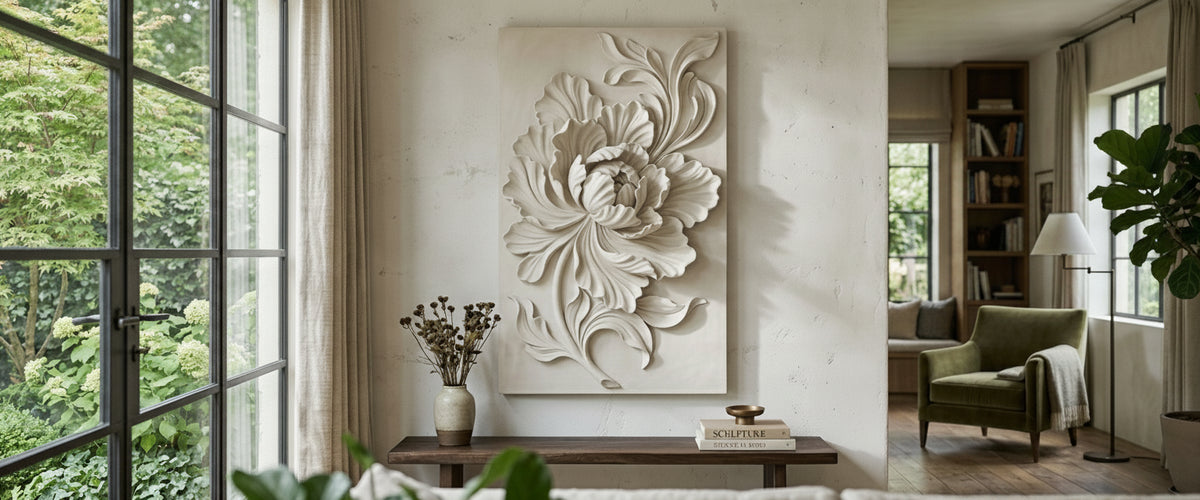

A flat print apologizes for itself the moment you walk past it. Wall art in 3D does the opposite. It catches a sliver of morning light, throws a shadow you did not plan for, and turns a blank plaster wall into the most considered surface in the room. That is the appeal of wall art in 3D, and that is also where most buyers get the placement wrong.
This guide is built from what we see in commissions every week at Giant Sculptures: rooms where a sculptural relief lands beautifully, and rooms where the same piece would have looked tentative if we had not pushed back on the spec. If you are weighing up 3D wall art for a project, the decisions below matter more than the piece itself.
A floral relief above an 11 ft sideboard, lit from one side to bring out depth.

Key Takeaways
Scale up, not down. Most 3D wall art is bought too small for the wall it ends up on.
Light is half the artwork. Raking light from one side reveals depth; flat overhead light kills it.
Backdrop matters as much as the piece. A matte, mid-tone wall almost always outperforms gloss white.
Outdoor 3D wall art has different rules. Material, fixings and orientation decide whether it lasts a decade or a season.
Bespoke beats off-the-shelf at scale. Past roughly 6 ft (1.8 m), commissioning wall art in 3D is usually the only honest answer.

What Wall Art in 3D Actually Looks Like in a Real Room
Wall art in 3D is a broad category. It covers carved relief panels, cast bronze plaques, layered acrylic compositions, sandstone friezes, metal botanicals, and 3D printed wall art used as architectural inserts. What unites them is depth: the surface stands proud of the wall, sometimes by half an inch, sometimes by a foot.
In a Napa dining room we shipped to last spring, the client wanted a single floral relief above an 11 ft sideboard. The piece we delivered sat about 3 in (7.6 cm) off the wall, close in profile and scale to Floraventa Bloom II Floral 3D Carving Wall Art. That depth is small in numbers and large in effect. Candlelight at dinner pushed the petals into relief; by lunchtime, the same piece read almost graphic. Two artworks for the price of one, which is what well-judged 3D wall art decor actually buys you.
Living rooms, stair landings, hotel lobbies, restaurant private dining, primary bedroom headwalls and exterior courtyard walls are the rooms where we see 3D wall art decoration earning its keep. Galleries of small framed prints are doing different work. If you want a wall that holds attention without competing with the furniture, depth is the lever, and wall art in 3D is the format.

Scale, Sightlines and Hanging Height
The single most common mistake we see with wall art in 3D is buying a sculptural piece that is correctly sized for the sofa and badly sized for the wall. The sofa is a red herring. What matters is the visual field: the wall, the ceiling height, and where the viewer first sees the piece from.
A working rule we use in client conversations:
Standard 8 to 9 ft (2.4 to 2.7 m) ceilings: the piece should occupy 55 to 70 percent of the available wall width.
Double-height rooms (12 ft / 3.6 m and above): think in terms of a vertical composition that reads from across the room, not just from the seating area. Where a single tall panel would feel narrow, a triptych such as Moro I Triptych White Relief 3D Wall Art spreads the visual weight horizontally while still answering the height.
Stair walls: hang to the diagonal sightline, not the floor. The center of the piece should sit at eye level for someone halfway up the stairs.
Center height for most wall art in 3D still defaults to 57 to 60 in (145 to 152 cm) from finished floor to the optical center of the work. For relief pieces with strong vertical weight at the base, drop that by 2 to 3 in. You are aligning the visual gravity, not the geometric middle.
Outdoors, a sculptural relief becomes architecture and is read from across the courtyard.

Indoor Versus Outdoor: When Each Wins
Wall art in 3D indoors is mostly about texture, shadow and intimacy. Outdoors, it becomes architecture. A Corten relief on a courtyard wall in Aspen or a cast bronze panel on a Hamptons pool house is doing a different job: it anchors the elevation, takes weather as part of its character, and is read from 30 ft (9 m) away rather than 3 ft (0.9 m).
If a client is choosing between an interior hallway or an exterior garden wall for the same budget, we usually ask one question: how often will you walk past it versus look at it from a distance? Walking past favors interior placement and finer detail. Long views favor exterior, larger forms and bolder silhouettes. A sandstone relief like Malachra Crest I Relief Sandstone 3D Wall Art can work in either context as wall art in 3D, but the surface treatment and fixing spec we recommend changes completely.
For outdoor commissions we lean on bronze, stainless steel, Corten and dense stone. These materials behave predictably outdoors over decades; lighter composites and acrylics belong inside. The Smithsonian's guidance on outdoor sculpture care is a useful reference if you want to understand why material choice drives lifespan more than any sealant (si.edu/mci).

Light, Backdrop and Contrast
A sculptural relief is the only category of art where the lighting plan is part of the artwork. Get this wrong and a beautifully carved piece of wall art in 3D reads as a flat shape from six feet away.
What works:
Raking light from one side. A wall washer or a directional spot at 25 to 35 degrees off the wall plane reveals depth. Symmetrical lighting from both sides cancels shadow and flattens the relief.
Warm color temperature, 2700K to 3000K indoors. Cooler temperatures make stone and bronze look clinical.
A matte mid-tone backdrop. Deep plaster, limewash, oak paneling and warm gray drywall all outperform gloss white. A metallic surface like the one on Orienta II Templescape Gold 3D Carving Wall Art needs a backdrop that lets the gold modulate through shadow; against bright white it blows out and reads flat.
Outdoors, orientation does the work that lighting does indoors. North-facing walls give consistent, soft light all day. South-facing walls give dramatic shadow that moves: great for wall art in 3D with bold reliefs, hard on figurative detail. The Illuminating Engineering Society publishes useful baseline guidance on exterior accent lighting if you are specifying a full scheme (ies.org).
Common Placement Mistakes We See
For wider placement ideas, 3D Magic: How Sculptural Ceramic Art Adds Depth to Flat Walls is useful companion reading before finalising the setting and sightlines.
Patterns repeat across commissions for wall art in 3D. These are the ones worth pre-empting.
Hanging too high. Buyers nervous about a large relief push it up the wall. The result looks like it is floating away. Bring it down to a confident center height.
Choosing a piece that competes with a window. If natural light enters from the same wall, the artwork will lose every time. Move it to an adjacent wall.
Mixing too many finishes in one sightline. A gold relief, a brass mirror and a polished marble console in one frame is noise. Let the sculptural piece be the metallic note.
Under-engineering the fixing. Dimensional wall art in 3D is heavier than its visual weight suggests. We have specified pieces over 200 lb (90 kg) that need French cleats anchored into studs or masonry, not drywall plugs. Always confirm wall build-up before you finalize a piece.
Forgetting the approach. A relief seen edge-on from the doorway reads as a sliver. Walk the room before you commit to a wall.
3D Printed Pieces, Cast Work and Bespoke Commissions
3D printed wall art has expanded what is possible at the smaller end of the market. It is useful for intricate geometry, lighter weight and faster turnaround. For statement wall art in 3D above 4 ft (1.2 m), or any exterior installation, we still default to traditional material processes: carved stone, cast bronze, fabricated stainless steel, or layered acrylic for interior color work. Print quality at scale is improving, but lifespan, UV stability and surface depth are still where cast and carved pieces lead.
Smaller decorative categories, 3D butterfly wall art being the obvious example, sit in a different conversation. They are charming as accents in a powder room or a child's space, but they are not the same brief as a sculptural installation for a great room or a commercial lobby.
When clients ask us to commission a bespoke piece of wall art in 3D, the early conversation is almost never about the image. It is about wall dimensions, ceiling height, sightlines, light sources, existing materials in the room, and how long the piece needs to last. From there we work back to material, depth profile, finish, and fixing detail. Budget depends on material, scale, complexity, engineering, installation and finishing; we quote each commission individually rather than working from a price list.
A Quick Pre-Purchase Checklist
Measure the wall, not the furniture. Width, height, and clear space around fixtures.
Photograph the wall at three times of day. Light tells you everything.
Decide indoor or outdoor before you choose material for your decor 3D wall art.
Confirm wall build-up (stud, masonry, plasterboard over batten) for fixings.
Plan the lighting scheme alongside the piece, not after.
For anything over 6 ft (1.8 m) or destined for exterior, ask for a bespoke quote on wall art in 3D.
Wall art in 3D is one of the few interior decisions that genuinely improves a room over years, not months. Get the scale and the light right, and a single piece of wall art in 3D can carry an entire elevation. Browse the full 3D wall art collection or talk to our studio about a commission if your wall deserves something built for it.