



























































































Walk into most corporate lobbies and you will spot the same mistake: a small framed print stranded in the middle of a fourteen-foot wall, hovering somewhere near the ceiling, doing nothing for anyone. The wall wins, the art loses. Good wall art ideas office planners rely on start with the wall itself, not the picture, and that shift in thinking is what separates a piece that anchors a room from one that reads as an afterthought.
Looking for the full range in this category? Browse our Wall Art and Wall Decor collection for every available finish, size, and configuration.
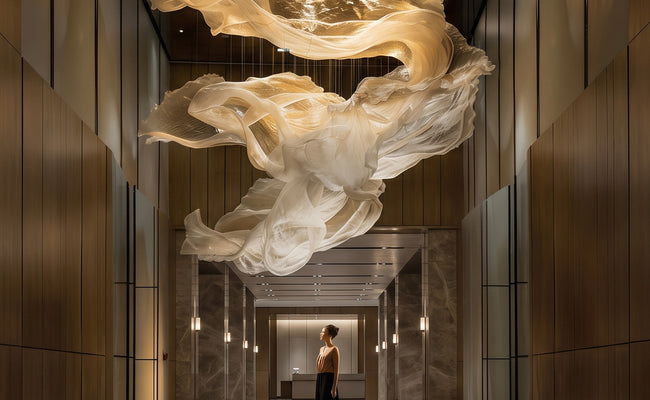
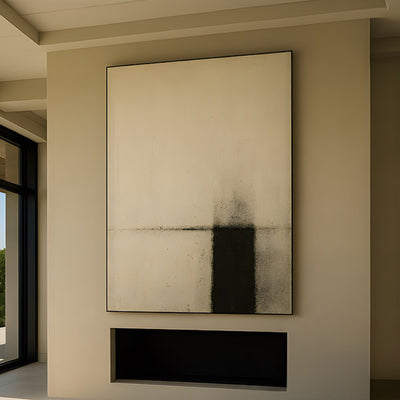
Scale to the wall, not the desk: a large composition anchors a reception space.
We ship large-scale and bespoke work to reception areas, boardrooms, and outdoor courtyards on both sides of the Atlantic, and the questions that decide success are almost always the same. How big is the wall? Where does the eye land first? What sits behind and beside the piece? The best wall art ideas office teams settle on come from answering those questions before anyone picks a finish. Get them right and even a restrained composition carries a room.

Key Takeaways
Scale to the wall, not the desk. Office art usually needs to be larger than people expect; a piece should occupy roughly two-thirds of the available wall width.
Set the visual center around 57 to 60 inches (145 to 152 cm) from the floor for standing sightlines, higher only when people mostly view it seated.
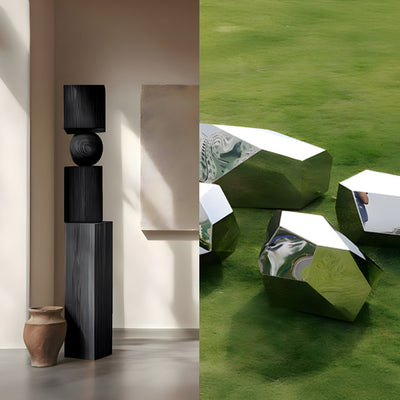
Indoor and outdoor placement demand different materials. Ceramic and lighter metal suit interiors; Corten, stainless steel, and bronze belong outside.
Backdrop and light do half the work. Contrast and a grazing light source decide whether texture reads or flattens.
Bespoke commissions solve the odd wall that no off-the-shelf panel ever fits.

What Office Wall Art Ideas Actually Look Like Across Different Spaces
A reception wall, a corner office, and a shaded courtyard all ask for different things, so treating office wall art ideas as one category is the first trap. The strongest wall art ideas office designers use flex with the space: in a double-height lobby, you want presence, so a wide metal composition or a modular grid that reads cleanly from thirty feet away. In a private office, the viewing distance shrinks, so surface detail and texture matter more than sheer footprint.
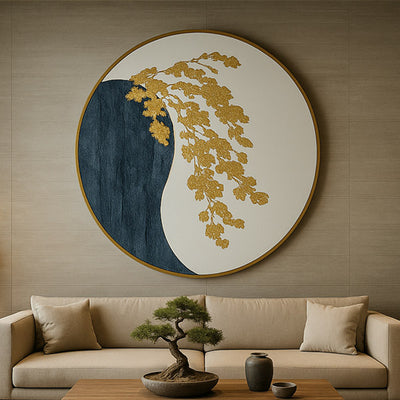
Reception and lobby walls reward pieces with movement. Where a space is passed through rather than sat in, a flowing abstract such as Astrid Azure Flow Gold Abstract Wall Art gives the eye something to follow the moment someone walks in. Boardrooms and meeting rooms, by contrast, are viewed slowly and up close, so tactile work earns its place. For the long look during a meeting that has stalled, a sculptural ceramic panel like Artevo Sculptural 3D Ceramic Wall Art With Dynamic Texture rewards close attention in a way a flat print never will.
Outdoor office settings, think a landscaped tech campus in California or a hospitality terrace in the Hamptons, change the brief again. This is where wall art ideas office managers borrow from indoor spaces tend to fall apart: the wall is often masonry, brick, or rendered concrete, and the art has to survive weather while holding its own against sky and planting. That is where we lean toward engineered metalwork rather than interior ceramics.

Scale, Sightlines, and Pedestal Height: The Choices That Change How a Piece Reads
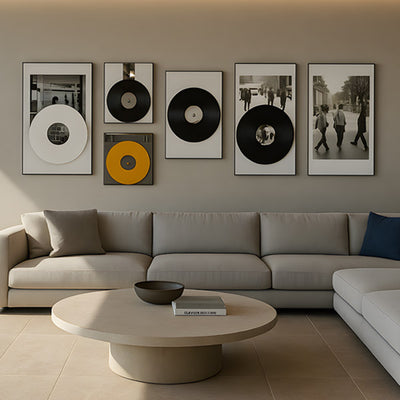
Scale is the decision people get wrong most often, and it is almost always undersizing. It sits at the heart of every set of wall art ideas office planners bring to us. A useful starting rule: your piece, or your grouping, should span around two-thirds of the usable wall width. On a twelve-foot wall that means roughly eight feet (about 2.4 m) of art, whether that is one large work or a coordinated cluster.
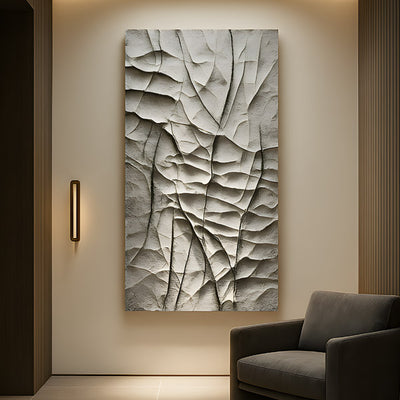
Grazing light reveals the texture of a dimensional piece far better than raw scale.
Height is the second lever. For a piece viewed by standing visitors, set the visual center near 57 to 60 inches (145 to 152 cm) from the floor. That figure comes from gallery hanging practice and it holds up in reception areas where people are on their feet. In a room where the audience is seated for long stretches, a boardroom or a waiting lounge, drop the center slightly so the work meets a seated eyeline.
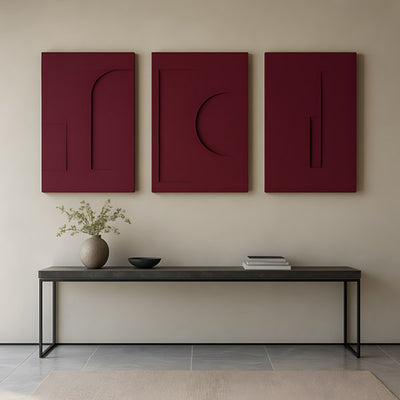
Modular systems give you control over both at once. Where a wall is broken up by a light switch or thermostat, a grid such as Artiora Gold Edge & Wood Block Modular Grid 3D Wall Art lets you tune the overall footprint by adjusting spacing between blocks, which is far more forgiving than trying to find a single panel in exactly the right dimension. We have used that flexibility to work a grid around obstructions instead of pretending they were not there.
Where a piece needs a pedestal or a projecting mount, keep the base proportionate. A shallow reveal of two to three inches (5 to 8 cm) off the wall lets a 3D work throw its own shadow, which is often what makes the texture come alive.

Indoor Versus Outdoor Placement: When Each Wins
For wider placement ideas, Inspirational Wall Art for the Office: What Sculptors Decide Before They Start is useful companion reading before finalizing the setting and sightlines. It also pairs well with the wall art ideas office sections you have already read here.
Indoors, you have a controlled climate and no UV assault, so material choice opens right up. Ceramic, wood, and lighter metal compositions all perform well and give you color and warmth that outdoor materials rarely match. A textured ceramic piece with plum and amber tones brings heat to a cool, glass-heavy interior in a way that raw steel never will.
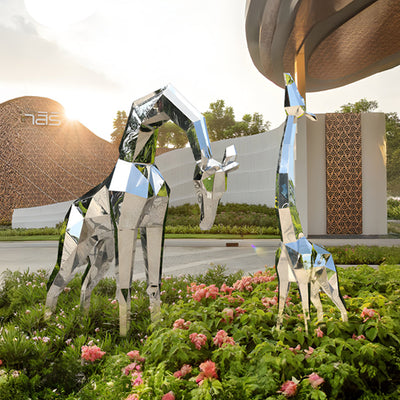
Outdoors, longevity governs everything. Corten weathering steel develops a stable rust-toned patina that suits landscaped grounds and reads beautifully against greenery; the ASTM A606 specification covers the high-strength, corrosion-resistant steel this effect relies on. Stainless steel holds a bright, reflective face that bounces light around a courtyard. Bronze ages gracefully and forgives coastal air better than most metals. For an exterior office wall, one of these will outlast an interior ceramic by decades, which is why outdoor wall art ideas office teams choose should always start with material.
The honest answer to which one wins is that it depends on the wall and the climate. A sheltered atrium can take interior-grade work; an exposed south-facing facade in Texas cannot. When clients are unsure, we specify by exposure first and aesthetics second, because a beautiful piece that chalks and fades in two summers is a false economy.
Light, Backdrop, and Contrast: The Details That Decide Impact
Texture only exists when light rakes across it. A 3D wall piece lit flat from the front looks like a photograph of itself; the same piece lit from a steep angle throws shadows that reveal every ridge. For interiors, a track light or wall-washer positioned to graze the surface at roughly 30 degrees will do more for a textured work than doubling its size. Lighting is the part of most wall art ideas office briefs that gets treated as an afterthought, and it should not be.
Backdrop contrast is the quiet decider. Gold and metallic finishes disappear against a pale, warm wall and snap into focus against a deep charcoal or forest tone. A metallic, dimensional piece such as Arcana Metallic Earth Textured Mosaic Half-Moon 3D Wall Art can look inert against magnolia paint and then transform the moment it goes up on a near-black feature wall. If your office walls are white, you may need to introduce a painted panel or a darker recess behind the art.
Outdoors, the backdrop is planting and sky, both of which move. Corten against evergreen hedging stays reliable year-round; a reflective stainless piece against changeable sky will look different every hour, which some clients love and others find restless. Think about what sits behind the work in every season before you commit.
Common Placement Mistakes We See in Commissions
The same errors turn up again and again, and all of them are avoidable. They are the mistakes that quietly sink otherwise sound wall art ideas office teams have spent weeks on.
Hanging too high. Fear of low art pushes people to mount it near the ceiling, breaking the connection with anyone standing in front of it. Trust the 57 to 60 inch center.
Undersizing to play safe. A small piece on a big wall looks tentative. If in doubt, go larger or group several works to build mass.
Ignoring the backdrop. A finish chosen without reference to the wall color behind it is a coin toss. Sample the pairing before you order.
Forgetting the fixings. Large metal and ceramic works are heavier than they look; masonry, stud, and glass walls each need different anchoring, and we spec this at the drawing stage rather than on delivery day.
Using interior materials outdoors. Ceramic and finished wood belong inside. Push them onto an exposed wall and you are booking a replacement.
When to Commission Bespoke Wall Art for an Office
Off-the-shelf works for standard walls. The moment your wall is an unusual proportion, spans two floors, wraps a curved reception desk, or needs to carry a brand color that no catalog piece matches, a bespoke commission becomes the sensible route. It is where custom wall art ideas office clients bring us usually pay off. At Giant Sculptures we work from the wall dimensions and the site conditions outward, choosing material, scale, and mounting to suit the actual space rather than forcing a stock size to fit.
Commissioned pieces also let you resolve the practical constraints, weight limits on a partition wall, an outdoor exposure rating, a finish that ties to an interior scheme, before anything is fabricated. If you want to see the range of finishes and formats first, our office art collection is a good place to start, and the metal wall art selection shows how the same material behaves across different scales.
Budget depends on material, scale, complexity, engineering, installation, and finishing, so the sensible next step is a tailored quote against your wall rather than a guess. Whatever the wall art ideas office brief in front of you, send us the dimensions and a photo of the space, and we will tell you honestly what will read well and what will not.