





































































































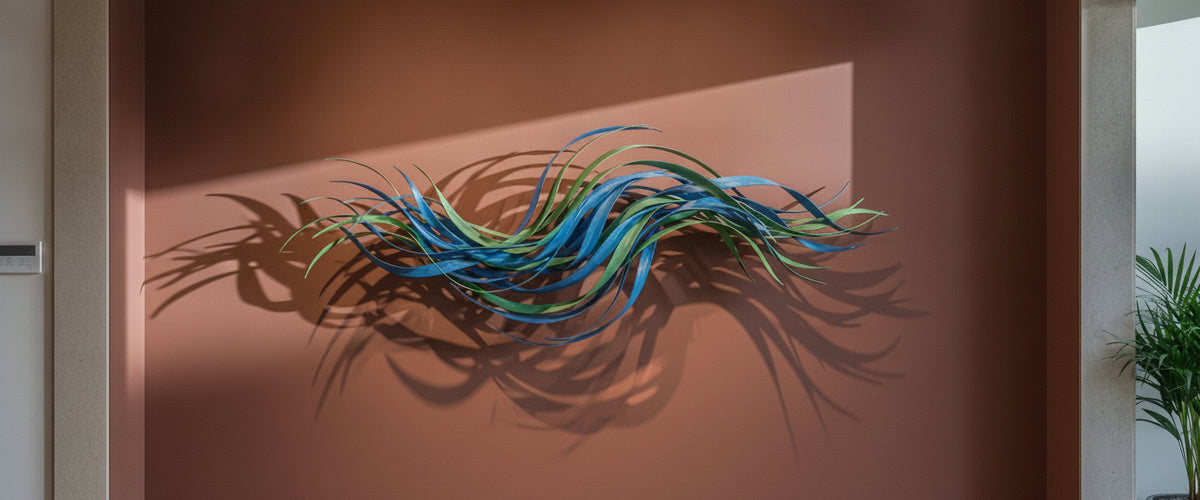

Most walls in beautiful houses are underdressed. A single canvas floats above a sofa, two feet too low, looking apologetic. The room is finished. The wall is not. Unique wall art decor is the lever that fixes this, and it has very little to do with finding a piece you like online and a lot to do with how that piece meets the wall, the light, and the eye line of someone walking in.
At Giant Sculptures we get pulled into wall commissions for the same reason clients ask us about large garden bronzes: scale. A six-foot metal relief in a Napa great room behaves completely differently than a 24-inch print in the same spot. Both can be lovely. Only one finishes the architecture. This guide is about how to make that call, what materials hold up where, and the placement mistakes we keep catching before installation day.

At a Glance: Unique Wall Art Decor That Earns Its Wall
Scale rule of thumb: unique wall art decor should cover roughly 60 to 75 percent of the wall furniture below it (sofa, console, headboard).
Center line: hang so the visual center of the piece sits around 57 to 60 inches (145 to 152 cm) from the floor, lower if seated viewing dominates.
Depth matters: 3D and relief pieces read across larger rooms than flat prints because they cast their own shadow.
Material to room: acrylic and button-form pieces for interiors, powder-coated steel and Corten for exteriors.
Light first, art second: a great piece under poor light loses most of its impact.

What Unique Wall Art Decor Actually Looks Like in Real Rooms
The phrase gets thrown around so often it has lost most of its meaning. In practice, unique wall art and decor falls into three working categories, and each one solves a different problem.
Sculptural relief and 3D wall art. Think dimensional metal flows, button-form temple panels, layered acrylic landscapes. This kind of unique wall decor throws shadow, so it works in rooms with cross-light from windows or directional ceiling fixtures. In a 30-foot great room with strong cross-light, a ribboned metal piece such as the Waverno Blue & Green Flow Metal 3D Wall Art reads from the far end of the room because each ribbon catches light at a different angle as you move. Flat art cannot do that.
Statement metal panels. Larger single-material works, often in brushed steel, blackened steel, or warm-patina bronze finishes. These tend to anchor a wall on their own without needing a frame or grouping. They suit double-height entries, stair walls, and the long blank walls behind a dining table.
Outdoor wall sculpture. Corten panels, marine-grade stainless reliefs, cast aluminum forms. This kind of unique outdoor wall art decor works on garden walls, pool houses, and courtyard elevations. It is designed to weather. A Manhattan terrace, a Hamptons pool wall, a Texas ranch entry court: all benefit from one significant piece outdoors rather than three small ornaments scattered along the fence.

Scale, Sightlines, and Pedestal Height Equivalents for Walls
The sculpture rule we use on pedestals translates directly to walls. On a pedestal, you raise the work so its focal point meets the standing viewer's eye. On a wall, you do the same with your unique wall art decor, but you also have to account for the wall's own architecture: baseboard, dado, picture rail, ceiling height.
In a standard 9-foot (2.7 m) ceiling, hang the visual center around 58 inches (147 cm) from the floor. Push it up two to four inches in a 10 to 12-foot room so it does not float low. In a double-height space, do not center the piece in the wall; that is the most common mistake we see. Center it on the human zone, roughly the lower third of the wall, and let the architecture breathe above it.
Sightlines matter more than wall area. Walk the route a guest takes from the front door. If your piece is first seen at 25 feet, it needs to read at 25 feet, which usually means a minimum of 36 inches (91 cm) on the long edge and real surface texture. A delicate watercolor at that distance disappears. For long-sightline foyers, a heavily textured surface such as the Minara Green & Gold Glint Palace 3D Button Wall Art works because the button relief catches light long before you can read the imagery.

Indoor Versus Outdoor: When Each Wins
Interior walls forgive more. Humidity is stable, UV is filtered, and you can use mixed media, acrylics, wood, gilded surfaces, and finer button-relief work without worrying about weather cycles. Layered acrylic unique wall art decor like the Horizon Jade Mist Mountain Acrylic 3D Wall Art belongs in this category: the depth between layers only resolves under controlled interior light against a clean wall.
Outdoor wall decor is a different engineering problem. The piece has to deal with thermal expansion, freeze-thaw cycles, salt air in coastal sites, and UV that will dull pigments quickly if the maker has not specified properly. We recommend marine-grade stainless, powder-coated aluminum, or Corten for outdoor commissions, with stainless fasteners and a ventilated mounting gap behind the piece so moisture does not get trapped against the wall. The outdoor wall art collection is built around these specifications.
The decision rule we give clients: if the wall sees direct rain or sustained sub-freezing temperatures, it is an outdoor commission and needs outdoor materials, full stop. Interior-grade unique wall decor installed on a covered loggia will still degrade because humidity swings are larger than people think. The Getty Conservation Institute publishes useful guidance on environmental thresholds for mixed-media artwork if you want to go deeper (getty.edu/conservation).
Light, Backdrop, and Contrast
The single biggest upgrade most clients can make is not buying a bigger piece. It is fixing the light. A unique wall art and decor commission lives or dies on three light decisions.
Color temperature. Warm whites (around 2700 to 3000 K) flatter bronze, gold leaf, warm woods, and oil-rubbed metals. Cooler whites (3500 to 4000 K) sharpen stainless, blackened steel, and acrylic. Mixing them inside one sightline muddies everything. Brief your electrician on a consistent color temperature per sightline before you start choosing fixtures.
Angle. For relief and 3D unique wall art decor, light should rake across the surface at roughly 30 degrees from vertical. Light hitting the piece head-on flattens the shadow and you lose the dimensionality you paid for. This is why so many beautiful 3D pieces look dull in showrooms with downlights placed directly in front of them.
Backdrop. A textured piece needs a quiet wall. A flat piece can take a textured wall (limewash, Venetian plaster, board-and-batten). If your wall is busy and your art is busy, the eye gives up. We often suggest a single accent wall in a deeper tone behind a sculptural piece. Deep greens, charcoals, and warm clays all work harder than gallery white at making metalwork pop.
Placement Mistakes We Catch Before Installation
For wider placement ideas, Bring the Outdoors In: Transform Your Walls with Nature-Inspired 3D Art is useful companion reading before finalising the setting and sightlines for your unique wall decor.
Across commissions shipped to homes in California, Colorado, Texas, and the New York metro, the same handful of mistakes come up when planning unique wall art decor. None of them are about taste. All of them are fixable on paper before drilling starts.
Hanging too low. The default North American hang height is around 57 inches to center. People still measure from the top edge and end up six inches low.
Underscaling above a sofa. A 30-inch piece above a 96-inch sofa looks like a postage stamp. The art should land between 60 and 75 percent of the furniture width below it.
Ignoring the seated eye line. Dining rooms and lounges are seated environments. Drop the center two to four inches from the standing default.
Crowding the ceiling. In high-ceiling rooms, people push art up to fill the wall. The piece then reads as ceiling decoration, not wall art. Keep it in the human zone.
Wrong material outside. Interior steel pieces installed on garden walls. They rust in patterns the maker never intended. Specify outdoor-grade from the brief stage.
One light source, head-on. Kills the dimensionality of any 3D or relief piece. Use two sources at angles, or a single raking light from above and to one side.
Skipping the mock-up. Painter's tape on the wall, in the actual size of the piece, for 48 hours before committing. This single habit catches more problems than any other.
Matching Wall Art with Furniture and Existing Decor
The best unique wall art decor results come from picking one anchor and letting the other elements respond. If the room is already furniture-led (a strong sofa, a sculptural dining table, a notable rug), the wall art should answer in tone, not compete in volume. Pull one color from the existing palette and let the art carry it. If the room is quiet, the wall decor becomes the anchor and the furniture can stay neutral.
For mixed-metal rooms, repeat the metal already in the room at least once in the art. In a space with antique brass hardware and warm wood, a warm-toned relief like the Minara Bronze Pagoda 3D Button Wall Art is closer to the right design language than a cool stainless panel. Cool stainless or blackened steel suits rooms with chrome, polished nickel, and gray stone. Mixing freely is fine; mixing without a repeating note reads as accident.
Commissioning Bespoke Wall Pieces
When stock pieces will not solve the wall, a commission is usually the better path. Bespoke unique wall art decor lets you specify the exact width, depth, finish, mounting system, and weight rating for your wall construction. Budget depends on material, scale, complexity of the relief work, engineering for the mount, and finishing, so we always quote against the actual brief rather than guessing.
A useful brief for your unique wall decor includes a photo of the wall with a person standing in front of it, ceiling height, the route guests take into the room, the existing lighting plan, and any color or material you want the piece to echo. With that, we can propose two or three directions and sample finishes before any fabrication starts. Browse the wider wall art and wall decor collection first to identify the language you respond to; it makes the commission conversation for your unique wall art decor much faster.