





































































































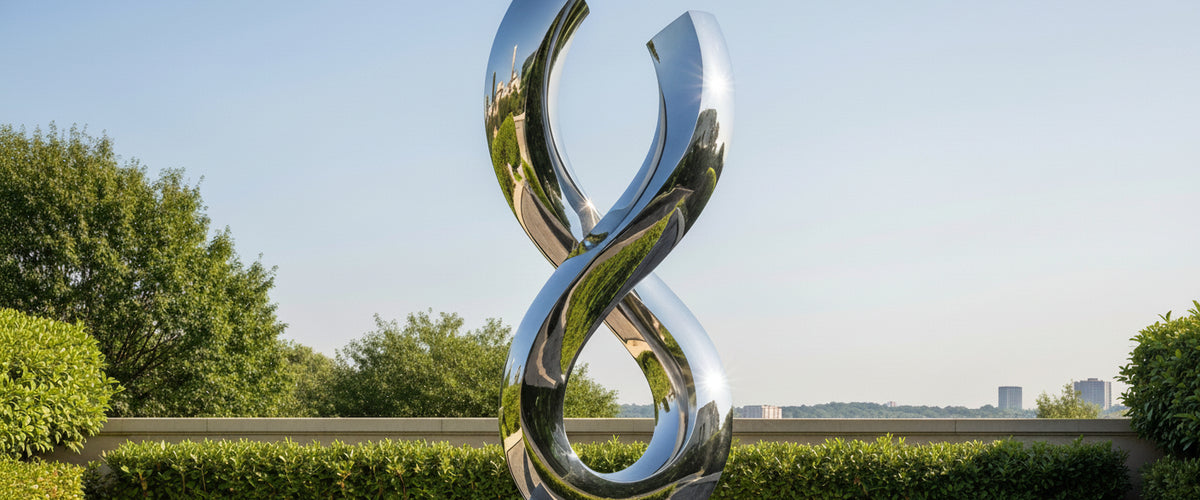

A mirror-polished stainless steel sculpture will tell you, fairly brutally, whether you chose the right spot. Place it well and the surface pulls the sky, the lawn, the gallery wall into itself and the piece reads as alive. Place it badly and you get a bright object that fights the room. Most of the problems we see in commissions are not about the sculpture; they are about the wall behind it, the height of the plinth, or a downlight aimed at the wrong angle.
This piece is for buyers, designers and venue owners seriously considering a sculpture in stainless steel who want to think through placement before the crate arrives. Giant Sculptures works on large bespoke pieces shipped worldwide, so the advice below is drawn from real installations rather than showroom theory.

Key Takeaways
- Mirror-polished steel reflects its surroundings; brushed and satin finishes absorb light more softly. Pick the finish to suit the backdrop, not the other way around.
- Outdoor stainless steel sculpture wants sky, foliage or water around it. A blank stucco wall flattens the piece.
- Pedestal height should put the visual center of the work at roughly eye level for the main viewing distance, not the closest one.
- 316 marine-grade stainless is the right specification for coastal, pool-side or high-humidity sites.
- Lighting matters more than people expect. Two soft sources beat one harsh spot every time.

What Stainless Steel Sculpture Actually Looks Like in a Real Setting
Stainless steel reads very differently depending on finish, form and surroundings. A mirror-polished abstract in a Napa courtyard with olive trees and a long pool will hold soft green and blue tones all day, then turn warm at sunset. The same piece on a white Houston terrace with no planting around it can look like a chrome bumper. Neither result is the sculpture's fault.
Indoors, stainless steel works hardest in rooms with one strong material to play against: a board-formed concrete wall, a wide oak floor, a dark plaster fireplace. In a busy interior with patterned rugs and gallery hangs already on the walls, a brushed or satin finish usually settles in better than a full mirror polish. For a corner of an open-plan living room that needs a single sweeping form rather than a cluster of objects, a piece such as the Eternal Twist Abstract Steel Sculpture - 92cm carries the space on its own line without competing with surrounding furniture.
Outdoors, the calculation shifts. Stainless steel metal sculpture in a garden does two jobs at once: it gives the eye a destination, and it borrows color from the planting behind it. That is why our larger outdoor commissions almost always go in front of a hedge, a tree line, a stone wall or a stretch of lawn that runs to a horizon, rather than tight against the house.

Scale, Sightlines and Pedestal Height
Scale is the decision most often got wrong. People measure the space and pick a sculpture that fits the space; they should be picking one that fits the viewing distance.
A useful rule from the studio: the height of the sculpture, including its base, should be at least one third of the distance from the main viewing point to the piece. A 4 ft (1.2 m) work seen from 30 ft (9 m) away across a garden will simply disappear. The same piece set on a 2 ft (60 cm) plinth at the end of a 20 ft (6 m) hallway can dominate the room.
For an outdoor stainless steel sculpture, walk the property before committing. Stand at the kitchen window, the pool lounger, the gate. Mark the three viewpoints used most often. The sculpture needs to read from those, not from a drone shot.
Pedestals deserve as much thought as the work itself. Put the visual center of the piece, usually a third of the way down from the top, at the eye line of a standing adult viewing from the most common distance. Lower for a seated terrace; higher for a long approach down a driveway. At the larger end of the scale, a work like Strata Copper Abstract Steel Sculpture - 165/220cm at 165 to 220 cm rarely needs a plinth in a garden setting; it is already sized to hold open ground, and adding a base usually pushes it past the surrounding planting rather than locking it in.
Indoor Versus Outdoor: When Each Wins
Indoors, stainless steel is at its best in entryways, double-height lobbies, stair landings, the head of a dining table sightline, and the wall at the far end of an open-plan kitchen. Anywhere with a long approach and a clean backdrop. It is poorly suited to small rooms where you cannot stand back from it; the reflections become busy and the piece feels crowded.
Outdoors, stainless steel sculpture earns its keep in three settings: at the end of a lawn or formal axis, on the far side of a pool or reflecting water, and as a focal piece in a courtyard or motor court. Marine-grade 316 stainless handles coastal salt air; the American Institute of Steel Construction publishes technical material data worth reading before commissioning.
A note on stainless steel dog sculpture and other figurative outdoor work: these read best at slightly below human eye height, so the viewer engages with them rather than craning up. A life-size hound on a low slate slab in an Aspen entry court will pull more attention than the same piece on a tall pedestal in a lobby.
Light, Backdrop and Contrast
Mirror-polished stainless does not have a color of its own; it borrows from whatever surrounds it. That is the trick and the trap. A polished piece in front of a charcoal hedge becomes a dark sculpture with bright edges. The same piece in front of a white wall becomes a hot, glaring object. Most buyers want the first effect and accidentally engineer the second.
For indoor lighting, two soft wall-washers or grazers at roughly 30 degrees off the face of the work give a controlled image with depth. A single narrow spot from directly above tends to flatten the form and create a hard reflection in the eye. If the piece sits near a window, factor in midday sun; a south-facing wall in a Texas living room can turn a polished surface into a daily inconvenience.
Outdoors, let the sky and planting do the lighting. The most common evening addition is a pair of low-output ground uplights, warm color temperature, angled to skim across the form rather than hit it dead on. Where the brief calls for warmth against late-summer greenery rather than the cool flash of a silver mirror finish, a gold-toned piece like Whisper Gold Abstract Steel Sculpture sits closer to the right register, picking up amber from low uplights without going cold at dusk.
Common Placement Mistakes We See
For wider placement ideas, Reflections of Creativity: Exploring the Power of Abstract Sculptures in Stainless Steel is useful companion reading before finalising the setting and sightlines.
These are the issues that come up over and over in commissions:
- Pushing the piece against a wall. Even a few inches of breathing room behind a sculpture changes how it reads. Eight to twelve inches (20 to 30 cm) is a safe minimum indoors; outdoors, more.
- Choosing the finish before the site. Mirror polish in a busy reflective room creates visual noise. Brushed or satin would have solved it.
- Underscaling for the view. A piece that looks large in the studio can vanish on a half-acre lawn. Photograph the site with a person standing where the sculpture will go to test scale.
- Forgetting the foundation. Larger outdoor stainless steel works need a proper concrete pad or stainless anchor system. This is a structural decision, not a landscaping afterthought.
- Lighting from the wrong angle. A single overhead can kill a curved form. Test lighting before signing off the install.
- Ignoring the seasonal backdrop. A piece set against deciduous trees changes character in winter. Plan for both states.
Commissioning a Stainless Steel Sculpture for a Specific Site
When a client comes to us with a defined site, the conversation usually starts with photographs from the main viewpoints, a rough plan with dimensions, and a sense of the surrounding materials. From there, our team works through form, finish, scale and engineering. Stainless steel sculpture manufacturers vary widely in approach; we focus on large bespoke work that has to survive decades outdoors or anchor a serious interior, which means we specify materials, internal armatures and fixing systems for the specific site rather than offering an off-the-shelf piece in a bigger size.
Budget on a bespoke commission depends on material grade, scale, complexity of form, internal engineering, surface finish, base or plinth, crating, and installation. We quote per project rather than per square inch, and we are happy to walk a serious enquiry through the variables before any commitment.
For buyers who want to start by browsing finished work, our full stainless steel sculptures collection shows the range of finishes, forms and scales we work in. The wider outdoor sculptures collection is a good place to compare steel against bronze, Corten and stone for a particular garden setting.