






































































































Most large abstract wall pieces fail for one reason: the buyer chose the artwork before they understood the wall. The piece arrives, gets centered out of habit, and instead of anchoring the room it floats. A good large abstract wall installation is an architectural decision as much as an aesthetic one, and the choices that matter most happen before you commit to a single sculpture or panel.
At Giant Sculptures we ship oversized work into private residences, restaurants, lobbies and garden walls across the US and beyond. The patterns repeat. Below is the working logic we use with clients when planning large abstract wall art for living room installations, a stairwell run, or an exterior facade piece.
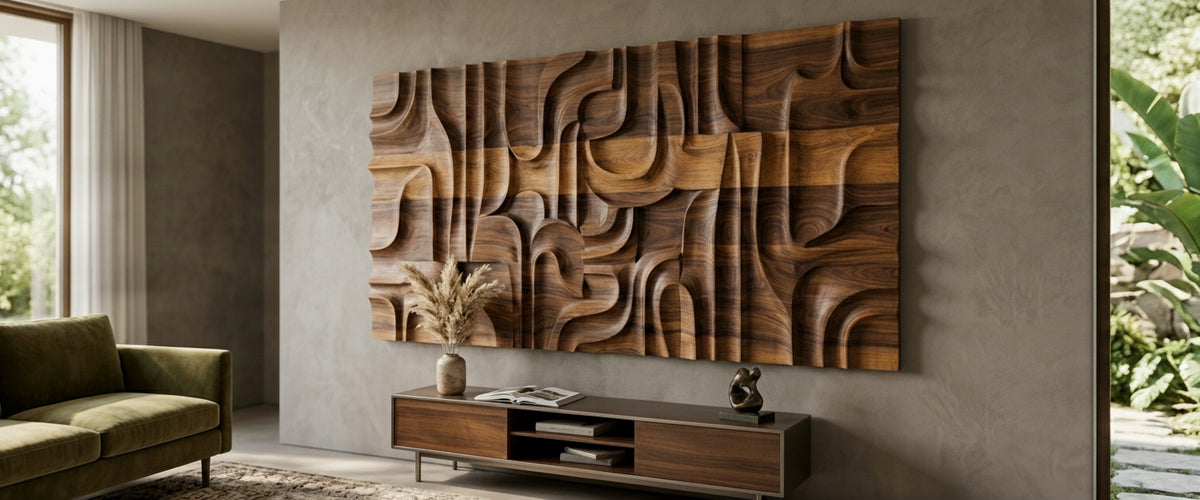
An oversized abstract piece sized to the wall, not to a catalog default.

At a Glance: What Decides Whether a Large Abstract Wall Piece Works
Wall ratio: the piece should fill roughly two-thirds to three-quarters of the available wall width above furniture, or the full uninterrupted plane if it stands alone.
Sightline distance: step back to the furthest natural viewing point in the room. If that distance is more than 15 ft (4.5 m), small detail will read as noise.
Light direction: raking side light makes carved or 3D abstract work sing; flat front light kills it.
Backdrop value: the wall tone needs to sit at least two values away from the dominant tone of the artwork.
Material to room: wood and acrylic indoors; powder-coated steel, Corten or cast bronze relief for outdoors and pool walls.

What Large Abstract Wall Art Looks Like in Real Rooms
Abstract large wall art behaves differently depending on the room it serves. In a double-height living room in Austin or Pacific Palisades, a single piece running 7 to 9 ft (2.1 to 2.7 m) tall above the fireplace will register as architecture. In a long Manhattan loft, the same piece hung on the short wall reads as a punctuation mark at the end of a sentence. Neither is wrong, but the rooms ask different things of the work.
Texture-driven pieces, the kind that throw shadow, do their best work in rooms with directional light. Where a wall sits beside a tall west-facing window or under a wall-grazing track, a deeply carved panel such as Deralin Mocha Stroke Abstract 3D Carving Wall Art uses its ridges to draw a different composition every hour of the day. In a flat-lit corridor those same ridges go quiet. If your space only ever sees overhead pot lights, choose flatter graphic abstracts or commission a piece with deeper relief so the shadow still reads.
Outdoor walls behave differently again. A pool wall in Scottsdale or a courtyard in the Hamptons will hit the artwork with hard overhead sun for hours, then cool blue shade in the late afternoon. Matte finishes hold up; high-gloss acrylic will flare. For exterior work we generally steer clients toward Corten relief, powder-coated aluminum, or cast bronze panels rather than indoor wood or acrylic.
Scale, Sightlines and Hanging Height
The single most common error we see is hanging large wall art abstract pieces at the height someone learned in a gallery handling class: center of artwork at 57 in (145 cm). That rule was written for single-height gallery walls viewed from 6 to 10 ft away. It rarely applies to a residential great room with a 14 ft ceiling, a sectional sofa, and a viewing distance of 22 ft.
Three working rules we use instead:
Anchor to the furniture, not the floor. Above a sofa or console, the bottom of the artwork should sit 6 to 10 in (15 to 25 cm) above the back of the piece. Higher, and the work floats; lower, and it competes.
Anchor to the architecture above a fireplace. Treat the mantel as the lower edge. Let the artwork rise to within 12 to 18 in (30 to 45 cm) of the ceiling line if the piece is tall enough.
Anchor to the eye for standalone walls. On an empty wall with no furniture, the visual center of the piece (not the geometric center) should sit at the average eye height of viewers as they enter the room.
Sightlines matter just as much. Walk the path a guest takes from the front door, through the kitchen, to the sofa. The piece should be visible from at least two of those waypoints, and ideally framed by a doorway or column from one of them. That framed reveal is what makes the installation feel intentional rather than decorative.
Corten relief on an exterior courtyard wall, photographed in late afternoon raking light.
Indoor Versus Outdoor: When Each Wins
Indoor placement gives you control: stable temperature, predictable light, no UV load. That is why most carved wood and resin-finish pieces stay inside. Where the design language leans contemporary and minimal rather than tactile and carved, a layered acrylic relief like Linea Abstract Embrace Minimal Acrylic UV 3D Wall Art is built for interiors, where its UV-printed surface stays crisp under normal household conditions.
Outdoor placement gives you something indoor walls cannot: weather as a collaborator. A Corten panel will shift through orange, rust and deep brown over its first two years before stabilizing. A patinated bronze relief reads completely differently in morning fog than in dry afternoon sun. If you want a piece that becomes part of the site, outdoor wins. If you want a piece that stays exactly as delivered, stay indoors. The American Institute for Conservation publishes useful guidance on how outdoor metals and finishes age, which is worth reading before committing to an exterior commission.
The hybrid case is the covered loggia, the deep porch, or the indoor-outdoor pool room. These spaces tolerate more than a fully exposed wall but less than a sealed interior. Acrylic and treated wood can work here if the wall sits at least 4 ft (1.2 m) back from the drip line and never sees direct rain.
Light, Backdrop and Contrast
Light is the unpaid co-author of every abstract piece. Three light situations to plan for:
Raking side light from a window or wall-grazing track. Best for textured, carved or 3D relief work. Shadows do half the composition.
Diffuse ambient light from skylights or large north-facing glazing. Best for color-driven flat compositions where you want the pigment to read true.
Directional accent light from picture lights or recessed adjustables. Best when you want the artwork to dominate at night and recede during the day.
A useful starting point for accent lighting: aim for the artwork to sit roughly three to five times brighter than the surrounding wall. That gives clear focus without glare. Push higher and you get hotspots; lower and the piece flattens.
Backdrop matters almost as much as light. A taupe composition on a taupe wall is invisible. The same piece on a deep charcoal or warm white surface snaps forward. When clients are committed to a tonal scheme, we often pair a quieter wall color with a higher-contrast piece, or shift toward a tone-on-tone finish like Deralin Taupe Grid Abstract 3D Carving Wall Art, where shadow does the contrast work that color cannot.
Common Placement Mistakes (and the Fixes)
For wider placement ideas, Abstract Art Trends 2025: What's Next for Wall Decor is useful companion reading before finalising the setting and sightlines.
Mistake 1: Buying for the wall in isolation. The piece needs to work with the rug, the sofa back, and the window treatment opposite it. Photograph all four and look at them together before committing.
Mistake 2: Going too small to be safe. A piece that is 30 percent under-scaled looks timid. A piece that is 10 percent over-scaled looks confident. If you are between two sizes on a bespoke commission, go up.
Mistake 3: Ignoring the wall construction. Oversized pieces in carved wood, metal or stone routinely run 60 to 200 lb (27 to 90 kg). Drywall with no blocking will not hold them. Identify studs, or specify a French cleat with through-bolts into structure, before the piece ships.
Mistake 4: Treating bespoke like off-the-shelf. When we commission a piece for a specific wall, we ask for the wall dimensions, the ceiling height, the dominant light source, the furniture layout, and a photograph taken from the main seating position. Skipping any of those means the piece is being designed for an idea of the room, not the room itself.
Commissioning a Large Abstract Wall Piece
Bespoke is worth it when the wall is unusual: double-height, curved, exterior, or proportioned in a way that no standard piece fits. Budget on a commission depends on material, scale, depth of relief, engineering for the mount, finishing, and crating for international shipping, so we always quote against the specific brief rather than a price list. Lead times for large carved wood, cast bronze or fabricated metal commissions typically run several months from approved design to delivery.
Browse the abstract art collection and the broader wall art catalog to calibrate scale and finish before you brief us. Even if the final piece is bespoke, knowing which existing works you respond to gives the studio a far better starting point than a mood board alone.