





































































































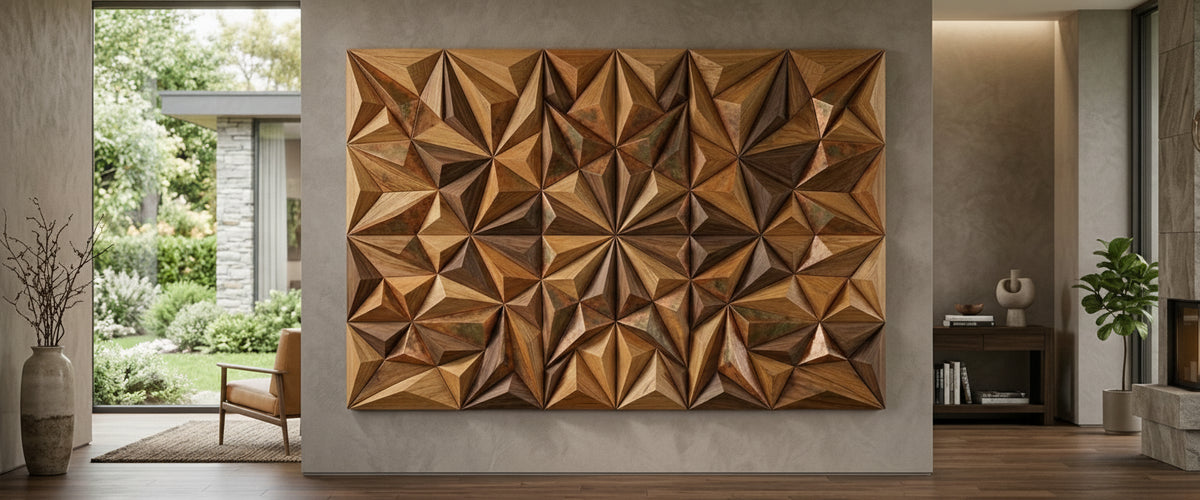

A faceted wood panel can look magnetic in the showroom and flat on your wall, and the difference is almost never the piece. It is placement. Geometric wood wall art works by catching light across raised facets and casting its own shifting shadow, so the wrong height, the wrong backdrop, or a flush downlight overhead can quietly kill everything that made you want it. Get the staging right and a single piece of geometric wood wall art can hold a double-height entrance hall on its own.
We design and ship large-scale wall pieces for homes and venues across the US and beyond, so most of what follows comes from real installs rather than theory. Here is how to think about geometric wood wall art before you buy.

Key Takeaways
Scale to the wall, not the sofa. Big blank walls swallow small panels; measure the wall, then size up.
Light is the medium. Geometric wood relies on raking light to show its facets. Flat front light erases the relief.
Backdrop contrast decides readability. A textured carving on a busy wall cancels itself out.
Eye line beats math. Center on the sightline people actually use, not a tape-measure midpoint.
Outdoor needs different material thinking. Wood-look panels in metal or sealed timber outlast raw wood in weather.

What Geometric Wood Wall Art Looks Like Room to Room
The same family of geometric wall art behaves very differently depending on where it lands. In a Napa living room with white plaster walls and a lot of afternoon light, a warm-toned panel of geometric wood wall art reads as quiet architecture; the facets do the work and you barely notice the frame. Drop the same piece into a paneled Texas study with walnut joinery and it competes with the woodwork unless you choose a contrasting tone or a cleaner, more minimalist geometric pattern.
Open-plan spaces are where 3D wood carving earns its keep. A long sightline from kitchen to lounge gives a faceted panel room to shift as you move past it, which a framed print never does. Where you want metallic highlights riding the carved ridges rather than a flat matte surface, something like the Prismetal Copper Flow Wood Carving 3D Wall Art wants a wall it can own rather than a crowded gallery cluster.
Rounder compositions soften a hard, rectilinear room. Above a console or fireplace, where a square panel would feel boxed in by surrounding cabinetry, a circular piece of geometric wood wall art such as the Orbitale Cream & Blue Round Wood Carving 3D Wall Art does a real job rather than just decorating. The shape earns its place.

Scale, Sightlines and Hanging Height
Most underwhelming installs come from one error: the piece is too small for its wall. A 24-inch (60 cm) panel on a 12-foot (3.7 m) feature wall looks like a postage stamp. As a rough starting point, a single statement piece of geometric wood wall art should fill roughly two-thirds of the usable wall width above a furniture line. When in doubt, go larger; oversized reads as intentional, undersized reads as a placeholder.
Hanging height is where people overthink the math and underthink the room. The gallery convention puts a work's center near 57 to 60 inches (145 to 152 cm) from the floor, but that assumes a standing viewer in an empty space. Above a low sofa or a sideboard, you want the bottom edge to sit a hand's width to a forearm's length above the furniture so the two read as one group. Behind a dining table where everyone is seated, drop the center lower than instinct suggests.
Sightlines beat the tape measure. Stand where people actually enter and pause, then center the piece on that view, even if it is a few inches off the geometric middle of the wall. We once re-hung a large panel of geometric wood wall art three times for a client in the Hamptons before realizing the real sightline came from the stair landing, not the front door. Once we centered on the landing view, the argument ended.

Indoor Versus Outdoor: When Each Wins
Indoors, raw and sealed timber is at home. Stable humidity and no UV punishment mean a finely carved wood surface keeps its crisp facets and warm grain for decades. This is the natural habitat for detailed geometric wood wall art and softer palettes; where the relief shadows matter more than any bright color, a panel like the Grida Soft White Wood Carving 3D Wall Art is closer to the right design language for a quiet, light-filled interior.
Outdoors is a different argument. Wood movement, moisture and sunlight are unkind to natural timber over time; the US National Park Service documents how UV and moisture cycling degrade exposed wood surfaces and finishes (NPS Preservation Briefs). For a covered loggia or a sheltered courtyard you can run sealed timber successfully. For an open garden wall in Aspen or a poolside elevation in California, we usually steer clients toward geometric metal wall art or marine-grade finishes that read like wood but shrug off weather. Stainless steel, Corten and powder-coated aluminum hold geometric crispness through freeze-thaw and salt air in a way raw wood will not.
If you love the timber look outdoors, commission it as engineered metalwork with a wood-tone finish rather than fighting nature. You keep the faceted geometry and lose the warping risk.
Light, Backdrop and Contrast
A carved panel of geometric wood wall art is a relief surface, so its whole effect depends on directional light. Light skimming across the facets at a shallow angle (raking light) pulls out every ridge and casts the shadows that make the piece feel three-dimensional. A single downlight directly above, or flat ambient light from straight ahead, flattens it into a texture you stop noticing within a week. Aim an adjustable spot or wall-washer from the side at a steep-ish angle and the same panel comes alive.
Backdrop contrast is the other lever. A pale carved panel on a pale wall relies entirely on shadow, which can be elegant and subtle. A dark-stained geometric piece on a deep wall almost disappears unless you light it hard. For an abstract geometric piece carrying strong color, such as the Orbitale Mustard & White Geometry Wood Carving 3D Wall Art, give it a quieter wall so the color and pattern carry the room, not the paint behind it.
Mirrored and metallic finishes change the calculation again. Mirrored geometric wall art bounces whatever is in front of it, so check the reflection before you commit; a beautiful facet pattern is wasted if it mirrors a cluttered kitchen island all day.
Placement Mistakes We See in Commissions
For wider placement ideas on geometric wood wall art, Wood Wall Art: A Buyer's Guide to Carved, Geometric, and Bespoke Pieces is useful companion reading before finalising the setting and sightlines.
Sizing to the furniture, not the wall. The sofa is not the boundary; the wall is. Measure the wall first.
Hanging too high. Eye line in a lived-in room is lower than the empty-gallery rule suggests.
Killing it with flat light. No raking light means no shadow means no relief. Plan the lighting before the hang.
Pattern on pattern. A geometric abstract wall art panel on wallpaper or stone with its own busy texture cancels out.
Raw wood outdoors. Lovely for a year, then the weather wins. Specify weatherproof construction from the start.
Ignoring the approach. People rarely see a piece head-on first. Test it from the doorway and the corridor.
Commissioning a Bespoke Geometric Panel
When a stock size or palette does not fit the wall, a bespoke build of geometric wood wall art pays off. We size the geometry to your exact wall, adjust facet depth for the throw of your lighting, and match tone to existing joinery or stone. For very large feature walls we engineer panels in sections with concealed fixings so a heavy piece hangs flat and dead level, which matters more on a faceted surface than a flat one. Budget depends on material, scale, carving complexity, finish and installation, so the honest answer is to send us the wall dimensions and a photo and we will quote it properly.
To gauge scale and finish on geometric wood wall art, the wider wood wall art range is the place to start, then look at the geometric art collection for pattern direction. If your wall is outdoors or high-traffic, begin with the metal wall art options and we will translate the geometry you like into a weatherproof build.