






















































































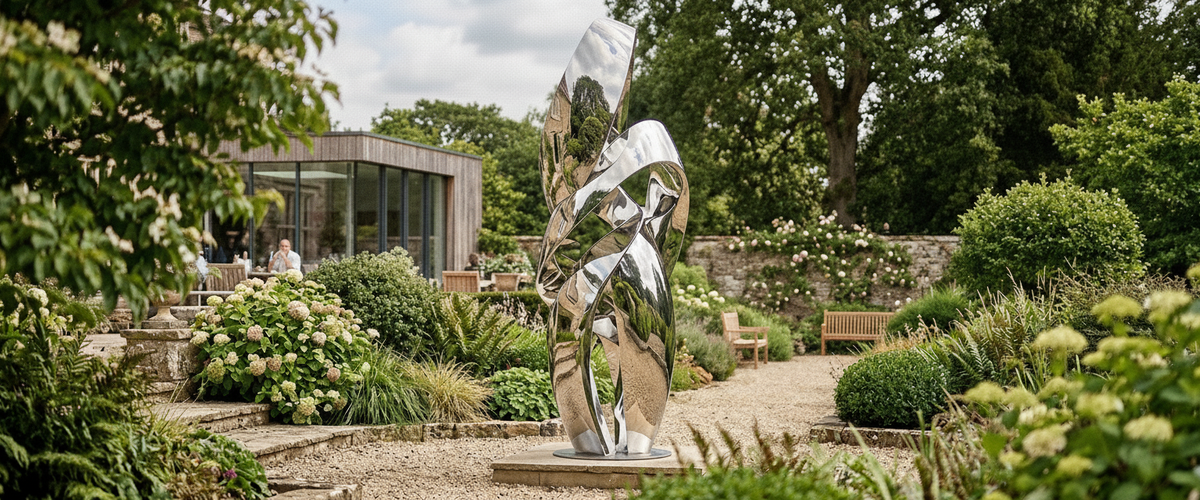

Most buyers arrive at a custom sculpture commission because nothing off the shelf fits. Maybe the ceiling height in a Napa entryway swallows anything under nine feet. Maybe a Texas ranch owner wants a stainless steel horse angled to catch the late sun, not a stock pose that faces the wrong way. A commission solves the specific problem a catalog piece cannot, and it produces something that belongs to one site and one owner.
The trade-off is that a custom sculpture commission asks more of you up front. You are making decisions about material, scale, finish, and installation months before the piece exists. Get those decisions right and you own an object that reads as inevitable in its setting. Get them wrong and you have paid for a very heavy mistake.

Quick Answer: Is a Custom Sculpture Commission Right for You?
Best for buyers with a specific site, a defined budget, and patience for a multi-month process.
Materials that last outdoors: bronze, stainless steel, Corten steel, stone, and marble.
Scale drives cost more than almost anything else, followed by complexity and finishing.
Lead times run in months, not weeks, so plan around the season you want it installed.
Delivery and installation for large work needs engineering, rigging, and sometimes a crane.

What a Custom Sculpture Commission Means, and Who It Suits
A custom sculpture commission is a made-to-order piece built to your brief: your subject, your dimensions, your material, your finish. It sits at the opposite end of the spectrum from buying a finished sculpture in stock. You are commissioning design and fabrication, not choosing from what already exists.
A commission suits people with a clear site problem. Architects specifying a focal point for a lobby atrium. Landscape designers who need a piece to hold a long axis in a Hamptons garden. Collectors who want a subject no one else owns. Venue owners looking for something that photographs well and survives a decade of weather and foot traffic.
A custom sculpture commission suits you less well if you are undecided, working to a tight deadline, or hoping a bespoke piece will cost the same as stock. Commissioning rewards buyers who know roughly what they want and will commit to the process. If you are still exploring, browsing finished work first is smarter; our bronze sculptures collection is a good place to calibrate what a given scale and finish looks like before you commit to your own.
Key Materials, Finishes, and Scale Decisions
Material sets the character and the lifespan of the piece, so decide it early. Each option behaves differently outdoors, and that behavior matters far more than the showroom look.
Bronze is the traditional choice for figurative and detailed work. It holds fine detail, ages into a patina that many buyers actively want, and lasts generations with light care. A bronze sculpture commission for a figure or animal reads as a permanent fixture, which is why estate and civic buyers keep coming back to it.
Stainless steel suits contemporary, reflective, and abstract forms. Marine-grade 316 stainless resists corrosion in coastal and poolside settings, which is why we specify it for anything going near salt air. A mirror-polished stainless piece throws its surroundings back at the viewer and changes through the day. If that language appeals, our stainless steel sculptures show the range of finishes, from mirror to brushed satin.
Corten steel forms a stable rust-toned layer that protects the metal underneath, giving you a warm, architectural surface with almost no ongoing maintenance. It works beautifully against greenery and modern stone. The one caution is runoff staining on pale paving during the first weathering season, which good detailing designs around.
Stone and marble carry weight and history. A carved marble commission suits classical and figurative work where you want the material itself to signal permanence. It needs more thoughtful siting than metal, since some stones are sensitive to acidic rain and freeze-thaw cycles; the Smithsonian's Museum Conservation Institute publishes useful guidance on how outdoor stone weathers over time.
On scale, the single most common regret we hear is going too small. A piece that looks large in a studio can vanish on a wide lawn or in a double-height lobby. As a working rule, sculpture in an open landscape needs to be bigger than instinct suggests, because the surrounding space fights it. We often mock up footprint and height on site before fabrication begins, and buyers are routinely surprised by how much presence a piece loses across twenty or thirty feet.
Where to Place a Custom Sculpture Commission for the Strongest Impact
For wider placement ideas, What a Wall Art Panel 3d Commission Actually Involves Before Anyone Touches a Wall is useful companion reading before finalizing the setting and sightlines.
Placement is a design decision you make before, not after, the piece is built. A custom sculpture commission gives you the rare chance to design the object to its exact spot, so use it.
Terminate a sightline. The strongest position for a garden sculpture is at the end of a view: down an allee, across a lawn, at the turn of a path. The eye travels to it and rests. Design the front-facing angle to whatever point people approach from.
Anchor an entrance or atrium. Indoors, a large piece in a lobby or stair hall gives arriving visitors a fixed point. Height matters here more than width; a tall vertical form uses volume that horizontal work cannot.
Work with reflection and water. Stainless and polished pieces near a pool or reflecting pond double their effect. We have shipped mirror-polished work to Californian poolside settings specifically because the water and the sculpture play off each other through the day.
Respect the approach and the light. Note where the sun sits at the hours the piece will be seen most. A form that reads flat at noon can come alive in low morning or evening light. For reflective metal, orient the best face toward the view people hold longest.
Budget, Commissioning, and Delivery Considerations
Buyers always ask what a custom sculpture commission costs, and the honest answer is that it depends on a handful of factors that compound. Material, scale, complexity, engineering, finishing, and installation each move the number. A large mirror-polished stainless figure with an internal armature and a crane install is a different project from a modest Corten silhouette bolted to a prepared pad. Rather than quote a band that would be meaningless, we scope each project and give you a tailored quote once the brief is defined.
The commissioning process generally runs like this:
Brief and concept. You describe the subject, site, scale, and mood. We translate that into sketches or references.
Design sign-off. Drawings or a maquette confirm proportion, pose, and finish before fabrication money is committed.
Fabrication. The piece is built and finished. This is the longest phase and where lead time lives.
Delivery and installation. Large work is crated, shipped, and rigged into place, sometimes with a crane and always with a plan for the base.
Two practical points buyers underestimate. First, the base and groundworks. A tall or heavy piece needs a foundation designed for its weight and wind load; that is engineering, not an afterthought. Second, access. We have had projects where the sculpture cleared every technical hurdle and then met a garden gate too narrow for the crate. Measure your access route early.
On lead time: a bespoke sculpture commission takes months from sign-off, and international shipping adds to that. If you want a piece in place for a specific season, count backward generously.
What Collectors Say About Commissioning Custom Sculptures
Ask collectors what they think about a custom sculpture commission and the same themes come back. The ones who are happiest treated it as a collaboration rather than a transaction; they engaged at the design stage, asked for a maquette, and trusted the makers on engineering. The opinions that skew negative almost always trace back to skipped steps: no site mock-up, a rushed brief, or a scale chosen from a screen rather than the actual space.
The point collectors make most often is that a made-to-order piece feels different to live with. It carries the memory of the decisions behind it, and it fits its site in a way stock work rarely does. That is the real return on the patience a custom sculpture commission demands.
How Giant Sculptures Helps With Bespoke Projects
Giant Sculptures is a bespoke sculpture supplier built around large-scale work, and we handle each custom sculpture commission end to end: brief, design, material selection, fabrication, and installation. Because we work in bronze, stainless steel, Corten, stone, and engineered metalwork every week, we can steer material choices toward what will actually survive your climate and site rather than what looks good only in a render.
If you are still shaping ideas, browsing our finished collections is the fastest way to sharpen your brief. Bring us a photo of the site, a rough scale, and a subject or mood, and we will tell you honestly what is achievable, what it takes to install, and how to plan the timeline. A custom sculpture commission is a long-term piece of ownership, and the work you do at the brief stage is what makes the decade after it worthwhile.