






















































































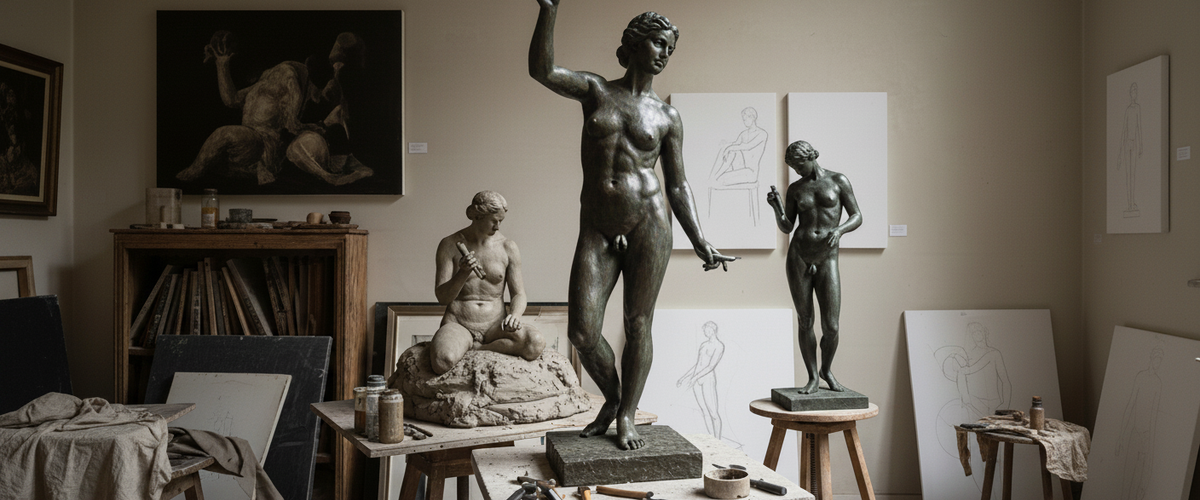

What Is a Sculpture Commission?
A sculpture commission is a made-to-brief artwork created for a specific person, building, or site, rather than bought from a catalog. The buyer agrees the subject, scale, material, finish, base, and installation with the studio, and the studio fabricates the piece from scratch through a sequence of signed-off stages: brief, concept sketches, scaled maquette, full-size fabrication, finishing, and install.
In plainer terms, a sculpture commission is what happens when nothing in the catalog quite fits. The driveway turn at a Napa estate needs a 12 ft (3.7 m) bronze that holds its own against the architecture. A Manhattan lobby needs a stainless steel piece that reads cleanly from the street and still rewards close inspection at the reception desk. A private collector wants a portrait bust of a parent that does not look like a portrait bust. In each case the buyer is not shopping; they are authoring.
That authorship is the point. A sculpture commission gives you control over subject, scale, material, finish, base, and installation, in exchange for a longer timeline and a more involved brief. Done well, the finished piece looks inevitable in its setting. Done badly, it looks like a stock figure that grew. The difference between a strong sculpture commission and a weak one is almost always in the early conversations.

Key Takeaways Before You Commission a Sculpture
What it is: a custom sculpture commission is a made-to-brief artwork, sized and finished for a specific person, building, or site.
Who it suits: collectors with a clear subject in mind, designers matching an architectural scheme, estates and venues needing scale beyond standard production.
Lead time: a realistic sculpture commission runs several months from approved maquette to delivery, longer for monumental bronze.
Budget logic: material, scale, complexity, engineering, finishing, and installation drive cost. Ask for a tailored quote rather than guessing from a range.
What to bring: reference images, site photos, dimensions, sightlines, and a sense of how the piece should feel, not just how it should look.
How a Sculpture Commission Actually Works
Commissioning sculptures is a structured creative process, not a one-off purchase. At Giant Sculptures a typical sculpture commission moves through five stages: brief, concept sketches, scaled maquette, full-size fabrication, then finishing and installation. Each stage has a sign-off. You are not handing over a deposit and hoping; you are approving the work as it grows.
Private sculpture commissions tend to fall into three buckets. Portrait and figurative work, where likeness and pose carry the piece. Abstract or architectural work, where form, material, and scale do the talking. And site-specific work, where the location dictates everything from the silhouette to the weight of the base. Knowing which bucket your project sits in early on saves weeks of back-and-forth on references.
The other thing worth saying out loud: a commission art sculpture is a collaboration. The sculptor will push back on ideas that will not read at the intended viewing distance, or that will weather badly outdoors, or that need engineering the budget does not support. That pushback is the value. You are paying for judgement as much as craft.
Materials, Finishes, and Scale Decisions
Material choice is where most commissions get decided. Each option carries a different visual register and a different ownership profile.
Bronze
Bronze is the default for figurative work and for any piece that needs to outlast its owner. Cast in a foundry from a clay or wax original, patinated by hand, and capable of holding fine detail at any scale. Bronze suits a portrait sculpture commission, classical and contemporary figures, and outdoor pieces that need to look correct in 50 years. The American Institute for Conservation has good public guidance on how outdoor bronze ages and what maintenance keeps the patina honest (see culturalheritage.org).
Stainless Steel
Stainless steel is the material of choice for a contemporary sculpture commission where the piece needs to reflect its surroundings and read as architectural rather than sculptural. Mirror polish for showpiece work, brushed or satin for quieter settings. It scales up cleanly for lobbies, plazas, and large gardens. A piece like a polished stainless balloon dog or a tall mirrored figure is fundamentally a stainless decision before it is a subject decision.
Corten and Fabricated Steel
Corten weathers to a deep rust patina and suits ranch, desert, and contemporary landscape settings (think Aspen, west Texas, the high desert outside Santa Fe). It is also forgiving at monumental scale because it can be plate-fabricated rather than cast. Painted steel opens up color, but adds a maintenance cycle.
Stone and Marble
Carved marble and stone read as permanent in a way that no other material quite matches. They suit classical subjects, garden settings with mature planting, and interiors with strong natural light. The trade-off is weight; a life-size marble figure can run well over 1,000 lb (450 kg), which changes how the piece gets craned in and based.
Scale is the other early decision on any sculpture commission. A 6 ft (1.8 m) figure reads as human and invites approach. An 8 to 10 ft (2.4 to 3 m) piece reads as monument and asks for distance. Anything above 12 ft (3.7 m) needs engineering input on base, anchoring, and transport before the design is finalized. Underscaling is the most common mistake we see when commissioning sculptures for outdoor sites; a piece that looked huge in the studio can look polite once it is sitting in a 2-acre garden.
Placement: Where Commissioned Work Earns Its Keep
For wider placement ideas, Custom Marble Sculptures: Why Bespoke Is the New Must-Have in Art is useful companion reading before finalizing the setting and sightlines.
The strongest sculpture commissions are designed around a specific sightline. A few placements worth thinking about before you brief:
Driveway arrival. A single tall piece at a turning circle, sized to be read from a moving car at 20 to 30 mph. Stainless steel and Corten both work; bronze if the architecture is traditional.
Garden terminus. A figure or abstract form at the end of a lawn, allee, or pool axis. The piece is the full stop at the end of a sentence the garden has been writing.
Lobby and atrium. Hospitality, corporate, and luxury residential lobbies often need a piece that resolves a double-height space. Suspended work, tall verticals, and reflective surfaces all earn their keep here.
Private interior. Portrait busts, smaller figurative work, and tabletop bronzes belong in libraries, studies, and stair landings where they are seen close-up and daily.
Memorial and dedication. Commission a sculpture as a marker for a family member, a founder, or a moment. These projects need the most careful brief because the emotional stakes are high and the result is permanent.
For inspiration on what is possible at scale, our bronze sculpture collection and stainless steel collection are useful reference points; many of the pieces shown began life as a sculpture commission before becoming part of the wider catalog.
Budget, Timeline, and Commissioning Logistics
The honest answer on how much money to commission a sculpture is: it depends, and any studio that quotes a flat number before seeing the brief is either guessing or selling you stock. The variables that move a sculpture commission price are material (bronze and marble sit higher than fabricated steel), scale (cost rises non-linearly above about 8 ft / 2.4 m), complexity of pose or form, the amount of hand-finishing, engineering for outdoor installation, crating, freight, and on-site install. A portrait bust and a 15 ft monument are not the same conversation.
What you can plan around is the timeline. From approved brief to delivery, a modest figurative bronze sculpture commission tends to run several months. Monumental work, multi-figure groups, and pieces needing structural engineering run longer. Rushing the foundry or the patination stage is the fastest way to end up with a piece you will quietly resent in five years.
A few practical points worth raising at the first meeting:
Confirm who owns the maquette and any working drawings at the end of the project.
Agree the number of revisions allowed at concept and maquette stage; unlimited revisions sound generous and end up diluting the work.
Ask about edition size. A bespoke sculpture commission can be unique, or it can be the first of a small edition, which affects both price and resale.
Plan the install. Crane access, ground conditions, and anchoring need to be agreed before the piece leaves the studio, not after it arrives on a flatbed.
Photograph the finished piece properly. Good studio photography of the install is the only record you will have if the work later needs to be insured, restored, or moved.
How Giant Sculptures Handles a Bespoke Sculpture Commission
We work as a bespoke studio for collectors, designers, architects, and venues who need a sculpture commission at a scale or specificity the catalog cannot cover. A project with us typically begins with a conversation about the site and the intent, not the subject. The subject often shifts once we understand where the piece is going and how it will be lived with.
From there we develop concept sketches, then a scaled maquette for sign-off, then move into full-size fabrication in the chosen material. We have shipped a sculpture commission to private estates, hotels, corporate headquarters, and family memorial sites across the US, UK, Middle East, and Asia. The logistics side, crating, freight, customs, and install, is handled in-house because the install is part of the artwork.
If you have a sculpture commission in mind, the most useful thing you can send first is not a reference image. It is a photo of the site, with a person standing roughly where the piece will go. That single image tells us more about scale and sightline than any mood board.