






















































































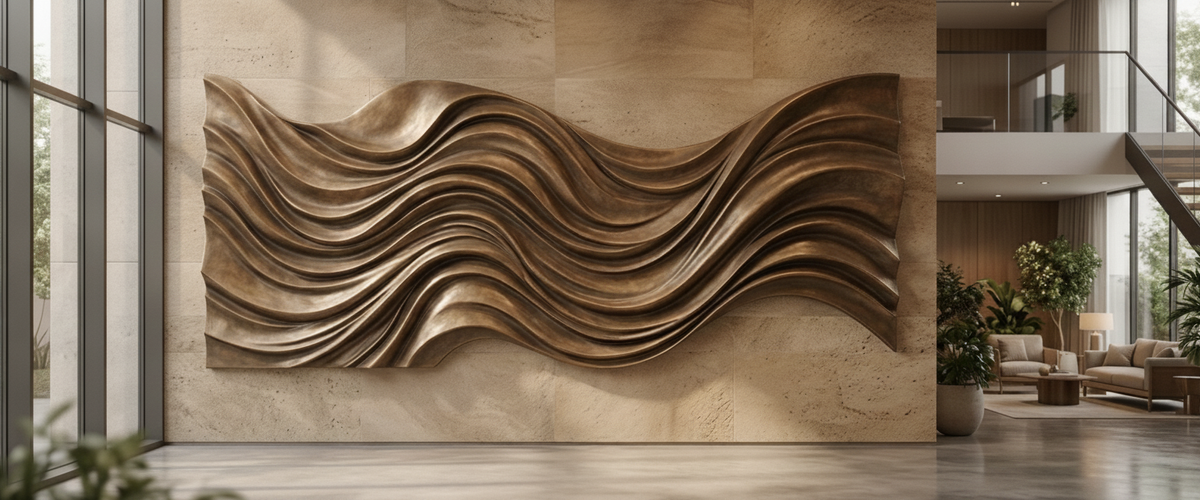

A blank professional office wall is a scale problem long before it becomes a taste problem. Get the reading distance wrong and even fine bronze work looks fussy from the lobby and thin from the elevator bank. That gap between what the piece is and how it lands in a room is exactly what a sculptor sizes up first, and it is where most professional office wall art projects quietly go sideways.
Looking for the full range in this category? Browse our Wall Art and Wall Decor collection for every available finish, size, and configuration.
We have shipped relief work and wall sculpture into corporate lobbies, hotel reception walls, and private offices from NYC to Napa, and the same conversations come up every time. Not "what looks nice," but "who sees this, from how far, and how long does it need to survive the building's climate." This piece walks through how the studio actually thinks before we quote a professional office wall commission.

Key Takeaways for a Professional Office Wall Commission
- Reading distance drives everything. A relief resolved for 10 ft flattens at 30; a piece built for 30 ft looks crude up close.
- Material sets the budget and the lifespan. Bronze, stainless steel, and carved stone age differently and cost differently.
- Weight is an engineering question. Large wall sculpture needs a mounting plan and often a structural check, not a couple of screws.
- The maquette is where you catch mistakes. Sign off the scale model and material sample before fabrication, not after.
- Budget depends on material, scale, relief depth, finishing, and install. Ask for a tailored quote rather than a headline figure.

What Sculptors Actually Think About Before Taking a Professional Office Wall Commission
The first question is the wall itself. Is it plasterboard over steel studs, poured concrete, brick, or a glazed curtain wall with almost nothing to fix into? That answer changes what we can hang and how. A cast bronze relief at architectural scale can run into hundreds of pounds (well over 100 kg), and that load has to land on structure, not decoration.
The second question is sightlines. In a lobby, people approach a professional office wall on the move, usually at an angle, often from a mezzanine or a stair. We map where the piece is seen from and for how long. A reception wall that greets visitors for a few seconds while they wait for a badge wants bold form and confident silhouette. A boardroom wall that people stare at through a two-hour meeting can carry finer detail and reward a second look.
Third is the building's environment. Interior climate, direct sun through south-facing glass, HVAC airflow, and cleaning routines all shape material choice. A humid atrium is a different brief from a dry, air-conditioned floor.

Craft Decisions That Change the Final Result and the Price
Two professional office wall pieces can look similar in a rendering and cost very differently once you open up the craft. A few of the decisions that move both the look and the number:
Relief depth. A shallow bas-relief reads as drawing in metal and photographs cleanly on a flat wall. A high relief throws real shadow and reads from across a room, but it needs more material, more modeling time, and a heavier mount. Where a wall needs form that holds its shape under directional light, a piece such as the Traditional Horse Head Bronze Relief - 80cm pushes off the wall enough to carry across mid-range distance rather than flattening into the surface.
Material. Bronze gives you warmth, weight, and a patina you can tune from near-black to green-gold. Stainless steel reads cooler and more contemporary and shrugs off fingerprints better on a reachable lobby wall. Carved stone or marble brings mass and a matte, light-absorbing surface that suits a quieter, more classical office. For corporate spaces leaning modern, our metal wall art range shows how finish alone shifts the mood from traditional to sharp.
Finish and patina. On bronze, the patina is a chemical process applied hot, then waxed or lacquered. The Smithsonian's conservation guidance on outdoor bronze is a useful reference on how patina and protective coatings behave over time (see the Smithsonian American Art Museum conservation notes). Interior walls are gentler than a garden, but the same principle holds: the coating is what you maintain, not the metal underneath.
Scale of the modeled detail. This is the one buyers underestimate. Detail that looks crisp on a maquette can vanish once the piece is enlarged, or turn noisy. A skilled sculptor exaggerates and simplifies deliberately so the piece resolves at the real viewing distance.

Why Some Professional Office Wall Pieces Read Right at 10 Feet and Wrong at 30
Distance is the quiet killer of wall commissions. A relief modeled for close inspection carries fine texture, tight edges, and subtle depth changes. Push that same piece to the far side of a double-height lobby and the detail collapses into gray mush; the eye reads only the outline, and the outline was never designed to carry the piece alone.
The reverse also bites. A form built to punch across 30 ft (about 9 m) looks blunt and unfinished when someone stands two feet from it waiting for the lift. The best professional office art is resolved for a specific band of viewing distances, and a good studio will ask you to define that band before anyone touches clay.
Bronze relief work reads especially well at mid-range because the raised surfaces catch building light and cast their own shadows. That is why a horse or bull relief sits comfortably on a lobby wall where a flat printed panel would look weak. Where the ambition runs past a single wall into an atrium or courtyard, freestanding work like the Monumental Classical Galloping Horse and Swallow Bronze Sculpture - 500cm shows how far bronze can be pushed to anchor a whole reception space rather than a flat plane.
Studio Process: Maquette, Sample, Fabrication, Install
A professional office wall commission moves through predictable stages, and skipping any of them is where regret creeps in.
- Brief and site read. Wall construction, sightlines, lighting, climate, and the reading distance band. Photos and a rough elevation help.
- Maquette. A scale model, usually in clay or a printed study, so you can judge composition and relief depth before committing. This is the cheapest place to change your mind.
- Material sample. A patina swatch or finish sample on the actual metal or stone. Colors read differently in your building's light than on a screen, every time.
- Fabrication. Casting, welding, or carving, then chasing, finishing, and patination. Large bronze relief is cast in sections and joined; the joins are worked so they disappear.
- Mounting and install. A concealed cleat or bolted subframe sized to the weight, with a structural check on the wall where needed. For heavy pieces we specify the fixings rather than leave it to a general contractor guessing.
For smaller, more decorative professional office art, the same logic applies at a gentler scale. Where a corridor or private office needs presence closer to human height rather than a soaring lobby statement, a piece like the Classical Figural Torso Wall Sconce Bronze Sculpture - 90cm still asks for a proper fixing and a considered eye line, even hung well below architectural scale.
Honest Red Flags to Ask About Before You Commit
Buyers who commission well ask uncomfortable questions early. Here are the ones worth raising:
- "Show me the mounting plan." If the answer is vague, the piece is heavier than the fixing story admits. Ask for weight and fixing spec in writing.
- "What does this look like at my actual viewing distance?" Insist the maquette be judged from the real distance, not held in the hand.
- "How is the finish maintained?" Interior bronze and steel need occasional dusting and a wax refresh, not much more, but you should know the routine. Conservation bodies like the American Institute for Conservation publish sensible care basics worth reading before you buy.
- "Is this cast, fabricated, or resin?" There is nothing wrong with the right material for the job, but you deserve to know exactly what you are paying for and how it will age.
- "Who installs it, and is that in the quote?" Freight, rigging, and install on a large wall piece are real costs. Get them itemized so there are no surprises on delivery day.
One hard-won lesson from the studio: the projects that go smoothest are the ones where the client sends a decent photo of the wall and honestly says how far away people stand. The projects that stall are the ones chasing a look from a mood board with no thought for the room. Scale first, style second.
Where to Start
If you are scoping a professional office wall, begin with the wall and the sightlines, then choose material and relief depth to match. Giant Sculptures works as a bespoke supplier of large-scale and commissioned wall sculpture, so we can size a piece to your lobby, tune the patina to your interior, and specify the mounting properly. Browse the office art range for direction, or send through a photo of the wall and the reading distance and we will tell you honestly what will work.
For wider placement ideas, Inspirational Wall Art for the Office: What Sculptors Weigh Before They Start is useful companion reading before finalising the setting and sightlines.