





































































































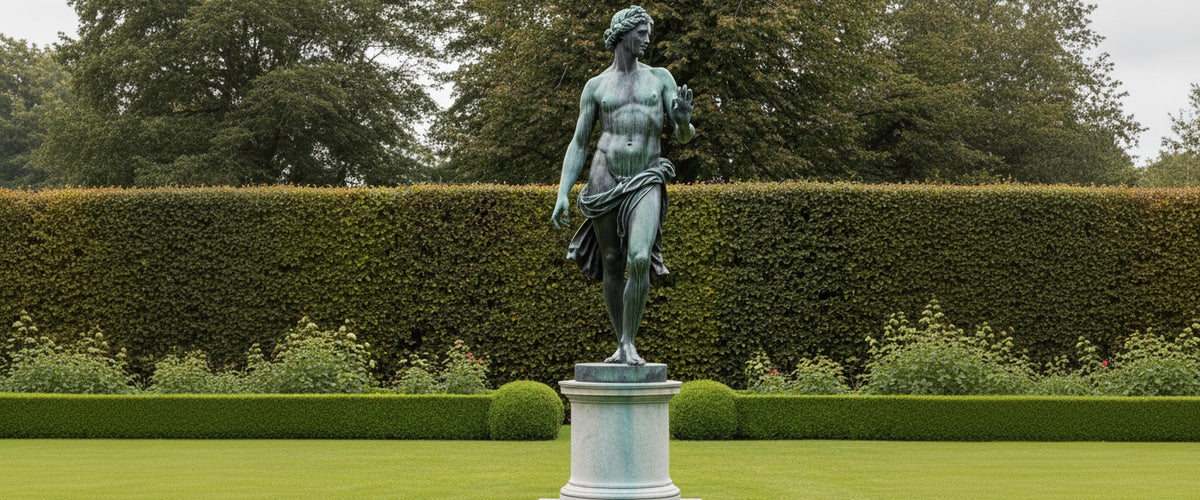

The fastest way to waste a six-figure bronze is to put it in the wrong spot. Most private sculpture commissions we ship are technically excellent the moment they leave the studio; the ones that look great a year later are the ones where placement was treated as part of the design, not an afterthought once the crate arrives. Before you sign off on a maquette for any private sculpture commission, you should already know the exact square of ground or floor the piece will stand on, what is behind it, where the sun rises, and how tall the average viewer will be when they first see it.
This is the part of commissioning sculptures that nobody really teaches. Material choice and pose get all the attention. Placement does most of the work, and it is the single biggest predictor of whether private sculpture commissions land or fall flat.

At a Glance: What Drives a Successful Sculpture Commission
Sightline first, then size. Decide where the viewer will stand before you decide how tall the piece should be.
Backdrop matters more than spotlights. A clean negative space behind the sculpture beats any lighting trick.
Pedestal height is a design decision. Eye line, hip line and overhead all read completely differently.
Indoor and outdoor pieces are engineered differently. A bronze sized for a courtyard will overwhelm a drawing room.
Budget depends on material, scale, engineering, finishing and installation. Ask for a tailored quote rather than guessing from online figures.
What Private Sculpture Commissions Actually Look Like in Real Settings
A private sculpture commission is not one thing. We have shipped a 12 ft (3.6 m) Corten figure to a ranch entrance in Texas, a 28 in (71 cm) polished bronze nude for a Manhattan library shelf, and a stainless steel abstract sized to a swimming pool terrace in the Hollywood Hills. Same studio, same commissioning process, completely different briefs. The common thread across these private sculpture commissions is that the client knew the room or the view before the sculptor put pencil to paper.
In an entrance hall, a commissioned piece tends to work hardest at roughly two-thirds of the ceiling height, set off-center from the front door so the viewer catches it on the diagonal as they walk in. In a double-height living space, the same logic flips: you want the sculpture to read from the upper floor and the ground floor, which usually means a taller, more vertical composition on a low plinth. Outdoors, a piece sited at the end of a lawn axis needs more mass than people expect. Open sky shrinks everything.
If you are still developing your taste, browse fully realized work before you commission art sculpture from scratch. Our bronze sculptures and stainless steel sculptures show how the same subject reads completely differently across materials and finishes, which is useful intelligence to bring into a sculpture commission conversation.
Scale, Sightlines and Pedestal Height
Three numbers decide how a sculpture reads: the height of the piece, the height of the pedestal, and the distance from the primary viewing position. Get any of those wrong and the work fights the room.
For figurative work indoors, eye line is the default and it is the default for a reason. A bronze head or torso whose eyes meet yours at standing height feels intimate and present. Drop the same piece to coffee-table height and it becomes a decorative object; lift it overhead and it becomes monumental and slightly cold. None of those are wrong. They are just different briefs for a private sculpture commission.
Outdoor commissions usually want the inverse. A life-size figure on a low stone plinth in a garden almost always disappoints, because the open sky and surrounding planting flatten the silhouette. Raise the same piece on a 24 to 36 in (60 to 90 cm) pedestal and it gains presence immediately. For larger-than-life pieces, you can often skip the pedestal entirely and let the work spring straight from the ground; pieces in the spirit of our large bronze horse sculpture are usually more powerful directly on grade, where the hooves and ground meet honestly.
Sightlines are the third lever. Walk the room or the garden before you commission a sculpture. Stand at the front door, the head of the stairs, the kitchen island, the pool steps. Where do your eyes naturally land? That is where the piece belongs. Not the architecturally obvious spot. The one your eye keeps choosing.
Indoor versus Outdoor: When Each Wins
Indoor private sculpture commissions reward detail. Patina variation, tool marks, the subtle pull of light across a polished cheekbone; all of it survives at close range. This is where marble, fine-finished bronze and hand-chased surfaces earn their keep. The client is going to walk past the piece daily, sometimes within inches of it. The work needs to hold up to that level of scrutiny.
Outdoor commissions reward silhouette. From 40 ft (12 m) away, nobody can see your tool marks. They see the outline against sky or hedge. That is why Corten, stainless steel and large-scale bronze tend to dominate garden commissions: they hold a strong profile and they survive weather for decades. The Smithsonian's outdoor sculpture conservation guidance is worth reading before you commit to any exterior bronze, particularly around protective coatings and annual waxing cycles (see Smithsonian's Museum Conservation Institute).
The mistake is treating these as interchangeable. We have been asked more than once to scale up a delicate interior figure to garden size. It rarely works. The features that made the small piece beautiful (subtle modelling, fine fingers, soft drapery) become liabilities at scale and outdoors. A genuine outdoor sculpture commission is conceived for the outdoors from the first sketch.
Light, Backdrop and Contrast
Backdrop does more for a sculpture than lighting ever will. A dark bronze in front of a pale limestone wall reads instantly. The same piece against busy wallpaper or a heavily planted border vanishes. Before you finalize a private sculpture commission, photograph the intended spot at three times of day and look at what is behind the empty space. If the backdrop is noisy, fix that first.
For interior pieces, north light is the most flattering and the most forgiving of patina shifts over the year. East and west light create dramatic shadows but change hour by hour, which can be wonderful or distracting depending on the piece. South-facing windows in California, Texas and Florida homes will fade and warm darker patinas faster than clients expect; we usually recommend a UV-filtering film on the glass or a placement at least 6 ft (1.8 m) back from the window.
Outdoor pieces benefit from a deliberate negative space. A polished stainless commission needs sky or water to bounce off it; a Corten piece needs a clean green or stone backdrop to let the rust tones sing. If a client wants something with the reflective character of our abstract sculptures collection, we will often ask them to clear an unexpected amount of planting behind the planned site. The visual gain is significant.
Common Placement Mistakes in Sculpture Commissions
For wider placement ideas, Custom Marble Sculptures: Why Bespoke Is the New Must-Have in Art is useful companion reading before finalising the setting and sightlines for any private sculpture commission.
Centering everything. Dead-center placement on an axis flattens the work. Offset by 10 to 20 percent and the piece comes alive.
Undersizing for outdoors. Open sky eats mass. If the maquette feels slightly too big in the showroom, it is probably right for the garden.
Lighting before backdrop. Clients spend on uplighters and ignore the busy hedge behind the piece. Fix the backdrop first.
Forgetting circulation. A figure needs at least one full pace of clearance on its primary viewing side. Two is better.
Ignoring engineering. A 1,500 lb (680 kg) bronze on a timber deck is a structural problem. Loads need to be confirmed before the piece is cast, not after.
Treating the pedestal as an accessory. Pedestal proportions are part of the artwork. They should be drawn at the same time as the figure, not bought from a catalog later.
How the Commissioning Conversation Should Start
When a client approaches Giant Sculptures about a custom sculpture commission, the first conversation is rarely about subject matter. It is about site. We ask for photos from multiple angles, ceiling heights or sky exposure, the throw of the nearest windows, the climate, and the way the client moves through the space. Subject and pose follow that, not the other way around. Most private sculpture commissions live or die on what we learn in that first call.
From there, the studio will usually develop sketches, then a scaled maquette, then engineering drawings and material samples. Patina swatches for bronze, brushed versus mirror samples for steel, stone test blocks for marble. Sign-off happens in stages, which protects everyone. Private sculpture commissions that go straight from drawing to full-scale casting without a maquette are heading for an expensive surprise.
On budget: there is no honest single answer to how much money to commission a sculpture costs. A small bronze portrait bust and a 15 ft (4.5 m) outdoor stainless steel piece exist in entirely different universes. Material, scale, complexity of form, engineering, finishing, crating and installation all move the number. The right move on private sculpture commissions is to share your site, your scale ambition and your material preference, then ask for a tailored quote. Anyone who quotes you a firm figure before seeing the brief is guessing.