





































































































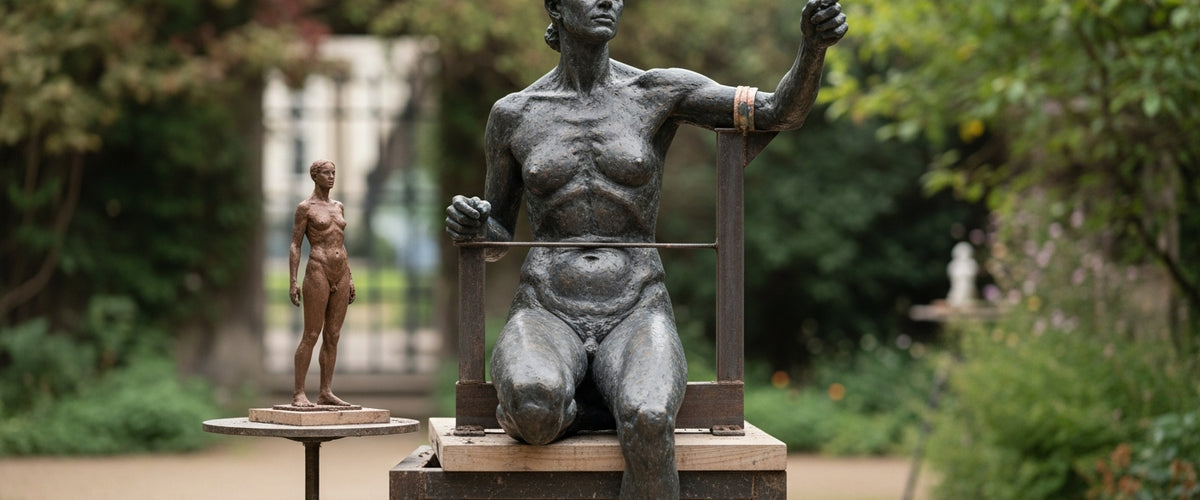

Ask ten collectors about their first custom sculpture commission and you will hear the same quiet regret: they wish they had slowed down at the start and asked harder questions in the middle. The piece itself almost always lands well. What burns time, money and trust is everything around it, the brief that was too vague, the maquette that was waved through, the install day no one had mapped out. At Giant Sculptures we work on bespoke, large-scale pieces in bronze, stainless steel, Corten and stone for private collectors, designers and architects, and the patterns are remarkably consistent.
This guide pulls together the advice we keep repeating to first-time and repeat commissioners. It is written for the person about to sign a deposit, not the person browsing in the abstract.

Key takeaways before you commission
- The brief decides more than the artist. Scale, site, material and intent set the ceiling for the whole project.
- A maquette is a contract, not a sketch. Treat sign-off as the last honest moment to change direction.
- Price is built, not quoted. Studio hours, material, engineering, finishing, crating and install each carry weight.
- Edition rights matter. Unique, limited edition or open edition changes both value and feel.
- Delivery is a project of its own. Rigging, access, base and siting need planning before the first armature is built.

What the brief stage really decides
Most failed commissions are not failures of talent. They are failures of brief. A custom sculpture commission lives or dies on what you agree before the artist touches clay, wax or steel. The brief is where you fix the non-negotiables: site, sightlines, climate, scale relative to architecture, budget envelope, and the emotional register you actually want. "Something striking for the entrance" is not a brief. "A 9 ft (2.7 m) vertical figurative piece in patinated bronze, visible from a 60 ft approach drive, that reads as contemplative rather than heroic" is.
Collectors who have commissioned more than once almost always say the same thing in reviews: they over-described the object and under-described the context. Photograph the site at different times of day. Note prevailing wind, salt air, snow load, pool splash, sprinkler reach. If the piece is destined for a Napa terrace or a Hamptons lawn, the artist needs to know that a stainless steel finish will behave very differently than it would in a sheltered Manhattan courtyard. Brief context, not just object.

Choosing your sculptor: portfolio signals that matter
It is tempting to choose on style alone. Style is the easy part. Look instead for evidence the studio can deliver at your scale, in your material, on a real site. When you scan portfolios, weigh the boring signals heavily: engineering drawings, armature shots, foundry partnerships, install photos with rigging in frame, completed works five or ten years on. Anyone can show a beautiful studio render. Far fewer can show the same piece weathering gracefully on a client's property a decade later.
If you are reading collector opinions on custom-commissioned sculptures, pay attention to comments about communication cadence and change-handling, not just the final reveal. The studios that get repeat business are the ones that send unprompted updates, flag issues early and price changes transparently. A monumental piece in stainless steel or mirror-polished steel is a multi-month engineering project as much as an artwork; you want a partner who behaves like both.
Questions worth asking before you sign
- Who actually fabricates the work, in-house team, foundry partner, or subcontracted metal shop?
- What is the studio's experience with your material at your scale?
- How are revisions priced, by hour, by stage, or absorbed up to a defined point?
- What happens if the maquette is approved but you change your mind during fabrication?
- Is the work unique, part of a limited edition, or open edition, and who holds reproduction rights?

Maquettes, sign-offs and the moment you can no longer change your mind
The maquette stage is the single most important conversation in a commission. A maquette, usually a scaled custom clay sculpture commission model or a 3D-printed study, translates the brief into a three-dimensional object you can walk around. This is where proportion, gesture, base treatment and silhouette get locked. Once it is signed off and scaled up, undoing a decision becomes expensive and, in some cases, structurally impossible.
Treat the maquette review like a building sign-off. Photograph it from the angles people will actually see the final work from. If the piece will live on a plinth at eye level, do not review the maquette from above on a studio table. Mock the height. Tape out the footprint on the real site. Collectors who skip this step are the ones whose reviews from collectors of custom commissioned sculptures contain the phrase "it reads differently outdoors than I expected."
After sign-off, most studios will only accept changes that do not affect the armature, weld plan or mould. That is not obstruction, it is physics. Internal steel structures for a piece weighing 800 lb (365 kg) or more are designed around a specific pose and load path. Changing the tilt of a head changes the engineering.
Pricing a custom sculpture commission
Pricing is the area where expectations diverge most violently from reality. A custom sculpture commission is not priced like a product. It is built from studio time, material volume, foundry or fabrication costs, engineering, surface finishing, base or plinth, crating, transport and installation. A custom steel yard sculpture commission for an Aspen residence with snow load considerations will be costed differently than a similar piece destined for a sheltered Texas courtyard, even if the form is identical.
Be wary of any studio that quotes a firm number before the brief is locked. Be equally wary of vague gestures toward price brackets. The honest answer is that budget depends on material, scale, complexity, engineering, installation and finishing, and a tailored quote is the only meaningful figure. If you want to compare, ask each studio to break the quote into the same line items. Then you are comparing like with like.
Edition rights deserve their own line in the conversation. A unique work commands a different price and different long-term value than an edition of three or eight. Clarify in writing whether the artist retains the right to produce variations, smaller studies, or related pieces, and whether your version is numbered. Collectors often discover this question too late, after seeing a near-identical piece appear at another residence.
Shipping, installation and the day it arrives
The crate lands, and suddenly a beautiful idea becomes a logistics problem. A large bronze, marble or metal sculpture can weigh anywhere from a few hundred to several thousand pounds. Getting it from a truck to its final position is rarely a matter of two people and a dolly. Plan for crane or Hiab access, ground protection, a prepared and engineered base, and a rigger who has handled artwork rather than industrial equipment. Stone and polished metal scratch in seconds and conserve poorly.
Site prep should begin in parallel with fabrication, not after. Foundations for outdoor work need to account for frost depth, drainage and the dead load plus wind load of the piece. For exterior bronze and Corten, the Getty Conservation Institute and similar bodies publish useful guidance on long-term care, patina stability and environmental exposure that is worth reading before, not after, install. Building this into the commission timeline avoids the awkward scenario where the sculpture is ready and the site is not.
If the piece is destined indoors, measure every doorway, stairwell turn and ceiling height on the route in. More than one commission has been completed beautifully and then required a wall to be opened to enter the room. Smaller wall-mounted or relief work from a range like 3D wall art sidesteps some of these issues, but a freestanding monumental piece does not forgive a missed measurement.
What collectors say they would do differently
Across the custom commissioned sculptures reviews from collectors we hear most often, three themes repeat. First, spend longer on the brief and the site visit than feels reasonable. Second, treat the maquette as the last creative decision, not a midway checkpoint. Third, budget for install and aftercare as a real line, not a rounding error. The collectors who follow that order tend to write the kind of reviews that send their designers and architects back to the same studio twice.
A commission, done properly, is one of the few purchases that genuinely improves with time. Get the early decisions right and the piece becomes part of the architecture of a place. Get them wrong and you spend years quietly negotiating with an object you never quite agreed to.
For wider placement ideas, Light & Shadow 3D Art: Wall Paintings That Glow, Shift, and Transform is useful companion reading before finalising the setting and sightlines.
For general conservation principles, V&A sculpture techniques is a useful external reference, though the final care routine should always follow the material and finish specified for the individual commission.