





































































































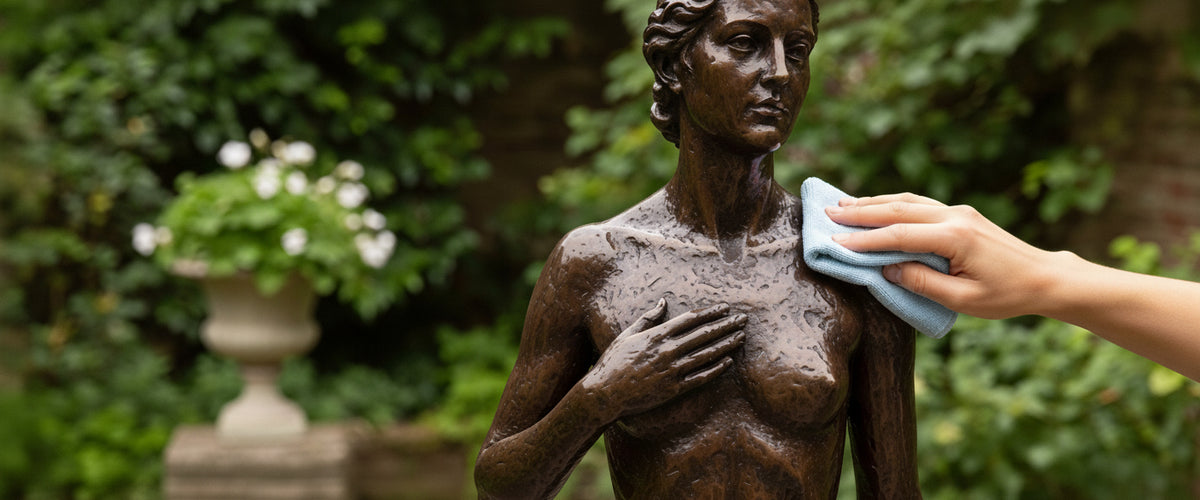

A bronze that looks tired after two winters almost never has a casting problem. It has a care problem, or worse, a placement problem nobody flagged at install. Outdoor bronze sculpture maintenance is mostly preventative: a rinse here, a wax cycle there, and a clear-eyed view of where the piece sits in relation to sprinklers, salt air, and direct afternoon sun. Get those decisions right and a well-cast bronze will outlive the house it stands in front of.
Looking for the full range in this category? Browse our Bronze Fountains collection for every available finish, size, and configuration.
This is the working guide we share with clients commissioning large pieces through Giant Sculptures, from Napa garden owners to Manhattan rooftop projects. It covers what actually changes year to year, what most owners overdo, and the placement choices that quietly decide how much outdoor bronze sculpture maintenance you sign up for.
Annual waxing in raking light, the core of any outdoor bronze sculpture maintenance routine.

Key Takeaways
Rinse outdoor bronzes with clean water every few weeks; wax once or twice a year depending on climate.
Patina is a finish, not damage. The job of outdoor bronze sculpture maintenance is to stabilize it, not strip it.
Placement decides most of your care load. Sprinklers, salt, and shade matter more than the wax brand.
Indoor bronzes need almost no upkeep beyond dusting and an occasional buff.
For monumental pieces, plan a professional condition check every three to five years.

What Outdoor Bronze Sculpture Maintenance Actually Looks Like
The honest answer: less than people fear, but more consistent than they expect. A bronze in a sheltered Texas courtyard might need a rinse every couple of months and a fresh coat of microcrystalline wax each spring. The same sculpture on a Hamptons dune, fifty yards from salt spray, wants outdoor bronze sculpture maintenance every few weeks and a heavier wax cycle twice a year.
The basic rhythm for any bronze sculpture maintenance routine breaks down into four jobs. Rinsing removes airborne salts, pollen, and bird droppings before they etch the surface. Gentle washing with a soft brush and pH-neutral soap handles ground-in grime once or twice a year. Drying is non-negotiable; water trapped in recesses is what causes the green streaking owners blame on the patina. Waxing seals the surface and gives the next year's weather something to attack instead of the metal itself.
For a more technical breakdown of materials and reagents, the conservation guidance published by AIC's Conservation Wiki on outdoor bronze sculpture is the document we point clients toward when they want to read further. It is written by working conservators and stays grounded in what actually happens on plinths and pedestals.
The Annual Outdoor Bronze Sculpture Maintenance Checklist
Inspect the surface in early spring under raking light. Look for streaking, pitting, or wax film breakdown.
Wash with soft brushes and lukewarm water. Avoid pressure washers; they drive water into hollow forms.
Let the piece dry completely. Compressed air helps in deep undercuts.
Warm the bronze gently in sunlight, then apply microcrystalline wax in thin coats. Buff with soft cloths.
Check the base, dowels, and any drainage holes. Standing water inside a hollow bronze is the single most common reason outdoor bronze sculpture maintenance fails long term.
Photograph the piece from four angles. Year-on-year comparison catches problems early.
Scale, Sightlines, and Pedestal Height
Upkeep and placement are the same conversation. A 130cm abstract piece on a low plinth is easy to wax in twenty minutes. A 370cm monumental arch needs scaffolding or a cherry picker, and that changes both your budget and your service intervals. We tell clients to think about access at the point of commissioning, not after delivery. A vertical abstract such as Flame III Matt Bronze Abstract Steel Sculpture - 130cm sits well within reach of a single step ladder for an annual wax, whereas something on the scale of the Monumental Modern Abstract Arch Bronze Sculpture - 370cm turns the same outdoor bronze sculpture maintenance job into a half-day operation with proper access equipment.
Pedestal height also decides how the sculpture reads. A reclining figure wants a low, broad plinth so the horizontal line carries; lift it onto a tall column and you have just defeated the pose. By contrast, a vertical piece reads beautifully when the base of the form sits at chest height, giving the upward sweep room to breathe against open sky.
A working rule from the studio: for figurative bronzes, the eye line of the sculpture should sit between the viewer's chin and forehead at the primary viewing distance. For abstracts, place the visual center of mass at roughly eye height. Pedestals exist to make that happen, not to add inches for their own sake.
Indoor Versus Outdoor: When Each Wins
Plenty of clients ask whether a bronze they love can move between a foyer and a garden. The short answer is yes; the longer answer involves finish choices. Indoor bronzes can carry softer, more reactive patinas because they never see rain, UV, or chloride. Pieces sited outside benefit from harder, more stable patinas and a wax barrier from day one, which sets the baseline for ongoing outdoor bronze sculpture maintenance.
Indoor placement wins when the piece is small enough that scale gets lost outside, when the patina is delicate, or when the work belongs to a curated room. A tabletop figure such as the Traditional Standing Gandhi Figure Bronze Statue - 30cm on a library shelf has presence; the same piece in a quarter-acre garden disappears. Outdoor placement wins when scale, weather, and sightlines all want a sculpture to anchor a view, terminate an axis, or hold a clearing in a planted bed. Monumental work only makes sense outdoors, where the eye has the distance to read it properly.
Sprinkler overspray and pooling water are the two placement errors that drive most outdoor bronze sculpture maintenance service calls.
Light, Backdrop, and Contrast
Bronze rewards directional light. Flat overcast days flatten the form; raking morning or late afternoon sun pulls every modeled surface into relief. When we site a piece during a client visit, we ask where the sun rises and sets relative to the primary viewing position, then orient the strongest profile to catch that light.
Backdrop matters just as much. A dark patina against a dark hedge vanishes. The same piece against a pale limestone wall or a clipped yew with sky behind it reads with real force. For lighter patinas, planting and stone walls work; for darker browns and near-black finishes, look for sky, water, or a pale architectural plane behind the sculpture. Action-led figures such as the Life-Size Contemporary Kneeling Archer Bronze Sculpture - 260cm depend on this; the drawn bow only reads when there is a clean plane behind it, which also makes the surface easier to inspect during routine outdoor bronze sculpture maintenance.
Common Placement Mistakes and How to Avoid Them
For wider placement ideas, Popular Themes for Outdoor Garden Sculptures: From Nature to Abstract Art is useful companion reading before finalizing the setting and sightlines.
After two decades of shipping monumental work into private gardens, country estates, and commercial plazas, the same handful of mistakes turn up again and again. Most are cheap to avoid at the planning stage and expensive to fix afterward, and each one quietly raises the cost of outdoor bronze sculpture maintenance for the life of the piece.
Sprinkler overspray. Irrigation water carries minerals and sometimes chlorine. A bronze hit by sprinklers three times a week will streak within a season. Resite the sprinkler heads, not the sculpture.
Pooling water. Bases without drainage become tiny reservoirs. Specify weep holes during commissioning.
Salt air without a wax plan. Coastal homes in Malibu, the Hamptons, or Florida need twice-yearly waxing as standard outdoor bronze sculpture maintenance. Skipping it is the fastest way to lose a finish.
Pressure washing. It strips wax, drives water into seams, and can lift patina. Soft brushes and rinse water only.
Wrong pedestal proportions. Too tall and the piece looks marooned; too short and it reads as a garden ornament. Mock it up with crates before pouring concrete.
Backdrop collision. A textured patina against a busy planting scheme cancels itself out. Decide the backdrop before the sculpture arrives.
For very large commissions, particularly seated or recumbent figures, we often supply a full-size cardboard mockup before casting begins. Clients walk around it, photograph it from the kitchen window, and live with it for a week. It costs almost nothing and prevents the most expensive mistake in outdoor sculpture: putting the right piece in the wrong place, then paying for outdoor bronze sculpture maintenance that cannot fix the siting.
When to Call a Conservator
For most owners, an annual wax and a careful eye are enough outdoor bronze sculpture maintenance for a decade or more. Bring in a professional conservator when you see active corrosion (bright green powdery patches that return after cleaning), structural movement, or damage to internal armatures. For monumental commissions, schedule a condition survey every three to five years regardless of how clean the piece looks. It is the same logic as servicing a high-end car. The Smithsonian's Museum Conservation Institute is a useful primer on what conservators actually look for during these surveys.
Looked after properly, an outdoor bronze does not just survive; it improves. Patinas mature, surfaces settle into their site, and the piece becomes the fixed point a garden organizes itself around. That is the long game we plan for with every commission, and the reason we treat outdoor bronze sculpture maintenance not as an afterthought but as part of the brief from day one.