






































































































Fiberglass gets dismissed at dinner parties and taken very seriously in foundries. Ask any sculptor who has tried to move a ten-foot bronze figure across a Hamptons lawn without tearing up the turf, and they will tell you why. To make fiberglass sculpture at a serious scale is to choose a material that lets you build big, ship sanely, and finish to a standard that holds its own next to metal and stone. The catch is that most studios that make fiberglass sculpture build down to a price, not up to a standard, and the gap between the two is enormous.
This is a working guide to how the material is actually used in studio practice, written for buyers, designers and collectors who want to understand what they are commissioning before they sign anything. If you plan to make fiberglass sculpture for a private estate or a public lobby, the decisions below are the ones that matter.

Quick Answer: Key Takeaways
To make fiberglass sculpture is to lay glass fiber mat and resin over a mould taken from a sculpted master.
Finish quality is set at the gel coat stage, before the fibers ever touch the mould. Get that wrong and no amount of paint hides it.
Studios that make fiberglass sculpture at scale offer the sane choice when transport, roof loads, balconies or sensitive lawns rule out bronze or stone.
For outdoor work, UV stability, internal armature and laminate thickness matter more than visible finish.
Custom fiberglass sculptures should be quoted on the work involved, not on weight; fiberglass weighs little and hides a lot of labor.

Why Fiberglass Gets Dismissed, and Why Serious Sculptors Still Use It
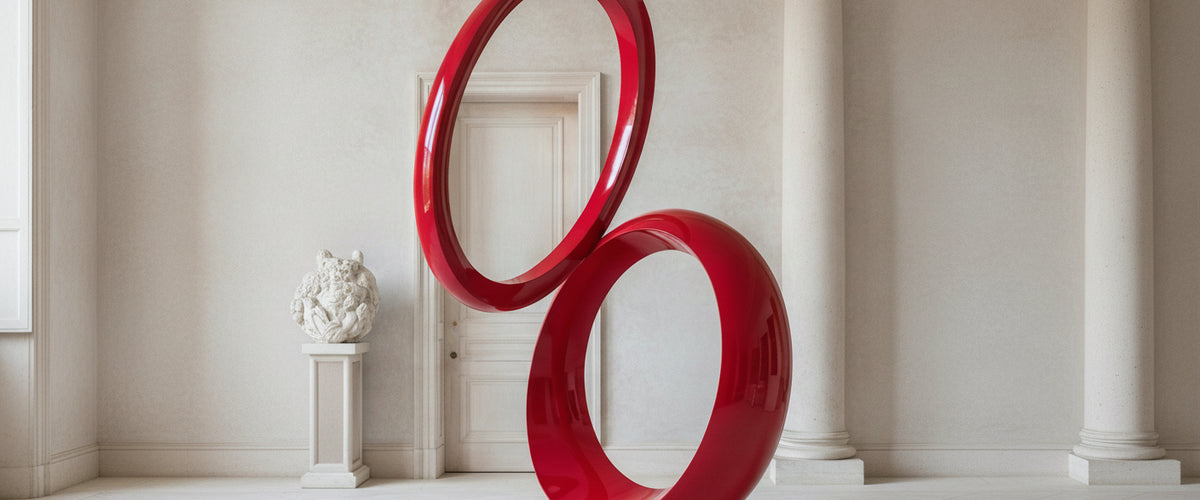
The dismissal is fair when you are looking at a hollow reindeer outside a garden center. The same material, in trained hands, builds the polished red curve of a public art commission or a fifteen-foot animal that ships flat-packed across the Atlantic. The difference is not the chemistry. It is the discipline of the lay-up, the quality of the master pattern, and what the studio is willing to do at the finishing bench.
Fiberglass earns its place when bronze becomes impractical. A bronze horse at 12 ft (3.6 m) tall can weigh several tons and demand a crane, an engineered base and an insurance call. The same horse in composite might come in at a few hundred pounds, ship in two sections, and install on a residential terrace without rebuilding the slab. For seasonal pieces, like fiberglass Christmas sculptures for a Fifth Avenue lobby or an Aspen hotel forecourt, the weight saving is the entire commercial argument for choosing to make fiberglass sculpture over cast metal.
From Maquette to Mould: The Decisions That Fix the Final Piece
Every fiberglass piece starts as something else. Usually clay, sometimes carved foam, occasionally a digitally milled pattern. This master is the only chance to fix proportion, gesture and surface detail. Once the mould is pulled, the geometry is locked.
Three decisions matter at this stage:
Sectioning. A 14 ft (4.3 m) figure cannot come out of a single mould. The sculptor decides where the seams fall. Good studios hide seams along anatomical lines, drapery folds or sculptural edges. Lazy studios put them where it is convenient and live with the visible scar.
Mould type. Silicone moulds capture undercuts and fine detail and suit complex figures and animal forms. Rigid fiberglass moulds are tougher and better for geometric, hard-edged work, including the polished prism and peak forms that lean into a Kapoor-influenced visual language.
Internal armature. For anything above roughly 6 ft (1.8 m), the laminate alone will not hold shape under wind load or its own weight over years. A welded steel armature, sometimes stainless for outdoor work, is designed in before the lay-up starts.
This is also where bespoke commissions live or die. When a client comes to our studio with a brief to make fiberglass sculpture in a custom fiberglass sculpture form, we spend more time at the maquette stage than at any other point. Changing a shoulder angle in clay takes ten minutes. Changing it after the mould is pulled means starting again.
Lay-Up, Gel Coat and the Finish Quality Buyers Cannot Unsee
Here is the sequence inside the mould, in order. It matters because the order is what makes a fiberglass resin sculpture either look like a museum object or look like a parade float.
Release agent is brushed or sprayed into the mould so the finished part will let go cleanly.
Gel coat goes in next, against the mould face. This is the layer the world will see. It is pigmented resin, usually 0.5 to 0.8 mm thick, and it carries the color and the surface quality. Bubbles, drag marks or thin spots here cannot be sanded out later without breaking through.
Skin coat of fine chopped strand mat with catalyzed resin is rolled into the back of the gel coat, working out every air bubble. This is slow work. Skip it and you get print-through, where the weave of the heavier mat telegraphs through the finish months later.
Structural laminate of heavier mat or woven roving is built up in layers to the engineered thickness. When you make fiberglass sculpture for the US Northeast or Pacific Northwest, we typically specify thicker laminates than a Florida or Texas piece would need, simply because of freeze-thaw cycling.
Cure, demould, trim, then bond sections together with structural adhesive and overlay tape on the inside seam.
The painting and finishing stage is where good studios separate themselves. Automotive-grade two-pack polyurethane, properly flatted between coats, gives a finish that reads as lacquered metal at 30 ft. A high-gloss mirror finish on a curved or faceted form requires multiple cycles of wet sanding from 800 up through 3000 grit, then machine polishing. There is no shortcut. When a brief calls for that kind of optical surface on a hard-edged geometric form, a piece like the Black Fiberglass Double Peak & Resin Prism Sculpture - 70cm is closer to the right reference than any figurative work, because the eye is being asked to read the gel coat as lacquer rather than as skin.
When you make fiberglass sculpture for outdoor placement, a UV-stable clear topcoat is non-negotiable. Standard polyester resin yellows in direct sun within a couple of seasons. The American Composites Manufacturers Association publishes good technical guidance on resin selection for exterior work if you want to read further (acmanet.org).
Reading a Fiberglass Piece at 10, 30 and 100 Feet
Sculpture is judged at three distances and any composite piece has to pass all three.
At 100 ft (30 m), what reads is silhouette and color. This is the distance a Napa winery visitor first sees a piece across the lawn, or where a hotel forecourt sculpture is registered from the street. Fiberglass wins here because you can build forms at scale that no studio could realistically cast in bronze on a private budget.
At 30 ft (9 m), what reads is proportion and surface continuity. Seams become visible if the studio cut corners. Sagging in the laminate, where wet mat was hung over an unsupported span, shows as a soft dimple. This is the distance most photographs are taken.
At 10 ft (3 m), what reads is the gel coat. Orange peel, pinholes, print-through, polish swirls, edge chatter. A good fiberglass piece reads at 10 ft the way a good car body reads at 10 ft. A bad one reveals every shortcut.
If you are commissioning a fiberglass garden sculpture for a private estate, ask the studio for photographs of previous work taken at all three distances. Brochures only ever show the flattering distance.
What Anish Kapoor's Fiberglass Work Teaches the Rest of the Field
The anish kapoor fiberglass sculpture pieces produced over the years, including the deep-pigment voids and the highly polished red curves, set a useful benchmark for everyone else who wants to make fiberglass sculpture at that level. Tate's collection notes on his pigment work are worth a read for anyone interested in how surface and color interact at sculptural scale (tate.org.uk).
The lesson is not to copy the work. It is to notice what those pieces refuse to do. They do not let the eye find a seam. They do not let the surface read as plastic. They commit completely to one color, one geometry, one optical effect. That kind of discipline is what separates a composite sculpture that holds a room from one that decorates it.
Most fiberglass animal sculptures fail this test because they try to do too much: textured fur, glass eyes, painted highlights, weathered patina. A stylized stainless or fiberglass animal in a single confident color usually outlasts the trend cycle by a decade, and it is a smart reference when you brief a studio to make fiberglass sculpture in animal form.
Questions to Ask a Studio Before You Sign
If you intend to make fiberglass sculpture on commission, or hire a studio to do it for you, use this as a buyer checklist when talking to any workshop about custom pieces, including ours. This is also the short list anyone researching how to make fiberglass sculpture from the buyer side should keep handy.
Who is sculpting the master? Is the maquette being made by a sculptor in clay or generated from a digital file? Both can work; the studio should be honest about which.
How is the piece sectioned, and where are the seams? Ask to see the section plan before mould-making begins.
What resin and gel coat are specified? For outdoor work, vinyl ester or isophthalic resin with a UV-stable topcoat is the answer you want.
What is the internal armature? For anything over head height, expect a welded steel skeleton and a specification for stainless or galvanized.
What is the finish process? Two-pack polyurethane, wet sanded and polished, is the standard for premium work. Single-pack rattle-can is not.
How is the piece anchored? Wind uplift on a hollow sculpture is real. Ask about base plates, ballast, or core-drilled fixings.
What is the realistic care schedule? Annual wash, periodic polish, and a topcoat refresh every several years for high-gloss exterior pieces.
Budget to make fiberglass sculpture at a serious scale depends on the master, mould strategy, armature engineering, finish specification and installation. Anyone quoting you a flat number per foot has not understood the brief. At Giant Sculptures we quote each project on the actual work involved and are happy to break the figure down line by line.
For a sense of what scale and finish look like in finished work, the wider fiberglass sculptures catalog and our large garden statues collection are the most useful places to browse before you decide to make fiberglass sculpture for your own setting. They show how the same material reads differently across figurative, animal, and geometric work, which is the conversation most clients want to have before committing to a bespoke piece.
For wider placement ideas, Angel Garden Statues: A Buyer's Guide to Scale, Stone and Placement is useful companion reading before finalising the setting and sightlines.