






















































































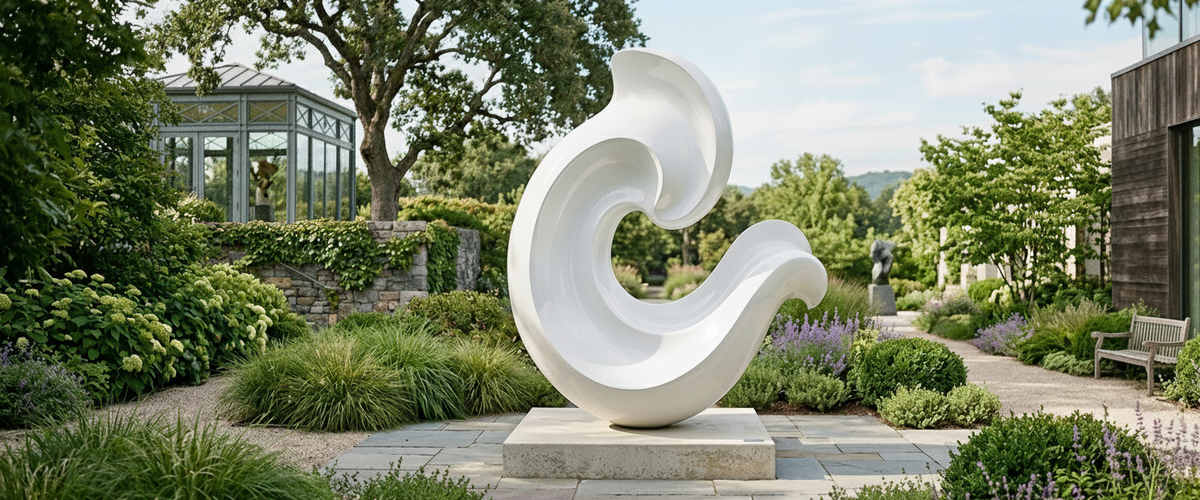

Most clients who ask us to make fiberglass sculpture pieces have already fallen for the idea of something tall, sculptural, and impossibly smooth. Then they get a fabrication quote that confuses them, or worse, a cheap one that looks great in renders and arrives looking like a pool slide. The gap between those two outcomes is craft, and it starts long before anyone mixes resin.
This is a look at how a serious studio actually approaches the work to make fiberglass sculpture that lasts, the choices that move the price, and the questions worth asking before you sign anything off.
Layup stage inside a multi-part mold, where the laminate schedule quietly decides the lifespan of the finished piece.

Key Takeaways Before You Commission
Fiberglass is a composite skin, not a solid material. The internal structure decides whether the piece survives ten winters or one.
Scale changes everything: a form that reads beautifully at 10 ft (3 m) can look bloated or hollow at 30 ft (9 m).
A maquette and a finish sample are non-negotiable when you commission a studio to make fiberglass sculpture work at scale.
Paint system and primer matter more than the gelcoat color you picked on a swatch.
Budget to make fiberglass sculpture depends on scale, mold complexity, engineering, finish level and installation. Ask for a tailored quote rather than a headline number.

What Sculptors Actually Think About Before Taking the Job
Before any quote goes out to make fiberglass sculpture for a client, the studio is running a quiet checklist. Where will the piece live? Coastal Florida, Aspen at 8,000 ft (2,400 m), a Houston lobby with skylights, a Hamptons garden under salt air? Each of those environments pushes the spec in a different direction. UV exposure, freeze-thaw cycles, chlorine off a nearby pool, and irrigation overspray all matter.
We also look at the geometry. Tight concave curves and undercuts mean a multi-part mold, which means more labor, more seams to hide, and more skilled finishing time. A clean convex form on a plinth is a different animal. When clients ask us to make fiberglass sculpture pieces with mirror-smooth automotive finishes, we flag early that the surface preparation will likely cost more than the layup itself.
The last quiet check is intent. Is this a gallery-style indoor object, a garden focal point, or a public-facing piece that needs to handle people leaning on it? The answer changes the laminate schedule, the core, and the engineering drawings. It is one reason buyers exploring our fiberglass sculptures catalog see such a range of construction approaches behind visually similar forms.
Craft Decisions That Change the Final Result
To make fiberglass sculpture properly, you build in layers, and every layer is a decision.
The Maquette and the Master
Most large commissions to make fiberglass sculpture start as a small physical maquette, usually 12 to 24 in (30 to 60 cm), carved or 3D-printed from the approved design. The maquette is then scaled up to a full-size master, traditionally sculpted in clay or high-density foam, then refined with body filler and sanded to the final surface. This master is what the mold is taken from, so any flaw here gets faithfully copied into every piece pulled later.
The Mold
Molds used to make fiberglass sculpture are usually built in tooling gelcoat backed with multiple layers of glass and a rigid framework. On complex forms you might have six, eight, twelve sections that bolt together. A cheap mold cuts corners here, and you see the result as wavy reflections and visible seam lines on the finished sculpture. A good mold is boring to look at and worth every hour spent on it.
Layup and Core
Inside the mold, the first layer is gelcoat, then chopped strand mat or woven roving wetted out with polyester, vinylester, or epoxy resin. For large pieces, a foam or balsa core is sandwiched between glass skins to add stiffness without weight. Steel armatures are bonded in where the piece needs to be lifted, bolted down, or resist wind load. This is where engineering quietly earns its keep. The Smithsonian's conservation guidance on composite sculpture is a useful primer on why internal structure dictates lifespan (see si.edu/mci).
Finish
The finish is where fiberglass either looks like art or looks like a prop. Body filler, primer, block sanding, high-build primer, more sanding, basecoat, clearcoat, polish. On a high-end piece, that cycle can repeat for weeks. A two-pack automotive polyurethane system over a properly prepared substrate is what carries a piece like Chrome and White Marble Wave Abstract Fiberglass Sculpture at 480 cm, where any ripple in the surface would be visible from across a courtyard. Skip the prep and the entire optical effect collapses.
A finished commission after weeks of block sanding, two-pack primer, and polyurethane topcoats.
Why Some Fiberglass Sculptures Read Right at 10 Feet and Wrong at 30
Scale is the most underrated factor when you commission a studio to make fiberglass sculpture. A form designed at desktop size often loses its tension when blown up. The shoulders go soft. The negative space stops working. The piece reads heavy or, more often, hollow.
This is something Anish Kapoor's fiberglass sculpture and resin work demonstrates well, even at smaller scales: the curvature has to keep its discipline as the piece grows or the optical effect collapses. We have walked clients back from a design that looked perfect at 4 ft (1.2 m) but would have looked like an inflated balloon at 18 ft (5.5 m). The fix is usually to re-sculpt edges, tighten radii, and sometimes add subtle facets the eye reads as crispness from a distance.
For garden commissions we always ask for site photos with a person standing where the sculpture will go. A compact, sharply faceted piece such as Black Fiberglass Double Peak & Resin Prism Sculpture at 70 cm belongs on a terrace, a console, or a plinth in a tight interior corner. The same silhouette scaled to 8 ft (2.4 m) needs structural reworking to hold its line outdoors, and it needs to earn that scale by the way it sits against the planting behind it.
The Studio Process, Start to Install
Brief and concept. Sketches, reference, site plan, budget direction, deadline.
Maquette. A small physical model so the client can walk around the form before any tooling is cut.
Finish sample. A panel in the proposed color and finish, photographed in the actual site light if possible.
Master build. Foam or clay sculpt at full scale, refined and sealed.
Mold making. Tooling gelcoat and laminate, split into sections that release cleanly.
Layup. Gelcoat, glass, core, steel armature, demold, trim, bond.
Finishing. Filling, sanding, priming, painting, polishing.
Crating and shipping. Custom timber crates, climate considerations, route planning for oversized pieces.
Install. Foundations, anchor bolts, lift plan, snagging, sign-off.
For a single bespoke piece at 15 to 20 ft (4.5 to 6 m), realistic studio time to make fiberglass sculpture at that scale is several months, not several weeks. Anyone promising otherwise is either skipping the master, skipping the finish cycles, or both.
How to Paint a Fiberglass Sculpture Properly
Paint failure is the most common complaint we hear about secondhand fiberglass pieces, and it is almost always a prep problem rather than a paint problem. The gelcoat layer, if used, has to be sanded with the right grit to give the primer something to grip. Any wax release agent left in the surface will sabotage adhesion. After that, a two-pack epoxy primer, block sanding, a two-pack polyurethane topcoat, and a UV-stable clearcoat is the spec we use for outdoor work. Single-pack rattle-can paint on an outdoor fiberglass sculpture will look tired within a season.
For fiberglass garden sculpture in strong sun, we specify pigments rated for high lightfastness and clearcoats engineered for marine or automotive exposure. The American Institute for Conservation has solid background reading on coating systems and exterior durability if you want to go deeper before you make fiberglass sculpture that has to live outside.
Red Flags Worth Asking About Before You Commit
No maquette offered. If a studio wants to skip straight to fabrication on a major piece, walk away.
Vague laminate schedule. Ask how many layers of glass, what weight, what resin, and where the core sits. A serious fabricator answers without hesitation.
No internal steel for large outdoor work. Wind load on a tall hollow shell is not a small problem.
Gelcoat treated as the final color. Pigmented gelcoat fades outdoors. A proper paint system on top is what protects the piece.
No finish sample. Colors and gloss levels look different at scale and in real light. Approving on a digital swatch is a recipe for disappointment.
No engineering drawings or anchor plan for site install. Especially relevant for public spaces or anywhere people will be near the piece.
One number for the whole job. A trustworthy quote to make fiberglass sculpture breaks out tooling, fabrication, finish, crating, freight, and install. Bundled lump sums hide where corners get cut.
Where Fiberglass Earns Its Place
For wider placement ideas, Angel Garden Statues: A Buyer's Guide to Scale, Stone and Placement is useful companion reading before finalising the setting and sightlines.
Choosing to make fiberglass sculpture is the right answer when you want generous scale without the weight of bronze or stone, complex curved forms that would be punishing to carve, or a vivid painted finish that needs to look factory-fresh. It works beautifully for fiberglass animal sculptures used in retail and hospitality, oversized fiberglass christmas sculptures for seasonal displays at resorts and shopping districts, and large-scale fiberglass resin sculpture pieces where weight on the floor slab is a constraint. For bronze-equivalent permanence at the same scale, we would steer you to a different material. For everything else, custom fiberglass sculptures give you a range of form and finish that few materials can match.
If you are weighing options for a specific site, the most useful next step is a short brief: location, sightlines, budget direction, and the feeling you want the piece to create. Everything else falls out from there.