






































































































The gap between a good abstract contemporary metal piece and a disappointing one usually opens long before anyone touches a torch. It opens in the first conversation, when a buyer describes a wall or a courtyard and the maker has to decide whether the idea will hold up at full size, in real light, over real years. Get that judgment right and the finished work looks inevitable. Get it wrong and you have a handsome object fighting its own setting.
So here is the view from inside the studio: what we actually think about before we agree to make something in abstract contemporary metal, why two pieces of similar size can cost very different amounts, and the questions worth asking any fabricator before you sign off.
Hand-forming and welding elements in the studio, where most of the cost of a bespoke piece actually accrues.

Key Takeaways Before You Commission
Scale is a design decision, not a size setting. A form that sings at 10 feet can fall flat at 30, and vice versa.
Material drives everything downstream: stainless steel, Corten, bronze and coated aluminum each age differently and cost differently.
Finish and fabrication method affect price more than raw size. Hand-formed and hand-finished work carries hours that a laser-cut panel does not.
A proper studio process runs maquette, sample, fabrication, then install. Skipping steps is where regret lives.
Budget depends on material, scale, complexity, engineering, installation and finishing. Ask for a tailored quote rather than trusting a flat catalog number.

What Sculptors Actually Weigh Before Taking a Commission
The first thing we assess is whether the concept and the location agree with each other. Someone sends over a photo of a double-height entry hall and a reference image of a delicate wire form. The form is lovely; it would also vanish against 20 feet of pale plaster. That is a placement problem, not a taste problem, and it is our job to raise it early when the piece is a large abstract contemporary metal one.
We look at sightlines. Will the piece be read head-on, or on the diagonal as people move through a space? Metal reads very differently when light rakes across a textured surface versus hitting it flat. We look at the wall or ground structure too, because a heavy abstract contemporary metal panel needs backing that can actually carry it, and not every drywall partition or garden render can.
Then we ask the uncomfortable questions. What happens to this piece in ten years? Is it going somewhere coastal, where salt air will pit an unsuitable alloy? Is it a resale-minded interior where a bold red should be reconsidered, or a private collector who wants exactly that jolt of color? The answers shape the material for any abstract contemporary metal commission before we draw a single line.

Craft Decisions That Change the Result (and the Price)
People assume price tracks size. It mostly tracks labor and engineering. A large flat panel that runs through a CNC process can be quicker to produce than a smaller abstract contemporary metal sculpture built from dozens of hand-shaped, individually welded elements.
Material is the first fork. Stainless steel gives you mirror polish or a brushed satin grain and shrugs off weather, which is why it dominates outdoor commissions; the wider metal wall art category leans on it heavily for that reason. Corten (weathering) steel develops a stable rust-colored patina that many designers want for gardens, though it needs correct detailing so runoff does not stain surrounding stone. Bronze carries a different weight and history, and takes chemical patinas that can be tuned toward brown, green or near-black. Coated aluminum keeps weight down for large wall pieces, which matters when you are hanging something 8 feet (2.4 m) across.
Finish is the second fork. A powder coat in a single flat color reads clean and modern and holds up well outdoors; the US Environmental Protection Agency notes that powder coating produces far fewer volatile emissions than many liquid solvent-based systems, one reason it has become a studio default for durable color (epa.gov). A hand-applied patina or a layered automotive-grade lacquer, by contrast, involves more hours and more skill, and that shows up in the quote for a piece of abstract contemporary metal.
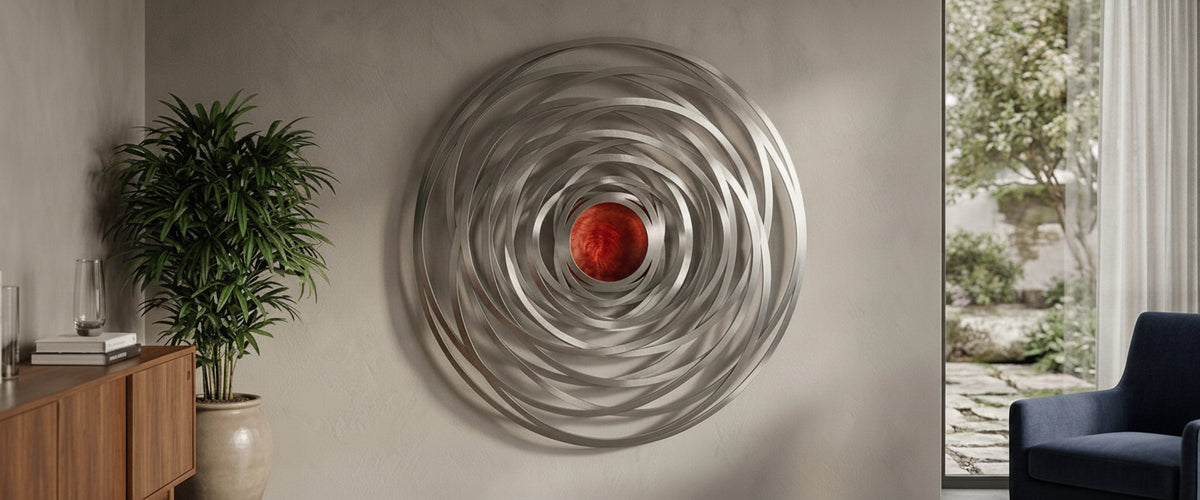
Color itself is a craft decision. On a neutral wall that needs a deliberate focal point, a saturated form such as Eclat Sphere Red Abstract Metal Wall Art throws shadow through its concentric rings and anchors the room. This is the kind of abstract contemporary metal wall art that carries a space on its own. Where the same form should recede into a companion piece rather than a statement, Eclat Sphere Bronze Abstract Metal Wall Art is closer to the right design language. Neither is better; they solve different rooms.
A brushed piece resolved for its silhouette so it carries from the far entrance of a large lobby.

Why Some Abstract Contemporary Metal Reads Right at 10 ft and Wrong at 30
Scale is where instinct fails buyers most often. A composition that feels balanced on a screen, or as a foot-tall maquette on a desk, does not automatically scale up in proportion to the eye.
Two things change with distance. Detail collapses, and negative space grows. Fine surface texture that gives an abstract contemporary metal piece life at conversational range disappears at 30 feet, so a design that relies on that texture goes flat. Meanwhile the open gaps between elements, which feel tight and intentional up close, can read as awkward emptiness across a large courtyard.
We shipped a brushed stainless piece to a corporate lobby a while back where the client had originally specced it smaller. Standing under the mezzanine at full scale, the earlier size would have looked like a coaster on a banquet table. We pushed the width and simplified the internal detail so the silhouette carried from the far entrance. That is the real lesson: as pieces grow, the outline has to do more work and the surface has to do less. Contemporary metal wall art destined for a big architectural wall should be designed for its silhouette first, and that same rule holds for any wall metal art contemporary enough to lean on clean geometry.
The reverse trap is just as common. Cram a busy, high-detail sculpture into a tight 10-foot alcove and the eye has nowhere to rest. Metal contemporary wall art in intimate spaces usually wants a single clear gesture, not a crowd of elements competing at close range. Abstract contemporary metal works hardest when it is edited down to that gesture.
Studio Process: Maquette, Sample, Fabrication, Install
A commission that is going to go well follows a sequence, and each stage exists to kill a specific risk.
Maquette. A scaled model, physical or detailed 3D render, confirms the form and proportion before metal is committed. This is where we test the silhouette at intended viewing distance.
Sample. A finish sample on the actual chosen material. Photos lie about color and reflectivity; a real swatch in your actual daylight does not. For patinated bronze or Corten especially, we want you to see the tone in person.
Fabrication. Cutting, forming, welding, grinding and finishing. For hand-built abstract contemporary metal this is the longest phase and the one most sensitive to complexity.
Install. Fixings, backing structure, weight distribution and access all get planned before delivery, not on the day. A large abstract contemporary metal wall piece often needs a concealed cleat or engineered bracket, and someone has to confirm the wall can take it.
Skip the maquette and you gamble on proportion. Skip the sample and you gamble on color. Skip install planning and you find out the freight elevator is 2 inches (5 cm) too narrow after the crate arrives. We would rather over-plan than send a crew home.
Honest Red Flags to Raise Before You Commit
Whether you commission your abstract contemporary metal from us or anyone else, these questions separate a serious fabricator from an optimist.
"What alloy or grade, exactly?" For anything outdoors or coastal, a vague "stainless" answer is not enough; marine-grade specification matters for corrosion resistance.
"Can I see a finish sample on the real material?" A studio that only offers renders is asking you to buy color blind.
"How is it mounted, and who confirms the wall or footing?" Weight and fixing detail should be part of the quote, not an afterthought, especially for heavier abstract contemporary metal wall art.
"What does aftercare look like?" Stainless wants occasional cleaning; patinated bronze may want a wax refresh; the Smithsonian's conservation guidance on outdoor bronze is worth reading for owners (si.edu).
"What is included in the quote?" Design, engineering, crating, freight and installation can each be a line item. Get it in writing.
On pricing, be wary of anyone who quotes a firm number before understanding scale, material and site. Real budgets for a bespoke abstract contemporary metal piece depend on material, scale, complexity, engineering, installation and finishing, which is exactly why we quote each commission individually rather than pretend one figure fits all.
Where Giant Sculptures Fits
We build large-scale and bespoke abstract contemporary metal work to last, from statement wall pieces to freestanding forms, and we ship worldwide. If you already know the look you want, our ready pieces in the abstract sculptures range give you a fast route in, and they cover plenty of abstract contemporary metal wall art too. If your wall or garden needs something made to fit, the commission process above is how we get you there without surprises. Either way, the goal is the same: a piece of abstract contemporary metal that looks like it was always meant for that spot.
For wider placement ideas, Contemporary Abstract Metal: How to Place It so It Actually Reads is useful companion reading before finalizing the setting and sightlines.