





































































































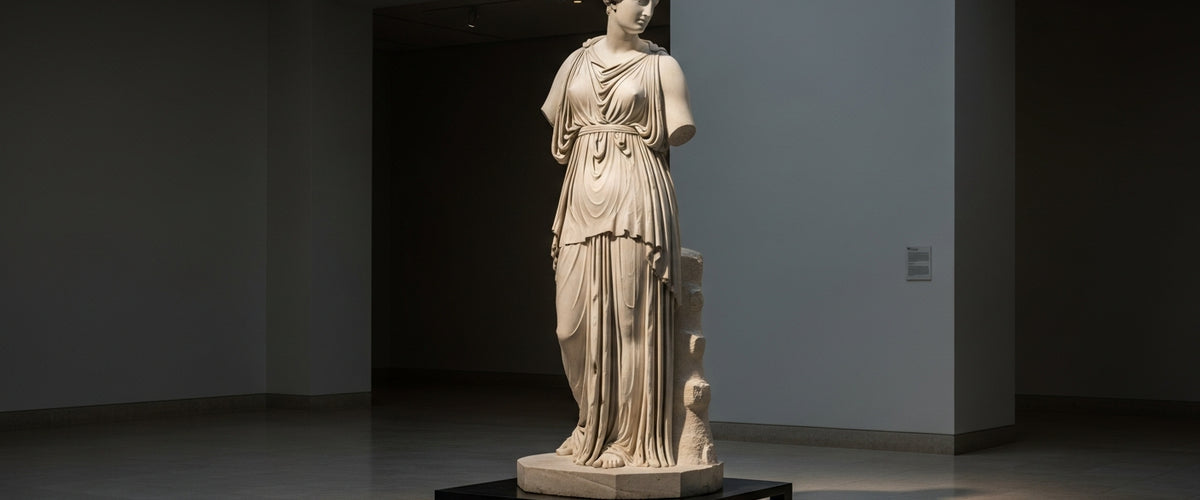

Walk into a quiet gallery hall, a private courtyard, or a well-considered hotel lobby, and the figure that holds the room is almost always the same: a classical female sculpture, weight shifted onto one leg, drapery falling in long vertical folds, gaze set somewhere just past you. Two and a half thousand years of taste-making, and we still cannot look away. There is a reason buyers keep coming back to this archetype, and it is not nostalgia. It is composition.
At Giant Sculptures we commission and supply large-scale figurative work for private homes, estates, hospitality clients and designers, and the classical female form remains one of the most requested briefs we receive. This guide is for buyers who want to understand what they are actually looking at, and how to choose a piece that will still feel right in a decade.

At a glance: what to know before you buy
- Pose matters more than face. Contrapposto, seated, or striding changes the entire energy of a room.
- Era is a style decision. Greek, Roman and Neoclassical pieces read very differently to a trained eye.
- Nude or draped is a placement decision, not a moral one. Think about sightlines, not squeamishness.
- Material decides lifespan. Solid marble and bronze outlast plaster reproductions by generations.
- Scale is the silent variable. A 120cm figure and a 230cm figure occupy a room in completely different ways.
- Budget is brief-driven. Material, height, complexity of carving, engineering and installation all move the number; ask for a tailored quote rather than guessing from a catalogue thumbnail.

Why the contrapposto pose still anchors modern interiors
Contrapposto, the asymmetric stance where weight rests on one leg and the shoulders counterbalance the hips, was the Greek invention that turned stone into a body. It is the reason a classical female sculpture in a glass-walled new-build does not feel like a costume drama. The pose introduces a subtle S-curve that breaks up rectilinear architecture: think open-plan kitchens, gallery corridors, large stairwell voids. Anywhere the architecture is rigid, contrapposto softens it.
If your interior is already curvy, with arched openings and rounded furniture, a more static pose works harder. Where the room needs stillness instead of an S-curve, a seated figure such as the Seated Classical Woman Marble Sculpture - 130cm resolves the brief better than another standing piece. The rule of thumb: match the pose to what the room lacks, not to what it already has.

Reading a classical female form: drapery, gaze and side profile
A good classical female sculpture rewards a slow walk around it. Three details tell you most of what you need to know about quality.
Drapery. The Greeks perfected the "wet drapery" effect, where fabric reveals the body beneath through fine, parallel folds. On a well-carved marble, the folds should feel like cloth, not corrugation. Run your eye from shoulder to hem; if the rhythm breaks or the folds flatten where they meet the floor, the carver lost interest at the bottom.
Gaze. Classical figures rarely look at the viewer. The downcast or middle-distance gaze is deliberate; it gives the sculpture privacy and forces you to circle it. When buyers ask why a piece "feels right" in a hallway, this is usually why.
Side profile. The classical female sculpture side profile is the most quoted, most photographed, and most diagnostic view. The line from forehead to nose should be near-continuous, the chin firm but not pointed, and the neck long enough to carry the head without strain. If the profile looks correct from both sides, the carver knew what they were doing. If only one side photographs well, you are looking at a piece designed to sit against a wall.

Greek vs Roman vs Neoclassical: telling the eras apart
Most large-scale figurative work we supply nods to one of three traditions. Knowing which is which stops you commissioning a Roman-feeling piece for a Greek-feeling room.
Classical Greek female sculpture
Idealised, restrained, often draped. The classical Greek female sculpture aims for a generalised beauty rather than a specific person. Think the Caryatids of the Erechtheion or the Venus de Milo. The faces are calm, the proportions mathematical, the surface finish satin rather than glossy. This is the register that suits minimalist architecture, pale stone floors, and rooms with very little colour.
Roman
Romans copied Greek originals at scale, then added portraiture. A Roman classical female sculpture is more likely to have an individual face, more elaborate hair, and a heavier presence. Drapery becomes deeper and more theatrical. These pieces sit well in panelled rooms, libraries, and traditional country properties.
Neoclassical
The eighteenth and nineteenth-century revival, led by Canova and Thorvaldsen, polished marble to a higher sheen and pushed sentiment further. Neoclassical figures often hold attributes: a lamp, a wreath, a vessel. Where a stairwell or entrance also needs to resolve a lighting problem, a lamp-bearing figure like the Classical Woman Lamp Marble Sculpture - 230cm belongs squarely to this Neoclassical lineage, performing a function as well as occupying space.
Nude vs draped: choosing what suits the room you actually live in
The classical female nude sculpture is one of the oldest subjects in Western art, and the British Museum's collections of Greek and Hellenistic figures show how completely it was accepted as a serious artistic register rather than a provocation. That said, a classical nude female sculpture asks more of its setting than a draped piece does.
Nudes need air. A figure in the round, fully nude, wants to be approachable from at least three sides and lit from above rather than head-on. Cramped alcoves flatten them. Draped figures, by contrast, are more forgiving; the folds carry the eye even in tight spaces, which is why they work well in narrow hallways and against walls.
For family homes and shared hospitality spaces, a draped figure is usually the easier brief. For private studies, primary suites, sculpture gardens and pool houses, the nude is often the stronger choice. There is no aesthetic hierarchy between them, only a placement question.
Classical female sculpture poses and what they do to a room
Pose is the single biggest driver of how a piece behaves in situ. A short field guide:
- Standing contrapposto: energising, directional. Best in entrances and at the end of long sightlines.
- Striding or in motion: dynamic, almost narrative. Best in gardens and large halls where the figure has room to "move".
- Seated: calming, grounding. Best in libraries, lounges and waiting areas.
- Reclining: intimate, low-horizon. Best on plinths in bedrooms, spa areas, and against long horizontal walls.
- Caryatid or load-bearing: architectural. Best when the piece can genuinely frame a doorway, fireplace or lamp fixture.
For entrance halls and gallery landings where a full life-size figure would feel pressed against the architecture, a sub-life-size standing piece such as the Classical Female Figure Marble Sculpture - 120cm tends to hold the room without crowding it. Scale, not just pose, is what decides whether a contrapposto figure energises a space or fights it.
Marble, plaster and bronze: longevity ranked honestly
Material decides whether you are buying for one generation or several. In order of long-term durability for an interior or sheltered exterior setting:
- Bronze. Effectively permanent outdoors with periodic waxing. Patinas develop character rather than damage. The trade-off is weight and foundation requirements.
- Solid marble. Centuries of indoor life with minimal intervention. Outdoors, marble is more vulnerable to acid rain and frost than people assume; the Getty Conservation Institute publishes useful guidance on stone conservation that is worth reading before placing a marble piece in a fully exposed setting.
- Cast stone and composite marble. Decades rather than centuries. Good for clients who want the look at lower weight, but resurfacing is sometimes needed.
- Plaster reproductions. Decorative only. Vulnerable to humidity, chips and yellowing. Avoid for any piece you want to keep.
For outdoor placements where a fully exposed marble feels like a stretch, we routinely steer clients toward bronze, or toward marble figures specifically finished for outdoor display, like the Four Season Female Angel Marble Outdoor Sculpture - 220cm, set away from constant overspray and standing water rather than directly under a gutter line.
Pairing classical figures with contemporary furniture
The fastest way to make a classical female sculpture look like a museum gift-shop prop is to over-stage it. Pedestals draped with velvet, gilt frames behind, urns either side. Resist all of it.
Three placement habits that consistently work:
- Let the figure be the only ornament in its zone. If there is a sculpture, there should not also be a vase, a side lamp and a stack of books on the same surface.
- Use a plain plinth in a material that disagrees with the figure. Marble on blackened steel, bronze on travertine, stone on lime-washed timber. The contrast keeps the piece reading as art rather than decor.
- Light from above and slightly to one side. Frontal lighting flattens the form; raking light reveals the carving.
Classical pieces sit surprisingly well with mid-century and contemporary furniture precisely because both traditions value clean silhouettes. The clash is conceptual rather than visual, and the room benefits from the tension.
Commissioning a bespoke classical female sculpture
If you cannot find the exact pose, scale or material combination in our existing range, a commission is usually the answer. A typical Giant Sculptures bespoke process for a classical female form involves agreeing the era and pose reference, scaling to the architecture rather than to a catalogue size, selecting marble grade or bronze patina, and engineering the base for the floor it will actually stand on. Budget on a commission of this kind is driven by height, complexity of drapery and hands, choice of stone, and installation logistics, so the most useful first step is to share the room dimensions, intended placement and any reference images, and request a tailored quote.
The pieces that age best are almost always the ones where the client resisted the urge to over-specify and trusted the proportions of the tradition. Two and a half thousand years of testing is hard to argue with.
For wider placement ideas, Light & Shadow 3D Art: Wall Paintings That Glow, Shift, and Transform is useful companion reading before finalising the setting and sightlines.
For general conservation principles, V&A sculpture techniques is a useful external reference, though the final care routine should always follow the material and finish specified for the individual commission.