






















































































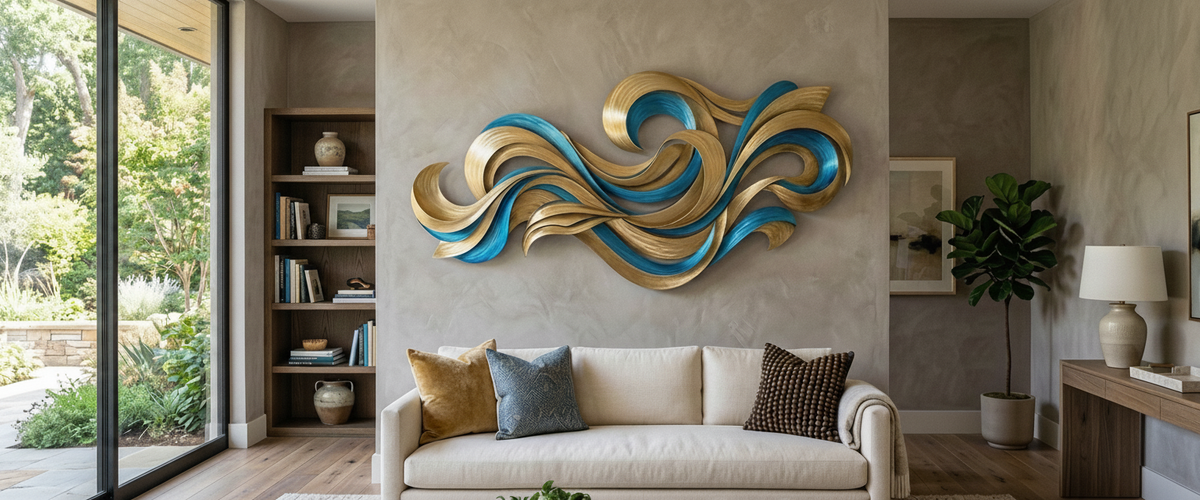

Most living room walls are working against you. The piece is too small for the space, hung a few inches too high, and chosen to be inoffensive rather than deliberate. Good wall art living room decisions start with the opposite instinct: pick something that owns the wall, then work backward to material, scale, and hanging. That is the difference between decoration and a focal point people actually notice when they walk in.
Looking for the full range in this category? Browse our Wall Art and Wall Decor collection for every available finish, size, and configuration.
We build large-scale and bespoke pieces at Giant Sculptures, and the questions we get about wall art living room choices are almost always about confidence. How big is too big? Metal or wood? Where does it sit above the sofa? This guide answers those questions the way we would in a studio conversation.

Key Takeaways
Scale first. A living room feature piece should span roughly two-thirds the width of the furniture below it. Undersized wall art living room choices are the most common mistake we see.
Material sets the mood. Metal reads modern and reflective; wood softens; ceramic and mixed-media add real depth and shadow.
Height matters. Center the piece around eye level, roughly 57 to 60 inches (145 to 152 cm) to the middle, adjusted for a sofa or console below.
Bespoke solves awkward walls. Double-height rooms, wide chimney breasts, and unusual proportions are where a commission earns its keep.

What Wall Art for the Living Room Means, and Who It Suits
Living room wall art covers a wide field, from framed prints to sculptural metalwork that projects several inches off the surface. For the purpose of this guide, we are talking about statement pieces: work substantial enough to anchor a room rather than fill a gap beside a bookshelf. Good wall art living room planning starts by naming that intent.
That suits a few types of buyer. Homeowners furnishing a new build in Texas or a renovated apartment in NYC who want one confident piece instead of a cluster of small frames. Interior designers specifying for clients who expect a focal point above a fireplace. Developers dressing a show home where the living room has to land in three seconds. If you want the wall to feel resolved rather than busy, a single larger work almost always beats a gallery wall of small ones.

How to Compare Wall Art for the Living Room Before Buying
Before you fall for a finish, run the piece through a short set of practical filters. This is roughly the order we walk clients through when they compare wall art living room options.
Wall width and furniture below. Measure the wall and the sofa or console. Your target art width is around two-thirds of the furniture width. A 90-inch (229 cm) sofa wants art in the region of 60 inches (152 cm) wide, whether that is one piece or a tight pairing.
Sight lines. Where do you sit, and where do you enter? The best living room wall art rewards both the seated view and the first glance from the doorway.
Light through the day. Metallic and reflective finishes change dramatically with the sun. A gold abstract that glows in morning light can flatten by evening, so think about when the room is actually used.
Color relationship. Decide whether the art should echo the room or contrast it. A warm metallic piece pulls a neutral scheme together; a bold red breaks up a muted one.
Depth and shadow. Flat prints sit on the wall. Dimensional metal and ceramic throw shadows that shift through the day, which is what gives your wall art living room genuine presence.
If you are weighing several options, the Living Room Art collection is a sensible place to compare finishes side by side before committing to a direction.

Key Materials, Finishes, and Scale Decisions
Material is where the character lives, and it shapes every wall art living room decision that follows. Here is how the main options behave in a living room.
Metal Wall Art
Metal is our default recommendation for a modern living room because it holds scale without visual weight. Brushed and layered metal catches light and reads as crafted rather than printed. Above a low sofa, where movement in a piece can counter the horizontal line of the furniture, a flowing abstract such as the Astrid Azure Flow Gold Abstract Wall Art sits comfortably. Where a room needs a single point of focus rather than a spread, a bolder composition like the Eclat Sphere Red Abstract Metal Wall Art gives you one clear anchor instead of scattered interest. Browse the wider metal wall art range to see how different finishes carry across a wall.
Wood Wall Art
Wood does the opposite job. It warms a room, absorbs sound slightly, and pairs naturally with stone floors and linen upholstery. It suits a Napa or Aspen aesthetic where the architecture already leans organic. The trade-off is that timber responds to humidity, so keep it away from unshielded fireplaces and direct radiator heat. The USDA Forest Products Laboratory Wood Handbook documents how wood expands and contracts with moisture, which is worth understanding before you hang a large panel above a heat source. For a wood-forward wall art living room look, that stability question matters.
Ceramic and Mixed Media
Dimensional ceramic and mosaic pieces add relief and texture that photographs never capture. Where the wall benefits from shadow and close-up detail rather than reflective sheen, a framed 3D form such as the Harmonia 3D Wave Ceramic Wall Sculpture With Black Frame & Acrylic Box is closer to the right design language. These pieces tend to be heavier per square inch than metal, so fixing matters more (see below).
Scale
Scale is the decision buyers get wrong most often. In a room with 9-foot (2.7 m) or taller ceilings, a small frame looks stranded. For double-height rooms, common in newer California builds, you often need a piece 4 to 6 feet (1.2 to 1.8 m) tall to hold the wall. When a stock size will not do, that is the point to consider a commission for your living room wall art.
Where to Place Wall Art for the Strongest Impact
For wider placement ideas, Abstract Metal Wall Art: A Buyer's Guide to Scale, Finish and Placement is useful companion reading before you finalize the setting and sightlines for your wall art living room.
The obvious spot is above the sofa, and for good reason: it completes the seating group. Center the art on the furniture, not the wall, if the two are not aligned. Leave 6 to 10 inches (15 to 25 cm) between the top of the sofa back and the bottom of the frame so the two read as related rather than stacked.
A fireplace or chimney breast is the other natural home. Here the art should relate to the width of the mantel or the breast, and sit high enough to clear a mantel clock or candlesticks without floating. In open-plan rooms, a large piece on the wall that faces the entry doubles as a way to define the living zone from the kitchen or dining area.
One detail we learned the hard way on a commission we shipped to a coastal home: a west-facing wall with a reflective gold piece became almost unreadable at sunset because of glare bouncing off a glass coffee table. We swapped the surface finish for a more textured, less mirror-like one, and the problem disappeared. If your room has strong low-angle light, favor matte or brushed finishes over high-polish.
How to Arrange and Hang Wall Art in a Living Room
Single statement piece: center around 57 to 60 inches (145 to 152 cm) to the middle of the work, adjusted down slightly when it sits above a sofa.
Pair or triptych: treat the group as one shape. Keep 2 to 4 inches (5 to 10 cm) of gap between panels and hang them as if they were a single rectangle.
Fixings: find the studs or use proper anchors rated well above the piece's weight. For anything over 15 pounds (7 kg), we recommend two fixing points minimum and a level check before you commit.
Heavy or projecting pieces: dimensional metal and ceramic need cleat or D-ring systems that spread the load. Ask us about the fixing method before delivery so the wall is ready.
Budget, Commissioning, and Delivery
There is no single price for living room wall art because the cost is driven by material, size, complexity of the finish, and whether the piece is stock or bespoke. A layered metal abstract and a hand-built ceramic relief of the same footprint sit in very different places. Rather than guess, request a tailored quote once you know your wall size and material direction; that is the only honest way to price a wall art living room statement piece.
For commissions, we ask for wall dimensions, a few photos of the room in daylight and at night, and your color scheme. We then work up scale and finish options before anything is made. Lead time depends on the material and detail involved, and we confirm it in writing rather than promising a date we cannot hold. Worldwide shipping is standard for us; larger works travel crated and, where needed, with installation guidance for the receiving trade.
DIY Versus a Bespoke Commission
Plenty of buyers ask about do-it-yourself pieces for the living room, and for a rental or a starter space, a self-made work can be a good stopgap. Where DIY stops working is scale and longevity. A large room asks for something that reads as intentional and holds up over years of light and temperature change, and that is hard to fake with craft-store materials. If the wall is a permanent feature of a home you intend to keep, a properly engineered wall art living room piece is the better long-term call.
Giant Sculptures sits at the bespoke end of that decision. We design and build large-scale wall art living room work and sculpture for homes and commercial venues, matched to the wall rather than trimmed to fit it. If you have an awkward chimney breast, a double-height void, or a specific color story to hit, that is exactly the brief we like.
A Short Buyer's Checklist
Measured the wall and the furniture below it
Chosen a material that suits the light and the room's mood
Confirmed the piece is around two-thirds the width of the furniture
Planned the hanging height and fixing method for the weight
Requested a tailored quote if going bespoke, with room photos supplied
Get the scale and the material right, and the rest of your wall art living room follows. A living room wall should feel decided, not decorated around.