






































































































Most wall art and decor decisions go wrong before the piece is even shortlisted. The room gets measured by eye, the budget is set against a print rather than a sculptural work, and the chosen piece arrives looking either marooned on a vast plaster wall or crowded against a sofa back. The fix is not better taste. It is a tighter brief for your wall art and decor: scale first, material second, subject third, and only then color.
This guide walks through how we think about wall art and decor at the Giant Sculptures studio, where we mostly work on three-dimensional, sculptural wall pieces rather than flat canvases. The same logic applies whether you are filling a 22 ft (6.7 m) double-height wall in a Napa winery tasting room or a single feature wall in a Tribeca loft.
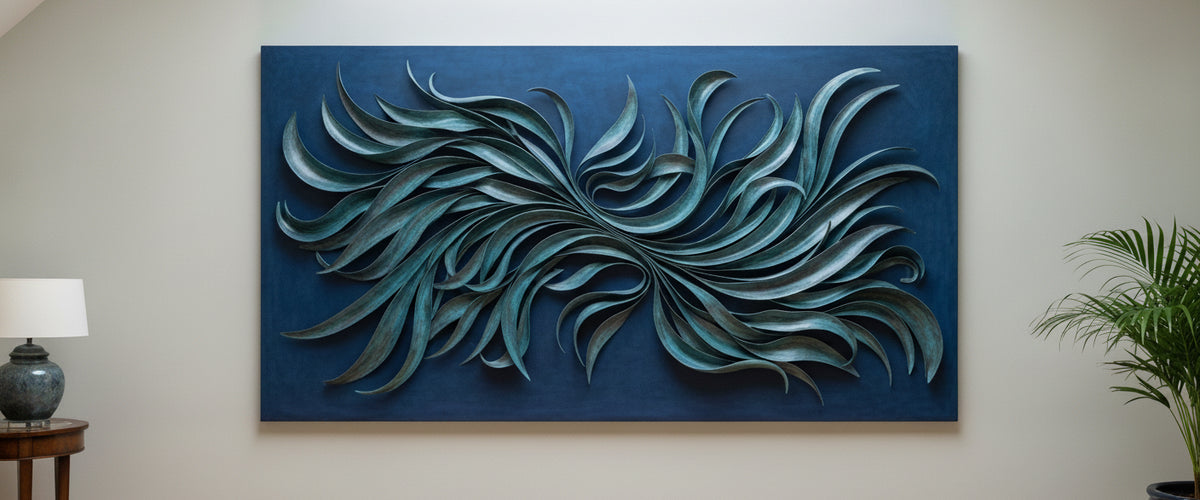
A flowing metal panel sized to fill roughly 70 percent of the usable wall width.

At a Glance: Key Takeaways
Scale beats subject. Wall art and decor that fills 60 to 75 percent of the available wall width almost always reads better than a smaller "safe" choice.
Depth changes everything. 3D wall pieces read as architecture; flat prints read as decoration. Pick the category before you pick the piece.
Match the wall, not the sofa. Tie the artwork to the architecture (wall color, ceiling height, light direction). Furniture changes every five years; the wall does not.
Material drives longevity. Metal, wood and acrylic each age differently. Outdoor wall decor and art needs outdoor-rated finishes, not indoor pieces pushed onto a patio.
Bespoke is often the only honest answer for very wide walls, unusual ceiling heights or branded commercial interiors.

What Wall Art and Decor Actually Covers
The phrase wall art and decor is broad on purpose. In practical terms it covers anything mounted to a vertical surface for visual effect: framed art, photography, mirrors, textile panels, carved relief, metal sculpture, 3D button assemblies, kinetic pieces and large-format mixed-media works. For Giant Sculptures clients the interesting territory sits in the sculptural half of that list: pieces with real depth, shadow play and physical presence.
Who is sculptural wall art and decor best for? Buyers who have either run out of floor space, have a long sightline wall they want to anchor, or want a piece that performs differently as the light shifts through the day. Restaurants, hotel lobbies, primary residences in California and Texas, and design-led offices all tend to fall into this group. Flat prints work hard on intimate walls; sculptural pieces earn their keep on the walls people see from across a room.

How to Compare Options Before Buying
Before you fall for a single piece, write down five constraints. They will save you from buying wall art and decor that photographs beautifully and disappoints in person.
Wall width and height in feet and inches, plus the height of any furniture sitting beneath it.
Viewing distance. A piece read from 25 ft away needs more contrast and bolder relief than one viewed from 6 ft.
Light source. Side light from a window creates raking shadows that flatter 3D work. Flat ceiling downlights flatten everything.
Existing palette. Note the three dominant colors in the room and the one accent you want the art to push.
Indoor or outdoor. Outdoor walls demand UV-stable, corrosion-rated materials. Do not assume an indoor piece can simply move outside.
With those constraints in hand, the shortlist gets honest quickly. The work then is matching material to the light and sightlines you already have, not the other way around.

Materials, Finishes and Scale Decisions
Material is where wall art and decor either earns its keep for decades or starts looking tired in eighteen months. The main categories we work with sit in our wall art and decor collection, and each behaves differently.
Metal, wood and acrylic react to the same raking light very differently.
Metal Wall Art
Welded and brushed steel, anodized aluminum and powder-coated mild steel all sit here. Metal handles scale better than almost any other material because the panels can be large without warping, and the surface picks up light in a way paint never can. On a wide, south-facing wall where the light shifts through the day, a flowing metal panel such as Waverno Ember & Graphite Flow Metal 3D Wall Art tends to carry the room on its own, which is why we often steer double-height spaces toward the metal wall art collection rather than a cluster of smaller works.
3D Button and Mixed-Media Panels
The Minara series sits in this category: thousands of small components built up into a larger composition. Where a dark accent wall calls for opulent wall art and decor rather than restrained, Minara Green & Gold Glint Palace 3D Button Wall Art is closer to the right design language than a flat painted canvas, and the same technique reads as meditative against a pale plaster wall. These pieces want raking light. Avoid mounting them under a single overhead downlight; you will lose the relief.
Acrylic and Layered Resin
Layered acrylic behaves like architectural glass: it glows when backlit and goes quiet when not. For a hallway or bar back where ambient light changes through the evening, a piece such as Horizon Jade Mist Mountain Acrylic 3D Wall Art makes more sense than a metal panel that would compete with the bottle lighting.
Wood and Carved Relief
Carved hardwood and engineered timber relief panels age gracefully and forgive humidity better than most clients expect. Our wood wall art collection tends to suit warmer interiors with linen, leather and plaster. Wood is also the easiest category to scale up through a bespoke commission because we are not fighting metal fatigue or panel joins.
On scale, a rule we keep coming back to when sizing wall art and decor: measure the wall, then size the piece to fill between 60 and 75 percent of the usable width. The instinct to "leave breathing room" usually leads to under-scaled work. A 5 ft (1.5 m) panel on a 14 ft (4.3 m) wall looks lost. A 9 ft (2.7 m) panel on the same wall looks intentional.
Where to Place a Piece for Real Impact
For wider placement ideas, Bring the Outdoors In: Transform Your Walls with Nature-Inspired 3D Art is useful companion reading before finalising the setting and sightlines.
Placement is where good wall art and decor earns the price of admission. A few principles we apply when we visit a site or review elevations:
Eye line, not center line. The visual center of a piece should sit roughly 57 to 60 inches (145 to 152 cm) from the floor in a residential setting, regardless of the ceiling. In double-height spaces, anchor to the dominant viewing position, often the seated sightline from a sofa or a dining chair.
Respect the furniture beneath. Leave 6 to 12 inches (15 to 30 cm) between the top of a sofa or console and the bottom of the piece. Closer and it crowds; further and the two stop talking to each other.
Use 3D pieces where there is side light. Stairwell walls, walls perpendicular to large windows, and corridors with sconces all flatter sculptural work.
Mirror walls and TV walls are not art walls. Trying to combine functions usually weakens both. If the TV is unavoidable, pick wall art and decor that is comfortable sitting beside it rather than competing with it.
Outdoor placement from a Hamptons pool house to an Aspen courtyard needs UV-stable finishes and a mounting strategy that accounts for thermal movement. Our outdoor collection is the right starting point for outdoor wall art and decor briefs.
How to Match a Piece With Furniture
The shortcut most interior magazines skip: match the wall decor and art to one element you are not planning to replace soon. That usually means architectural finishes (wall color, stone, timber, metalwork) rather than soft furnishings. If you tie the piece to the sofa, you will be replacing the art when the sofa goes. We often pull one accent tone from the piece into a cushion, throw or vase rather than the other way around. It reads more confident and gives the room a clear hierarchy.
Budget, Commissioning and Delivery
Honest answer on budget for wall art and decor: it depends on material, scale, complexity, engineering, crating and installation. A single 4 ft (1.2 m) wood relief panel and a 12 ft (3.7 m) welded metal triptych are not in the same universe, and we would rather scope the project properly than quote a misleading range. Request a tailored quote and we will price against the actual brief.
For bespoke wall art and decor commissions, the variables that move budget most are:
Overall dimensions and weight, especially anything over 8 ft (2.4 m) in any direction.
Material grade. Marine-grade stainless and architectural bronze sit well above mild steel.
Finish complexity, including hand-applied patinas, multi-stage powder coat or gilded detail.
Mounting engineering. Cantilevered or recessed mounts cost more than a French cleat.
International shipping and on-site installation, particularly to homes with restricted access or high-rise lobbies.
Lead times depend on the piece. Bespoke metalwork and large carved panels are studio-built and need a sensible window for fabrication, finishing and crating. We will confirm a realistic schedule once the brief is signed off, rather than promising dates we cannot defend.
How Giant Sculptures Approaches Bespoke Commissions
We started in large-scale freestanding sculpture, and that engineering background is what most clients end up valuing on a wall art and decor commission. A 14 ft (4.3 m) metal panel needs to be designed for the wall it is going on, not retrofitted after the fact. We work from elevations and site photographs, prototype the relief and finish, then build, crate and ship internationally. Recent work has included a long horizontal metal piece for a private residence outside Austin where the brief was specifically "do not center it," and a layered acrylic commission for a Manhattan lobby where we tested three backlighting setups before settling on the final fixture spec.
If you are weighing wall art and decor options for a serious project, the most useful next step is usually a short call with our studio. Send wall dimensions, two or three photographs in available light, and a note on the mood you are after. From there we can tell you honestly whether something in the catalog will do the job, or whether the wall is asking for bespoke wall art and decor built from scratch.
For wider context on how museums and conservators think about display surfaces, mounting and light exposure, the American Alliance of Museums publishes useful collection-care guidance worth a read before commissioning anything intended to last decades.