






















































































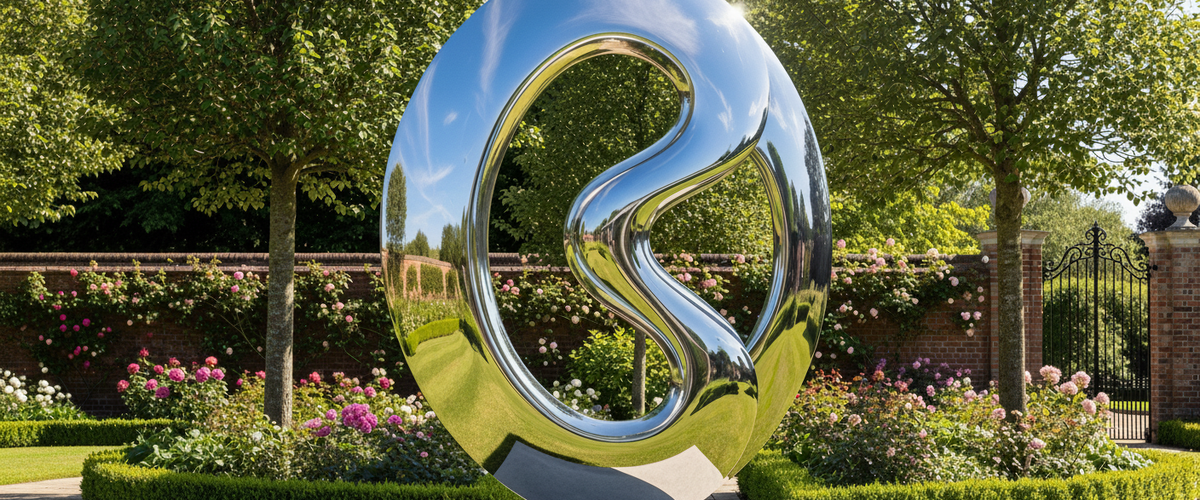

A stainless steel sculpture has to do two jobs at once: throw light around like a piece of jewelry, and stand in a Texas summer or a Maine winter without flinching. Get the grade and finish right and your stainless steel sculpture will outlive the building it sits next to. Get them wrong and you will be looking at tea-staining and pitting inside three years. This guide is the conversation we have with collectors, landscape designers, and developers before they commit to a piece, and it covers the decisions that actually matter.

At a Glance: What to Know Before You Buy
Grade matters more than gloss. 316 marine-grade stainless is the default for coastal and pool-side placements; 304 is fine for inland gardens.
Finish drives the mood. Mirror-polished reads jewel-like and reflective; brushed or satin reads architectural; PVD color coatings (gold, copper, bronze) sit somewhere between sculpture and paint.
Scale is the most common mistake. Outdoors, a stainless steel sculpture has to fight sky, lawn, and tree canopy. Most buyers go too small.
Budget is shaped by complexity, not just size. A mirror-polished organic curve takes far more handwork than a faceted geometric form.
Cleaning is simple but non-negotiable. Warm water, pH-neutral soap, soft microfiber, twice a year. No abrasives, ever.

What a Stainless Steel Sculpture Actually Is
The term covers a wide field. At one end you have small interior pieces, faceted or geometric, finished to a mirror so they bounce light around a hallway. At the other end you have a monumental outdoor stainless steel sculpture: ten, fifteen, twenty feet tall (3 to 6 m), built around an internal armature, engineered for wind load and anchored into a concrete footing. Both qualify as stainless steel metal sculpture, but they are made, finished, and installed in completely different ways.
The clients who get the most out of a sculpture in stainless steel are usually one of three: a homeowner with a strong piece of landscape architecture who wants a focal point that reads from the house, a developer or architect specifying lobby or plaza art that has to survive cleaning crews and weather, or a collector building a sculpture garden where bronze and Corten already do the warm tones and polished steel brings the cool, reflective counterweight. If you are after something soft, weathered, and patinated, stainless is the wrong choice; bronze or Corten will serve you better.

Grades, Finishes, and the Decisions That Drive Cost
Two grades cover most serious work. 304 stainless is the everyday choice: strong, weldable, corrosion-resistant in clean inland air. 316 contains added molybdenum, which gives it real resistance to chlorides; that is what you want within a mile or so of saltwater, around pools, or near road-salted driveways. The American Iron and Steel Institute publishes useful background on the austenitic stainless family if you want the metallurgy in detail. For a stainless steel sculpture you intend to keep for thirty years near the ocean, the cost difference between 304 and 316 is trivial compared to the cost of replacing pitted work later.
Finish is where the piece earns its personality. A mirror polish is the hardest to achieve and the hardest to maintain; every weld has to be ground flush, then taken through progressively finer abrasives, then buffed. On a continuous organic form such as the Swan Silver Abstract Steel Sculpture, that polish is what makes the surface read as liquid rather than as metal, because there is no facet line for the eye to catch on. Brushed or satin finishes are quieter, more architectural, and forgive fingerprints and light scratches. PVD-coated colored stainless uses a vacuum-deposited layer that is bonded into the surface rather than painted on; on a stainless steel sculpture like the Whisper Gold Abstract Steel Sculpture, that bonded gold layer is what lets the color hold against UV and weather in a way no clear coat or lacquer can match.
Cost is driven by three things in roughly this order: complexity of form, quality of finish, and size. A faceted geometric piece is more straightforward to fabricate than a continuous organic curve of the same height, because every facet can be cut, formed, and welded as a discrete plane. A flowing, seamless surface requires hand-rolling, careful weld blending, and many hours of polishing. Scale adds material and engineering, but a small, fully mirror-polished stainless steel sculpture can easily cost more than a much larger brushed one. Because every commission varies on grade, finish, internal engineering, base, crating, and installation, we quote each project individually rather than working from a price list.
Scale and Placement: Where Stainless Steel Earns Its Keep
For wider placement ideas, Reflections of Creativity: Exploring the Power of Abstract Sculptures in Stainless Steel is useful companion reading before finalising the setting and sightlines.
This material behaves differently from any other because it is essentially a mirror. A stainless steel sculpture picks up the color of the sky, the lawn, the pool, the planting, and the building behind it. That means placement is a design decision, not an afterthought.
Outdoors, the rule of thumb we give clients is that a piece meant to anchor a lawn or terrace should read clearly from the primary viewing point inside the house. In practice that usually means at least 5 to 7 ft (1.5 to 2.1 m) of visible height for a residential garden, and 8 ft (2.4 m) and up for a Hamptons-scale lawn or a Napa vineyard approach. For a landmark stainless steel sculpture intended to hold its own at the end of a long sightline, something at the scale of the Strata Copper Abstract Steel Sculpture (over 2 m tall) sits comfortably as a standalone; anything shorter usually needs a plinth, a hedge, or a planted bed to give it presence.
Reflective surfaces want context. A mirror-polished form on a flat lawn with no planting behind it will read as a bright blob from a distance. The same piece set against a dark yew hedge, a board-formed concrete wall, or a stand of mature trees suddenly has depth, because the reflections give it form. For indoor placement (a double-height entry in a California modern, a corporate lobby in NYC, a private gallery in Aspen) think about what the work will reflect back: the staircase, the chandelier, the visitor walking in. That reflection is part of the artwork.
Figurative work behaves the same way. A stainless steel dog sculpture or stag reads as both animal and abstract form depending on where you stand; the polished planes catch light as silhouette from a distance and dissolve into reflections up close. That dual reading is part of the appeal, and it only works if the piece has space around it.
Common Buyer Mistakes
Undersizing for outdoor placement. What looks large in a workshop or a showroom photo shrinks dramatically against an open sky. When in doubt, go one size up.
Choosing 304 for a coastal site. The savings disappear the first time you see brown tea-staining across a polished surface.
Skipping the footing drawing. A 6 ft (1.8 m) stainless steel outdoor sculpture in an exposed garden needs a properly sized concrete pad and stainless anchor bolts. Setting it on pavers is not a long-term plan.
Cleaning with the wrong materials. Steel wool, scouring pads, and chloride-based cleaners will all damage the passive layer that protects the metal. The American Institute for Conservation publishes solid general guidance on caring for metal artwork.
Treating PVD color as paint. It is more durable than paint, but it still wants gentle cleaning and no abrasives.
Commissioning a Bespoke Stainless Steel Sculpture
Most of the projects we ship to private gardens and commercial sites are bespoke or semi-bespoke. A stainless steel sculpture commission usually starts with a brief: site photographs, dimensions, sightlines, the architectural style of the building, and a sense of whether the client wants something figurative, abstract, or kinetic. We then work up sketches and small-scale maquettes, agree on grade and finish, and only then go to fabrication.
Lead times for a substantial outdoor stainless steel sculpture typically run several months from approval, because the metalwork itself is slow. A continuous polished curve cannot be rushed. Engineering drawings for the footing are produced alongside fabrication so the site is ready when the work arrives. For international shipping we crate in bespoke timber frames; large pieces ship in sections and are assembled on site. Installation usually needs a crane or a telehandler and a small rigging crew, which we coordinate with the local contractor.
Kinetic work is its own discipline. A mandala kinetic stainless steel sculpture, for example, relies on precision-balanced bearings and carefully calculated weight distribution so it moves on the lightest breeze without rattling or stalling. That kind of commission is best worked up from scratch rather than bought off a catalog, because the balance has to be tuned to the wind conditions of the actual site.
Cleaning and Long-Term Care
This material is low-maintenance, not no-maintenance. For most installations, twice-yearly cleaning is enough. Use warm water with a few drops of pH-neutral soap, a soft microfiber cloth, and work with the grain of the finish rather than across it. Rinse with clean water and dry with a fresh microfiber to prevent water spots. Avoid anything chloride-based, anything abrasive, and any cleaner sold for cookware or kitchen appliances; those are formulated for flat sheet, not for a hand-finished stainless steel sculpture.
For coastal sites, rinse your stainless steel sculpture with fresh water after major storms to clear salt deposits. If tea-staining appears (small rust-colored spots on the surface), it usually indicates surface contamination rather than corrosion of the steel itself, and a specialist cleaner will lift it. Polished pieces benefit from an occasional going-over with a stainless-specific polish to restore the optical depth; brushed pieces rarely need it.
How Giant Sculptures Approaches the Work
We work with collectors, designers, and architects on stainless steel sculpture commissions ranging from 3 ft (90 cm) interior pieces up to monumental outdoor work. Our standing catalog (browse the full stainless steel sculptures range, or the wider metal sculptures selection if you want to compare against bronze and Corten) is the starting point for many clients; from there we adjust scale, finish, base, and detailing for the specific site. For garden-led projects, the outdoor sculptures collection groups pieces by suitability for exterior placement.
One detail worth flagging: when we are asked to recommend between stainless steel sculpture manufacturers and individual studios, the honest answer is that the work splits between the two. Large-batch architectural panels come out of manufacturers; one-off sculptural pieces come out of studios. We sit on the studio side, which is why every stainless steel sculpture commission gets an engineering review and a finishing plan rather than a stock spec. If you have a site in mind, send us a few photographs and a sense of scale, and we will tell you what we think will work and what will not.