





































































































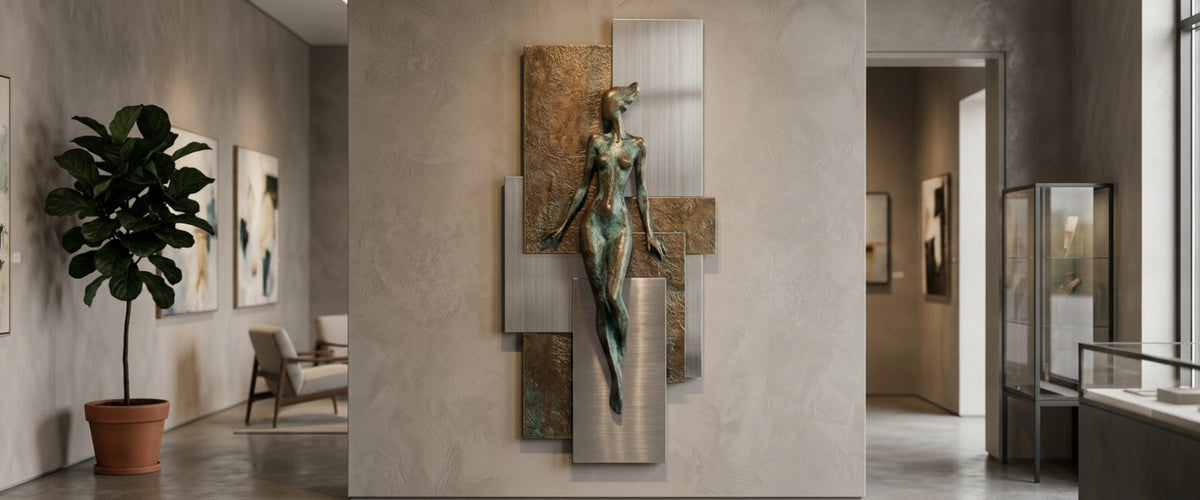

A blank wall in a double-height entry can swallow almost anything you hang on it. That is the trap with mixed media wall art. Buy for the framed print you saw online and you end up with a postage stamp floating on plaster. The pieces that actually hold a wall are engineered for scale, layered in real materials, and chosen with the room's sightlines in mind. This guide walks through how we think about it in the studio, and how to buy well the first time.
Mixed media wall art simply means a piece built from more than one material or technique: bronze relief set against brushed steel, carved wood paired with patinated metal, stone inlay against a painted ground. The interest comes from contrast. Light hits each surface differently, so the work shifts as you move past it.

Key Takeaways at a Glance
- Scale first. Measure the wall, not the sofa. Large walls need work that reads from across the room.
- Material contrast is the point. The best mixed media art wall pieces pair a warm material with a cool one, or matte with reflective.
- Weight and fixings matter. Heavy metal or stone components need proper anchoring into studs or masonry.
- Bespoke beats off-the-shelf when the wall is unusual in size, shape or lighting.
- Budget depends on material, scale, engineering and finishing. Ask for a tailored quote rather than guessing from a photo.

What Mixed Media Wall Art Means and Who It Is Best For
The term covers a wide range, from a modest relief panel to a wall-spanning composition of metal, wood and stone. What unites them is layering. A single-material piece can be beautiful, but a mixed media wall combines textures that catch light at different angles, which is why these works photograph so well and, more importantly, hold attention in person.
They suit buyers with a genuine wall to fill: a tasting room with a long feature wall, a penthouse with a two-story stair void, a hotel lobby that needs a focal point without turning into a mural. We have shipped relief work to all three types of space, and the pattern is consistent. The clients who are happiest measured their wall properly and let the material do the talking rather than crowding it.
Mixed media art also gives you room to bring in figuration without going fully sculptural. Where a wall needs an animal motif that reads as a considered art object rather than a trophy mount, a bronze relief such as the Traditional Horse Head Bronze Relief - 80cm pairs well against a plastered or timber-clad ground where the patina can sing.

How to Compare Mixed Media Wall Art Options Before Buying
Start with three questions. How far away will people usually stand? What is the wall made of? And what is the light doing across the day? Those answers shape everything else.
For viewing distance, a good rule is that the main subject should be legible from your typical standing point. In a corridor, that might be four feet (1.2 m); in a great room, thirty feet (9 m). The further the viewing distance, the bolder the relief depth and the larger the piece needs to be.
For the wall itself, timber-framed drywall, poured concrete and brick all behave differently under load. A cast bronze wall piece can weigh a good deal more than a painted panel of the same size, so the fixing strategy is part of the buying decision, not an afterthought. We supply fixing guidance with heavier work and can specify anchor types for the substrate you actually have.
For light, reflective surfaces like polished steel bounce whatever hits them. That is an asset near a window and a liability under a single harsh spotlight, which can blow out detail. Matte and patinated surfaces are more forgiving and hold form under raking light. If you are comparing two pieces and one is high-gloss, ask yourself where the light source sits before you commit.
Buyer Mistakes We See Most Often
- Buying to fit the furniture below rather than the wall as a whole.
- Underestimating weight and hanging into drywall alone.
- Choosing a glossy finish for a wall with one strong overhead light.
- Ignoring the frame gap: mixed media work often needs breathing room, not a tight border of other art.

Key Materials, Finishes and Scale Decisions
Material is where mixed media wall art earns or loses its keep. Bronze brings depth and a patina that ages gracefully; the American Institute for Conservation notes that a stable patina can protect the metal beneath rather than merely decorating it (culturalheritage.org). Stainless steel gives you clean reflection and a modern edge. Corten weathers to a warm rust that suits outdoor and semi-exposed walls. Wood adds warmth and grain, and stone or marble inlay adds mass and permanence.
The strongest wall art mixed media pieces play these against each other. Think brushed steel behind a bronze figure, or a carved timber ground framing a patinated relief. If you want a starting point for the metal side of that conversation, the metal wall art collection shows how brushed and patinated surfaces behave next to each other, while the wood wall art range shows how grain reads at scale.
On scale, err larger than instinct suggests. A common studio observation: a piece that looks assertive on a screen often looks timid on the wall, because your eye compares it to the whole plane of plaster around it. As a working guide, a feature piece should cover roughly two thirds of the visual width of the wall it anchors. For a genuinely tall wall, a vertical composition or a stacked arrangement reads better than one wide horizontal panel stranded at eye height.
Finish also affects care. Interior bronze and steel need little beyond dusting and the occasional wax; outdoor Corten and marble have their own weathering behavior. Match the finish to the environment and you buy yourself decades of easy ownership.
Where to Place Mixed Media Wall Art for the Strongest Visual Impact
For wider placement ideas, A Placement Guide for Large 3D Metal Wall Art Panels is useful companion reading before finalising the setting and sightlines.
The best positions share one trait: a clear approach. A wall you see as you walk toward it, from a doorway or the top of a stair, gives the work a moment to land. Placing the same piece on a wall you only ever see edge-on wastes it.
Entry walls, stair voids and long dining or corridor walls are the reliable winners in homes. In commercial settings, think reception walls, the wall behind a bar, or the sightline you get stepping out of an elevator. Where people pause and can approach closely, a textured relief such as the Classical Bull Head Bronze Relief - 70cm earns its place, because the depth rewards a closer look after the first impression from across the room.
Lighting deserves its own thought. A single spotlight aimed straight on flattens texture; two lights raking from either side pull out every ridge and hollow. Wall washers give even, gentle light that suits reflective pieces. If you can, position the work so daylight grazes it at some point in the day. That moving light is half the appeal of buying in real materials rather than a flat print.
Budget, Commissioning and Delivery Considerations
There is no honest flat price for mixed media wall art, and anyone quoting one from a thumbnail is guessing. Cost is driven by material, overall scale, the complexity of the composition, any engineering for fixing and load, and the finishing work. A large multi-material commission with structural backing sits in a very different place from a single cast relief. The sensible move is to send us the wall dimensions, a photo, and a sense of the mood you want, then get a tailored quote back.
Commissioning is where the format really opens up. Because we build bespoke, we can size a piece to your exact wall, match a patina to an existing material in the room, or combine metals that you will not find in a stock catalog. We have adjusted relief depth on commissioned work specifically so it read cleanly from a mezzanine thirty feet up, something a fixed off-the-shelf piece could never have solved.
On delivery, large mixed media work ships crated and, for the heaviest pieces, with installation guidance or coordination. We ship worldwide, so a bronze relief leaving our workshop can hang in the Hamptons or in a Melbourne office with the right fixings specified for the destination wall.
How Giant Sculptures Can Help With Bespoke Projects
Giant Sculptures works with buyers, interior designers, architects and venue owners on large-scale and bespoke wall pieces. If you are still exploring, the mixed media art collection is the right place to see how materials combine, and the broader wall art and wall decor range shows the span of scale we produce. When you know your wall and your mood, a commission gives you a piece built for that exact space rather than one you talk yourself into.
Where a single sculptural element can carry a wall on its own, a wall sconce such as the Classical Figural Torso Wall Sconce Bronze Sculpture - 90cm is often the smarter starting point than a busy arrangement, particularly at 90cm where it holds its own against the surrounding plane. Get the anchor piece correct, and the rest of the wall follows.